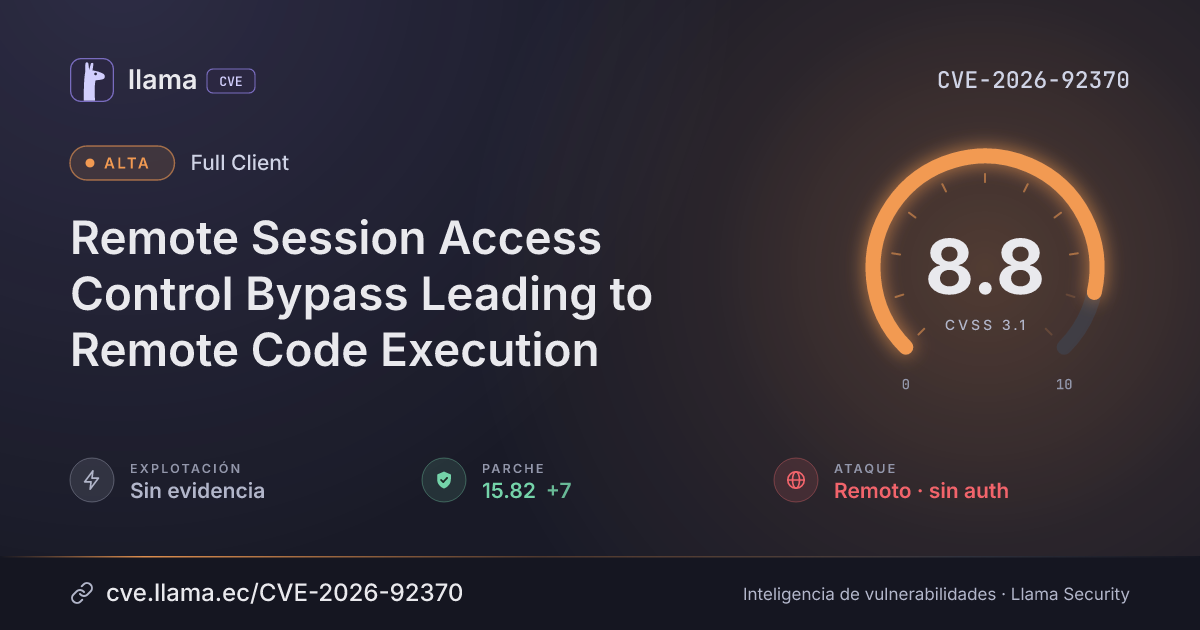
Full Client
CVE-2026-92370
Remote Session Access Control Bypass Leading to Remote Code Execution
Parche disponible
CVSS 3.1
8.8
Alta
CVSS:3.1/AV:N/AC:L/PR:N/UI:R/S:U/C:H/I:H/A:H
Fuente: CNA
Decisión SSVCSeguir de cerca
Monitorear y programar la remediación
Sin explotación conocida, no automatizable e impacto técnico total. Hay versiones corregidas disponibles.
Timeline
Ciclo de vida de la vulnerabilidad
| Fecha | Fase | Evento | Detalle |
|---|---|---|---|
| Divulgación | Publicada | CVE-2026-92370 divulgada · CVSS 8.8 (CNA) | |
| Divulgación | Evaluación SSVC | CISA-ADP · explotación ninguna | |
| Divulgación | Modificada | Última actualización del registro | |
| Monitoreo | Detectada | Ingresó al índice |
Resumen
An improper access control vulnerability in TeamViewer Full Client, Host, and related affected modules on Windows, Linux, and macOS allows an authenticated remote attacker to bypass user-configured permission settings during session establishment. By modifying access control parameters for restricted features, an attacker can perform actions that were explicitly denied by the victim's configuration. This may result in unauthorized actions and potentially lead to remote code execution on the target system.
Vector CVSS 3.1
Desglose de métricas
Vector de ataqueAV:N
RedAdyacenteLocalFísica
ComplejidadAC:L
BajaAlta
PrivilegiosPR:N
NingunoBajosAltos
InteracciónUI:R
NingunaRequerida
AlcanceS:U
CambiadoSin cambio
ConfidencialidadC:H
AltoBajoNinguno
IntegridadI:H
AltoBajoNinguno
DisponibilidadA:H
AltoBajoNinguno
Versiones
Rangos afectados
Afectada
Corregida
≥ 13.2.0 (Linux) < 13.2.153995 (Linux)
≥ 13.2.0 (MacOS) < 13.2.153994 (MacOS)
≥ 13.2.0 (Windows) < 13.2.36230 (Windows)
≥ 14.7.0 (Linux) < 14.7.48855 (Linux)
≥ 14.7.0 (MacOS) < 14.7.48855 (MacOS)
≥ 14.7.0 (Windows) < 14.7.48855 (Windows)
≥ 15.0 < 15.82
≥ 15.64.0 (Legacy Windows 7 & 8) < 15.64.8 (Legacy Windows 7 & 8)
13.2.0 (Linux)
13.2.0 (Windows)
13.2.153994 (MacOS)
13.2.153995 (Linux)
13.2.36230 (Windows)
14.7.0 (Linux)
14.7.0 (Windows)
14.7.48855 (Linux)
14.7.48855 (MacOS)
14.7.48855 (Windows)
15.0
15.64.8 (Legacy Windows 7 & 8)
15.82
Remediación
Estado del parche por paquete
| Paquete / producto | Estado | Corregida en | Desde divulgación | Última versión |
|---|---|---|---|---|
Full Client |
Corregida | 13.2.153994 (MacOS), 13.2.153995 (Linux), 13.2.36230 (Windows), 14.7.48855 (Linux), 14.7.48855 (MacOS), 14.7.48855 (Windows), 15.64.8 (Legacy Windows 7 & 8), 15.82 | — | — |
Versiones corregidas
13.2.153994 (MacOS)13.2.153995 (Linux)13.2.36230 (Windows)14.7.48855 (Linux)14.7.48855 (MacOS)14.7.48855 (Windows)15.64.8 (Legacy Windows 7 & 8)15.82Explotación
Arsenal público
Sin exploits, módulos ni PoC públicos conocidos a la fecha de verificación.
Referencias
Fabricante
https://www.teamviewer.com/en/resources/trust-center/security-bulletins/tv-2026-1010/Las referencias externas se muestran para copiar: cve.llama.ec no lo redirige a otros sitios.