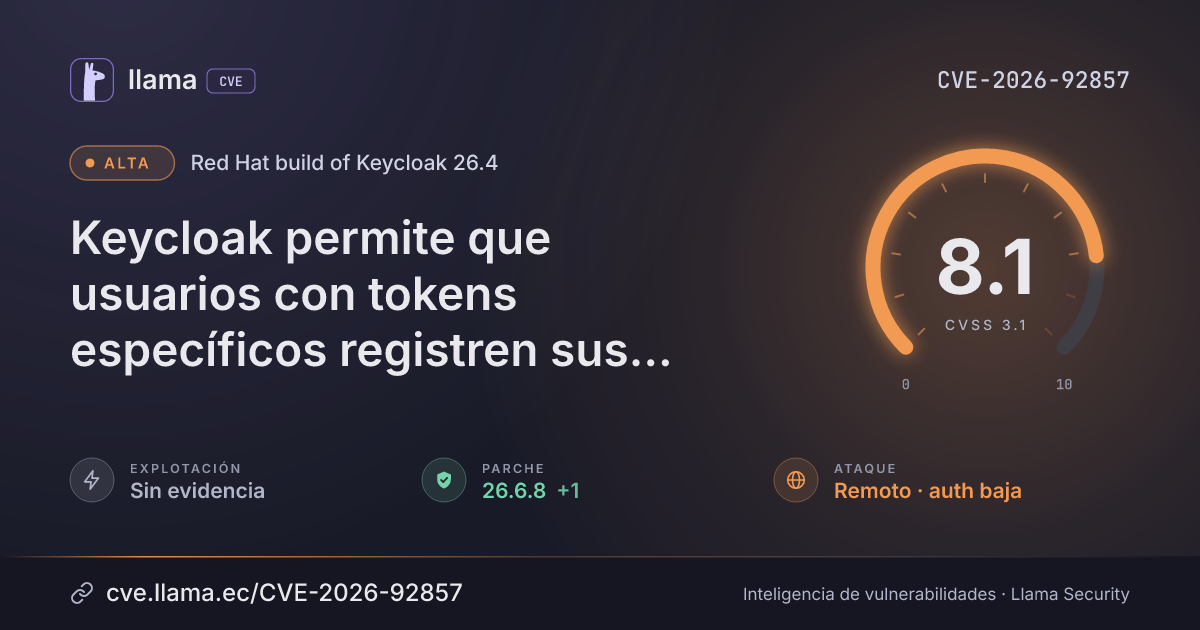
ExplotaciónSin evidenciaSSVC: ninguna · no figura en CISA KEV
Exploits públicos0Ninguno conocido
Parche2 versiones26.4.17 · 26.6.8
Exposición15 dDesde la divulgación, 5 nov 2026, 12:15 p. m.
Detección12 minDesde la divulgación hasta su ingreso al índice
Decisión SSVCSeguir de cerca
Monitorear y programar la remediación
Sin explotación conocida, no automatizable e impacto técnico total. Hay versiones corregidas disponibles.
Timeline
Ciclo de vida de la vulnerabilidad
Hoy
Divulgación
Publicada
Evaluación SSVC
Modificada
Explotación
Remediación
Monitoreo
Detectada +2
Verificada
5 nov 26
9 nov 26
19 nov 26
21 nov 26
5 nov 26
9 nov 26
13 nov 26
17 nov 26
21 nov 26
Fecha
Fase
Evento
Detalle
Divulgación
Publicada
CVE-2026-92857 divulgada · CVSS 8.1 (CNA)
Monitoreo
Detectada
Ingresó al índice
Monitoreo
Fuente: NIST NVD
Registro visto por primera vez en NIST NVD
Monitoreo
Fuente: ENISA EUVD
Registro visto por primera vez en ENISA EUVD
Divulgación
Evaluación SSVC
CISA-ADP · explotación ninguna
Divulgación
Modificada
Última actualización del registro
Monitoreo
Verificada
Última verificación contra las fuentes
Resumen
Resumen generado por IA · CC-BY 4.0 · 5 nov 2026
Keycloak's Dynamic Client Registration feature has a flaw that lets a user with a registration token forge the subject (sub) and audience (aud) claims in tokens it signs, so the tokens appear to belong to a different user. The attacker can do this remotely over the network after logging in with low-privilege credentials, and it could allow impersonation of other users or unauthorized access to services that trust those tokens.
Affects Red Hat build of Keycloak 26.4 and 26.6 lines where Dynamic Client Registration is enabled. Fixed in 26.4.17 and 26.6.8.
¿Qué significa?A holder of an Initial Access Token and a standard realm account can register a client and map their own editable profile attributes to the sub and aud token claims. The resulting signed identity tokens can carry another user's subject ID and an arbitrary audience, and they pass standard relying-party validation.
¿Quién está afectado?Red Hat build of Keycloak 26.4 before 26.4.17 and 26.6 before 26.6.8 are listed as affected. The setup involved is Dynamic Client Registration being enabled in the realm, so the realm's client registration settings and the installed Keycloak version are what to check against these versions.
¿Qué hacer?Upgrade to Red Hat build of Keycloak 26.4.17 or 26.6.8, or to the corresponding fixed Red Hat builds.
Descripción original del registro (redhat)
Keycloak provides a Dynamic Client Registration feature that allows users with specific tokens to register their own applications. A flaw in how Keycloak validates these registration requests allows an attacker to create a malicious application that forges identity information. By mapping their own user profile details to protected fields like the user ID (sub) or intended audience (aud), an attacker can generate signed security tokens that make them appear to be a different user. This could allow an attacker to impersonate other users or gain unauthorized access to services that rely on these tokens for identity verification.
Contexto
Condiciones y alcance
Condiciones necesarias para que el fallo sea explotable
01
Dynamic Client Registration is enabled and the attacker holds an Initial Access Token.“An attacker with a valid Initial Access Token (IAT) and a standard realm account can register a new client”
02
The attacker's own profile attributes are editable by the user, so they can be mapped to token claims.“map their own editable profile attributes to the sub and aud claims”
¿Quién debe revisar?Teams running Red Hat build of Keycloak 26.x or Single Sign-On 7 with Dynamic Client Registration, Initial Access Tokens and user-editable profile attributes.
Vector CVSS 3.1
Desglose de métricas
Opción resaltada = valor del vector · izquierda = peor caso · CNA
Vector de ataqueAV:N
RedAdyacenteLocalFísica
ComplejidadAC:L
BajaAlta
PrivilegiosPR:L
NingunoBajosAltos
InteracciónUI:N
NingunaRequerida
AlcanceS:U
CambiadoSin cambio
ConfidencialidadC:H
AltoBajoNinguno
IntegridadI:H
AltoBajoNinguno
DisponibilidadA:N
AltoBajoNinguno
Score de explotaciónQué tan fácil y probable es que la exploten
8.3/ 10Alto
Vector 8.3 (muy fácil) · sin evidencia de explotación.
Remediación
Estado del parche por paquete
Paquete / producto
Estado
Corregida en
Desde divulgación
Última versión
Red Hat build of Keycloak
Corregida
26.4.17, 26.6.8
—
—
Versiones corregidas26.4.1726.6.8
Explotación
Arsenal público
Sin exploits, módulos ni PoC públicos conocidos a la fecha de verificación.
Registro
MitigaciónMitigation for this issue is either not available or the currently available options do not meet the Red Hat Product Security criteria comprising ease of use and deployment, applicability to widespread installation base, or stability.
--- CME Mitigation Guidance (2026-11-06) ---
Disclaimer: The following mitigation solutions are provided as a courtesy, pending the application of an official patch. This content was generated utilizing AI tools in conjunction with data from https://cmetaxonomy.org. Customers are advised to independently evaluate and test these temporary mitigations within their own infrastructure.
The highest-value action is to validate protocol mapper claim.name configurations during Dynamic Client Registration to deny mapping to reserved identity claims: upgrade to Red Hat build of Keycloak 26.4.17, 26.6.8 (or the corresponding fixed Red Hat builds), which validate and reject protocol mapper configurations in Dynamic Client Registration that assign reserved claims to claim.name, closing all 2 injection vectors (Dynamic Client Registration protocol mapper configuration mapping user profile attributes to the sub claim, Dynamic Client Registration protocol mapper configuration mapping user profile attributes to the aud claim). Until patched, this is a concern on Keycloak deployments enabling Dynamic Client Registration where users possess an Initial Access Token and editable realm profile attributes, so restrict issuance of Initial Access Tokens, monitor new client registrations, and restrict user capabilities to edit profile attributes. As a compensating measure, detect unauthorized Dynamic Client Registration creations and protocol mapper changes by alerting on configuration drift against declared realm baselines and log Dynamic Client Registration events and mapper configurations to a SIEM to identify unauthorized clients mapping reserved token claims. These controls limit blast radius and contain exploitation, but they do not fix the underlying unvalidated protocol mapper claim.name defect — apply the upstream patch to fully remediate.
Highest-impact CME: CME-1315 Allowlist-Preferred Input Validation (Deny-by-Default Filtering) (high)redhat
Usamos cookies propias estrictamente necesarias para que el sitio funcione y sea seguro. Con tu permiso, también usamos almacenamiento local para recordar tus preferencias y medir el uso del sitio de forma agregada. Puedes aceptar, rechazar o configurar cada categoría, y cambiar tu decisión cuando quieras desde el enlace “Preferencias de cookies” del pie de página. Más información
Preferencias de cookies
Elige qué permites
Solo usamos tecnologías propias de este dominio. Sin publicidad ni rastreadores de terceros. Detalle en la Política de cookies.