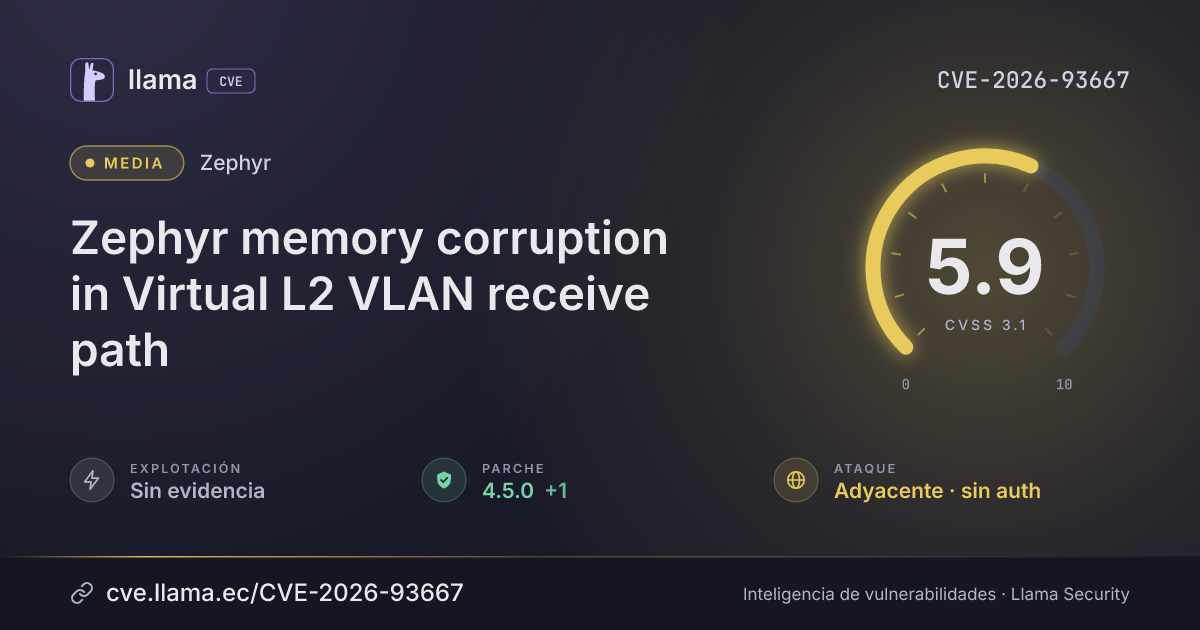
CVE-2026-93667
Zephyr memory corruption in Virtual L2 VLAN receive path
An attacker on the same network link can crash the device or corrupt memory by sending a VLAN-tagged frame.
CVSS:3.1/AV:A/AC:H/PR:N/UI:N/S:U/C:N/I:L/A:H
Fuente: CNA
Ciclo de vida de la vulnerabilidad
| Fecha | Fase | Evento | Detalle |
|---|---|---|---|
| Divulgación | Publicada | CVE-2026-93667 divulgada · CVSS 5.9 (CNA) | |
| Monitoreo | Detectada | Ingresó al índice | |
| Monitoreo | Fuente: NIST NVD | Registro visto por primera vez en NIST NVD | |
| Monitoreo | Fuente: ENISA EUVD | Registro visto por primera vez en ENISA EUVD | |
| Divulgación | Evaluación SSVC | CISA-ADP · explotación ninguna | |
| Divulgación | Modificada | Última actualización del registro | |
| Monitoreo | Verificada | Última verificación contra las fuentes |
Zephyr's Virtual L2 receive code can make a mistyped indirect function call when a VLAN-tagged Ethernet frame arrives that no active virtual interface claims, such as one tagged for a VLAN interface that is administratively down. An attacker on the same network link can trigger this without logging in or any user action, causing undefined behaviour in the network receive path, including crashes and memory corruption.
Descripción original del registro (zephyr)
The Virtual L2 receive handler virtual_recv() in subsys/net/l2/virtual/virtual.c ends with a fall-through path meant for a virtual interface that has nothing attached below it: it takes net_if_get_device(iface)->api, treats it as a struct virtual_interface_api, and calls api->recv(iface, pkt). That handler is however also invoked with a non-virtual interface: ethernet_recv() in subsys/net/l2/ethernet/ethernet.c deliberately passes the Ethernet interface so that a tagged frame can be dispatched over the VLAN interfaces attached to it. For an Ethernet interface dev->api is a struct ethernet_api, whose layout only shares the leading struct net_if_api, so the slot read as recv is actually get_config() (default) or get_capabilities() (when CONFIG_NET_STATISTICS_ETHERNET is enabled). The fall-through is reached whenever no attached virtual interface claims the frame - most simply when the VLAN interface owning the frame's tag exists but is administratively down, since net_eth_get_vlan_iface() resolves the tag without checking link state while virtual_recv() skips interfaces that are not up. Any host able to place an 802.1Q-tagged Ethernet frame on the same link can then trigger the mistyped indirect call; no authentication, IP reachability or user interaction is required, because the frame is consumed at L2 before any address check. The resulting call passes a struct net_if where the driver expects a struct device and a struct net_pkt where it expects a struct net_if , with the callee's remaining parameters left as whatever the call site happens to leave in the argument registers. Driver implementations dereference these values: get_capabilities() typically reads dev->config/dev->data (a wild read through a non-pointer field of struct net_if), and get_config() implementations write through the uninitialized struct ethernet_config * argument. The practical impact is undefined behaviour in the network RX path - crashes and uncontrolled memory corruption - plus mis-handling of the packet when a capability bitmask is returned as a net_verdict. The attacker controls neither the corrupted address nor the value written, so this is a denial-of-service and memory-corruption issue rather than a controllable write primitive. The same defective fall-through is reachable through any_recv() in subsys/net/l2/dummy/any/any.c, which passes a dummy interface whose struct dummy_api is shorter than the offset read, producing an out-of-bounds read of the driver's API object followed by an indirect call. The fix drops any packet whose interface is not a Virtual L2 interface, closing both entry points.
Desglose de métricas
Rangos afectados
Estado del parche por paquete
| Paquete / producto | Estado | Corregida en | Desde divulgación | Última versión |
|---|---|---|---|---|
zephyr |
Corregida | 4.3.2, 4.5.0 | — | — |
4.3.24.5.0Arsenal público
Sin exploits, módulos ni PoC públicos conocidos a la fecha de verificación.
https://github.com/zephyrproject-rtos/zephyr/security/advisories/GHSA-5q52-q965-fwp8https://github.com/zephyrproject-rtos/zephyr/commit/226e821d8587aaae955b9682234b0b44722c8a4eLas referencias externas se muestran para copiar: cve.llama.ec no lo redirige a otros sitios.