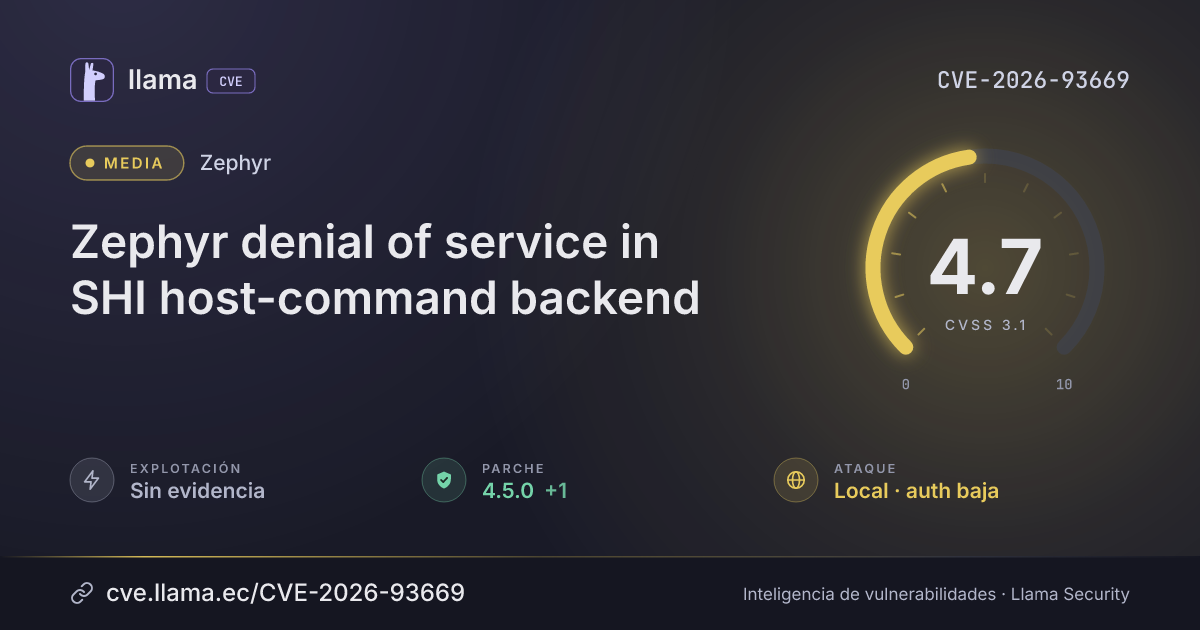
CVE-2026-93669
Zephyr denial of service in SHI host-command backend
A local attacker with low privileges can crash the embedded controller by sending a host transaction during startup.
CVSS:3.1/AV:L/AC:H/PR:L/UI:N/S:U/C:N/I:N/A:H
Fuente: CNA
Ciclo de vida de la vulnerabilidad
| Fecha | Fase | Evento | Detalle |
|---|---|---|---|
| Divulgación | Publicada | CVE-2026-93669 divulgada · CVSS 4.7 (CNA) | |
| Monitoreo | Detectada | Ingresó al índice | |
| Monitoreo | Fuente: NIST NVD | Registro visto por primera vez en NIST NVD | |
| Monitoreo | Fuente: ENISA EUVD | Registro visto por primera vez en ENISA EUVD | |
| Divulgación | Evaluación SSVC | CISA-ADP · explotación ninguna | |
| Divulgación | Modificada | Última actualización del registro | |
| Monitoreo | Verificada | Última verificación contra las fuentes |
The Zephyr software's ITE IT8xxx2 SHI host-command backend can dereference a NULL pointer when a host processor's SPI transaction arrives before the backend finishes initializing. A local attacker with low privileges can use this to crash the embedded controller's kernel, halting it until a hardware reset and denying service.
Descripción original del registro (zephyr)
The ITE IT8xxx2 SHI host-command backend in subsys/mgmt/ec_host_cmd/backends/ec_host_cmd_backend_shi_ite.c arms the SPI peripheral before its receive context exists. shi_ite_init_registers() sets the state machine to SHI_STATE_READY_TO_RECV and calls irq_enable() while the device initializes at POST_KERNEL priority CONFIG_KERNEL_INIT_PRIORITY_DEFAULT (40), but data->rx_ctx and data->tx are only assigned later by shi_ite_backend_init(), which ec_host_cmd_init() invokes at CONFIG_EC_HOST_CMD_INIT_PRIORITY (default 80). If the attached host processor starts a SPI transaction inside that window, the Rx-valid-length interrupt fires, shi_ite_int_handler() passes its state check and calls shi_ite_parse_header(), which stores the host-derived request length through the still-NULL data->rx_ctx. On the IT8xxx2 low addresses are not backed by RAM, and with CONFIG_NULL_POINTER_EXCEPTION_DETECTION_PMP the first bytes of the address space are explicitly made inaccessible, so the store raises a fatal access fault in interrupt context. The window widens further when CONFIG_EC_HOST_CMD_INITIALIZE_AT_BOOT is disabled and the application calls ec_host_cmd_init() itself. The result is a kernel panic on the embedded controller: with Zephyr's default fatal handler the CPU halts, so the controller stops servicing host commands until a hardware reset. Because the trigger is traffic from the attached host processor -- an untrusted peer from the controller firmware's point of view -- software on that host can provoke the fault by forcing a controller reset and issuing transactions during the reboot, turning a recoverable reset into a persistent outage. Impact is limited to availability: the faulting address is fixed and not attacker-chosen, so no memory-corruption primitive follows. The fix leaves the interface at SHI_STATE_DISABLED with the interrupt masked during device init, moves irq_enable() into shi_ite_backend_init() after the buffers are published, and makes shi_ite_int_handler() reject a NULL data->rx_ctx while write-clearing IT83XX_SPI_ISR and IT83XX_SPI_RX_VLISR so that an unexpected early interrupt cannot storm.
Desglose de métricas
Rangos afectados
Estado del parche por paquete
| Paquete / producto | Estado | Corregida en | Desde divulgación | Última versión |
|---|---|---|---|---|
zephyr |
Corregida | 4.3.2, 4.5.0 | — | — |
4.3.24.5.0Arsenal público
Sin exploits, módulos ni PoC públicos conocidos a la fecha de verificación.
https://github.com/zephyrproject-rtos/zephyr/security/advisories/GHSA-xqxg-8rx7-42hqhttps://github.com/zephyrproject-rtos/zephyr/commit/73c6a4ed9506ca81ddfb9d89197b74425a8ce632Las referencias externas se muestran para copiar: cve.llama.ec no lo redirige a otros sitios.