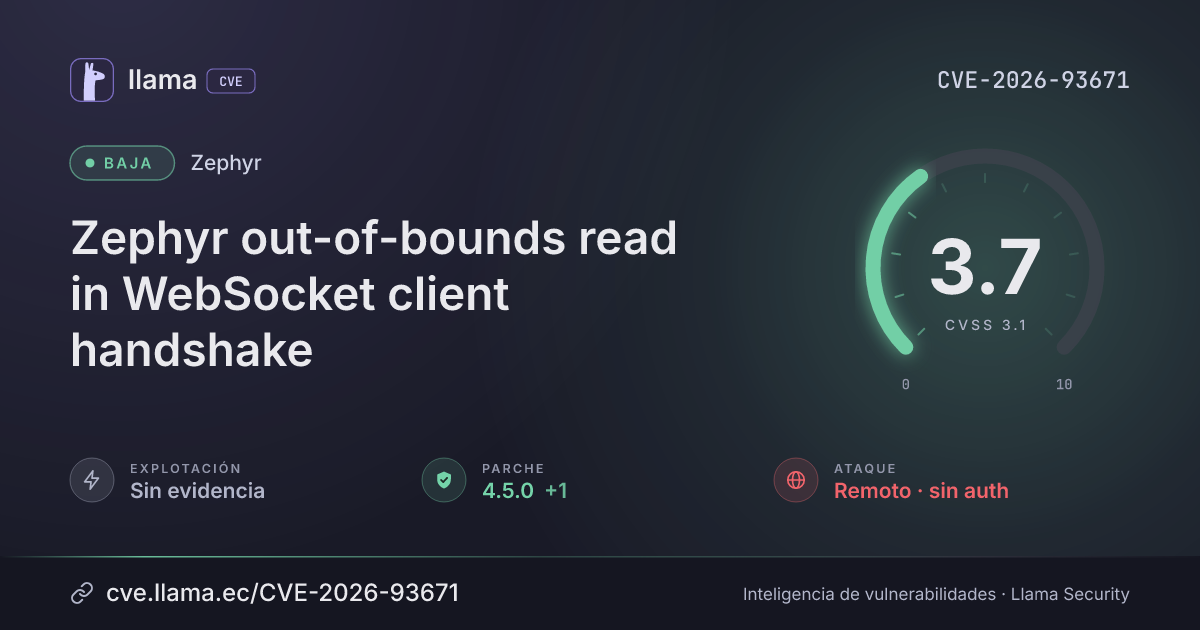
CVE-2026-93671
Zephyr out-of-bounds read in WebSocket client handshake
A remote server can leak nearby memory into device logs or crash the connection during the handshake.
CVSS:3.1/AV:N/AC:H/PR:N/UI:N/S:U/C:L/I:N/A:N
Fuente: CNA
Ciclo de vida de la vulnerabilidad
| Fecha | Fase | Evento | Detalle |
|---|---|---|---|
| Divulgación | Publicada | CVE-2026-93671 divulgada · CVSS 3.7 (CNA) | |
| Monitoreo | Detectada | Ingresó al índice | |
| Monitoreo | Fuente: NIST NVD | Registro visto por primera vez en NIST NVD | |
| Monitoreo | Fuente: ENISA EUVD | Registro visto por primera vez en ENISA EUVD | |
| Divulgación | Evaluación SSVC | CISA-ADP · explotación ninguna | |
| Divulgación | Modificada | Última actualización del registro | |
| Monitoreo | Verificada | Última verificación contra las fuentes |
The Zephyr WebSocket client can read past the end of its receive buffer when it logs a mismatched Sec-WebSocket-Accept header, and a remote server can trigger this during the handshake without logging in. An attacker can use this to expose adjacent memory in the device's logs, or to crash the connection or thread where the memory after the buffer is unmapped.
Descripción original del registro (zephyr)
The websocket client's HTTP header callback on_header_value() in subsys/net/lib/websocket/websocket.c receives the Sec-WebSocket-Accept header value as a pointer/length pair from the HTTP parser. The referenced bytes live inside the application-supplied receive buffer and are not NUL terminated. When the received value did not match the expected accept key, the pointer was passed directly to a %s conversion in a NET_DBG() call, so the logging code measured the string with strlen() and read on past the end of the header value looking for a terminator. The value is supplied by the peer during the WebSocket handshake, before any application-level authentication, so a malicious or man-in-the-middle server reached over a ws:// (or otherwise attacker-terminated) connection can trigger the mismatch branch at will simply by answering with a wrong accept key. By sizing the response so the header value ends at the tail of the buffer passed to websocket_connect() as wreq->tmp_buf, the peer can make the scan run off the end of that buffer and into adjacent memory. The defective log statement is compiled in only when websocket debug logging is enabled (CONFIG_NET_WEBSOCKET_LOG_LEVEL_DBG=y, or CONFIG_LOG_DEFAULT_LEVEL=4); it is absent from a default build, which bounds exposure to diagnostic configurations. The consequence is an out-of-bounds read whose contents are emitted to the log stream: memory adjacent to the receive buffer is disclosed wherever the device's logs are collected or displayed. On targets where the memory following the buffer is not mapped, the scan can instead fault and terminate the connection or thread. No out-of-bounds write occurs, so there is no integrity impact. The fix copies at most sizeof(got) - 1 bytes of the parser-provided slice into a bounded stack buffer, NUL terminates the copy, and logs that instead, so the formatter never reads beyond the bytes the parser actually offered.
Desglose de métricas
Rangos afectados
Estado del parche por paquete
| Paquete / producto | Estado | Corregida en | Desde divulgación | Última versión |
|---|---|---|---|---|
zephyr |
Corregida | 4.3.2, 4.5.0 | — | — |
4.3.24.5.0Arsenal público
Sin exploits, módulos ni PoC públicos conocidos a la fecha de verificación.
https://github.com/zephyrproject-rtos/zephyr/security/advisories/GHSA-686p-f363-q695https://github.com/zephyrproject-rtos/zephyr/commit/221b72b32060e613ee5f2416b270073d7be79277Las referencias externas se muestran para copiar: cve.llama.ec no lo redirige a otros sitios.