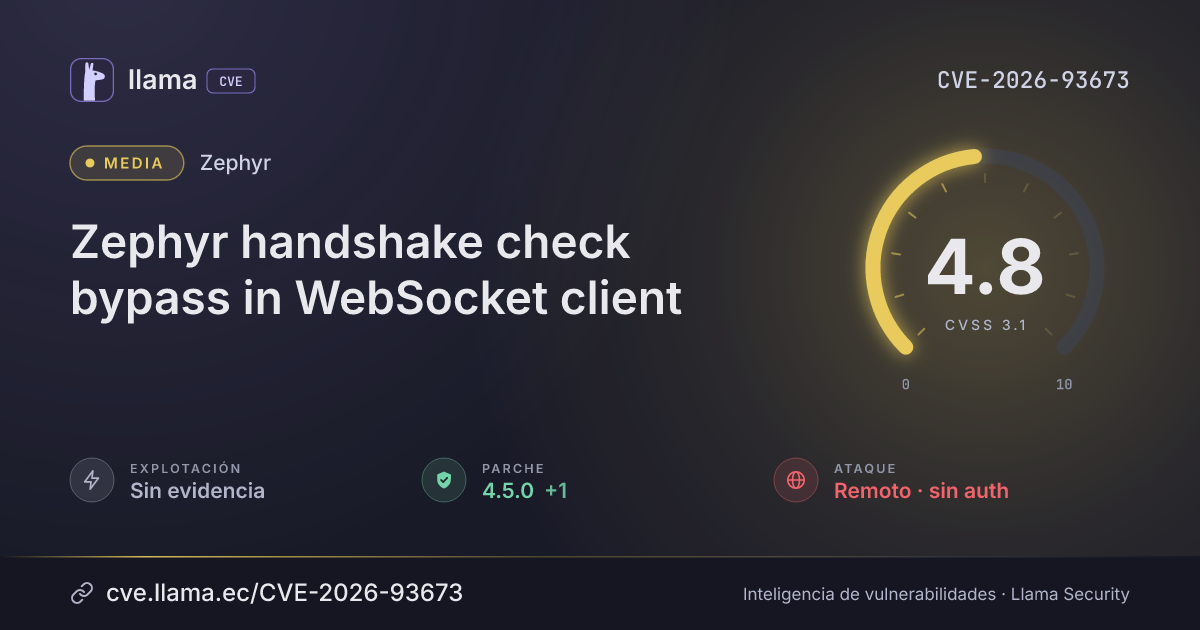
CVE-2026-93673
Zephyr handshake check bypass in WebSocket client
An unauthenticated attacker on the network can skip the handshake check and feed the client malicious WebSocket frames.
CVSS:3.1/AV:N/AC:H/PR:N/UI:N/S:U/C:L/I:L/A:N
Fuente: CNA
Ciclo de vida de la vulnerabilidad
| Fecha | Fase | Evento | Detalle |
|---|---|---|---|
| Divulgación | Publicada | CVE-2026-93673 divulgada · CVSS 4.8 (CNA) | |
| Monitoreo | Detectada | Ingresó al índice | |
| Monitoreo | Fuente: NIST NVD | Registro visto por primera vez en NIST NVD | |
| Monitoreo | Fuente: ENISA EUVD | Registro visto por primera vez en ENISA EUVD | |
| Divulgación | Evaluación SSVC | CISA-ADP · explotación ninguna | |
| Divulgación | Modificada | Última actualización del registro | |
| Monitoreo | Verificada | Última verificación contra las fuentes |
The Zephyr WebSocket client accepts a server handshake response whose Sec-WebSocket-Accept header is empty or only partly checked. An attacker who can reach the client over the network, without logging in or any user action, can complete the connection and have the client parse all further peer data as WebSocket frames. The attacker must be a caching or transparent intermediary, an off-path party injecting a spoofed response, or a non-WebSocket endpoint the client was induced to contact.
Descripción original del registro (zephyr)
The Zephyr WebSocket client validates the server's handshake response in on_header_value() in subsys/net/lib/websocket/websocket.c. The comparison was performed as strncmp(at, str, length), where length is the length of the value the server sent rather than the length of the expected value, so the check only asked whether the received value was a prefix of the expected base64(SHA-1(key || GUID)). A server that returned a handful of correct characters passed, and a response carrying an empty Sec-WebSocket-Accept: header caused strncmp() to be called with a count of zero, which returns 0 and set ctx->sec_accept_ok with no comparison performed at all. The header-value callback also cleared ctx->sec_accept_present after the first chunk, so a value split across receive-buffer boundaries was only ever examined in part. ctx->sec_accept_ok is the sole WebSocket-specific gate in websocket_connect(); the client does not check the HTTP status code or the Upgrade:/Connection: headers. Any HTTP response containing an empty or prefix-matching Sec-WebSocket-Accept header therefore completed the handshake, after which the socket is finalized as a WebSocket and all further peer bytes are parsed as frames. The affected path is driven directly by remote input through subsys/net/lib/http/http_parser.c, and is reached by every user of websocket_connect(), including MQTT over WebSocket (subsys/net/lib/mqtt/mqtt_transport_websocket.c) and subsys/net/lib/ocpp/ocpp.c. The Sec-WebSocket-Accept exchange is not a secret-based authentication -- an endpoint or on-path attacker that sees the request can compute the expected value -- so the impact is bounded to parties that never observed the handshake request: a caching or transparent intermediary replaying a canned response, an off-path attacker injecting a spoofed response, or a non-WebSocket endpoint the client was induced to talk to. For those, the per-connection binding that RFC 6455 requires the client to enforce provided no protection at all, letting a single crafted response convince the device it holds a live WebSocket session and causing it to send application data to, and accept frames from, an unverified peer. There is no memory-safety consequence. The fix compares each delivered chunk against the expected value at the position reached so far, refuses a chunk that would overrun it, and accepts only once every byte of the expected value -- and no more -- has been matched; on_header_field() now also clears the flag for any other header so a partial value cannot be continued across an intervening header.
Desglose de métricas
Rangos afectados
Estado del parche por paquete
| Paquete / producto | Estado | Corregida en | Desde divulgación | Última versión |
|---|---|---|---|---|
zephyr |
Corregida | 4.3.2, 4.5.0 | — | — |
4.3.24.5.0Arsenal público
Sin exploits, módulos ni PoC públicos conocidos a la fecha de verificación.
https://github.com/zephyrproject-rtos/zephyr/security/advisories/GHSA-vcpg-3c2r-7mxfhttps://github.com/zephyrproject-rtos/zephyr/commit/971a304afacf2bc72608ff3fc8cd23a74893654aLas referencias externas se muestran para copiar: cve.llama.ec no lo redirige a otros sitios.