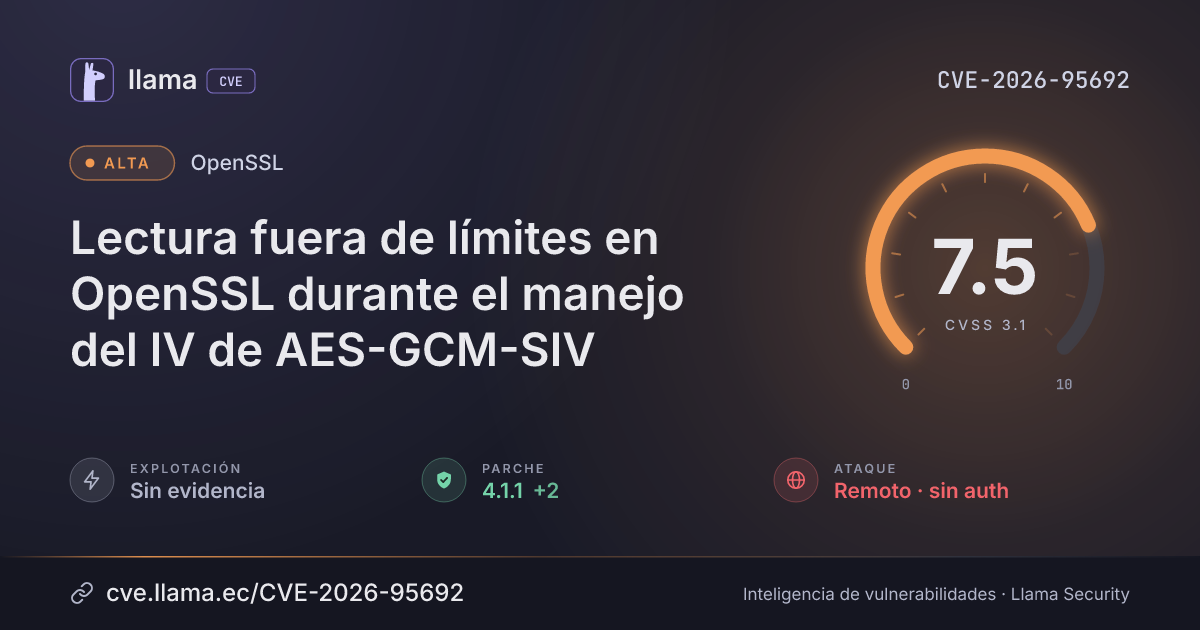
CVE-2026-95692
OpenSSL out-of-bounds read in AES-GCM-SIV IV handling
An attacker who has seen one message and tag can forge messages under a different IV that shares its leading bytes.
CVSS:3.1/AV:N/AC:L/PR:N/UI:N/S:U/C:H/I:N/A:N
Fuente: CISA-ADP
Ciclo de vida de la vulnerabilidad
| Fecha | Fase | Evento | Detalle |
|---|---|---|---|
| Divulgación | Publicada | CVE-2026-95692 divulgada · CVSS 7.5 (CISA-ADP) | |
| Monitoreo | Detectada | Ingresó al índice | |
| Divulgación | Evaluación SSVC | CISA-ADP · explotación ninguna | |
| Divulgación | Modificada | Última actualización del registro | |
| Monitoreo | Verificada | Última verificación contra las fuentes |
Issue summary: Setting an AES-GCM-SIV IV shorter than the expected nonce length via EVP_CipherInit_ex() may trigger a heap out-of-bounds read. Supplying a longer IV is silently truncated instead of rejected. Impact summary: An application passing a caller-supplied IV of the wrong length may crash or read beyond its buffer. Because trailing IV bytes are ignored, an attacker who knows one message and tag may forge messages under a different IV. CWE: CWE-125: Out-of-bounds Read Description: AES-GCM-SIV copies the caller-supplied IV or nonce into its internal state using a copy whose length is taken from the expected nonce size rather than from the length the caller actually provided. When the caller passes a shorter IV, the copy reads past the end of the caller's buffer; AddressSanitizer confirms a heap out-of-bounds read reached through EVP_CipherInit_ex() into ossl_aes_gcm_siv_init(). When the caller passes a longer IV, the implementation silently discards the trailing bytes instead of rejecting the length. The truncation breaks the binding between the IV and the computed authentication tag. An attacker who has observed a message and its tag under one IV can produce a message and tag that verify under a different IV whose first bytes match, since the surplus bytes never influence the computation. The message itself is unchanged, so this is a failure of IV commitment rather than a classic existential forgery. Only applications that call EVP_CipherInit_ex() (or the equivalent provider cipher initialization) with an IV length other than the standard 12 bytes for AES-GCM-SIV are affected. The severity is limited because the out-of-bounds read is small and attacker-controlled only in length, and the forgery requires an unusual IV length choice by the application. FIPS impact: no The FIPS modules are not affected by this issue, as AES-GCM-SIV is not an approved algorithm.
Affects OpenSSL 4.1.0 to before 4.1.1, 4.0.0 to before 4.0.4, and 3.5.0 to before 3.5.10 when an application passes an AES-GCM-SIV IV length other than 12 bytes. Fixed in 4.1.1, 4.0.4 and 3.5.10.
Condiciones y alcance
Desglose de métricas
Rangos afectados
Estado del parche por paquete
| Paquete / producto | Estado | Corregida en | Desde divulgación | Última versión |
|---|---|---|---|---|
OpenSSL |
Corregida | 3.5.10, 4.0.4, 4.1.1 | — | — |
3.5.104.0.44.1.1Arsenal público
Sin exploits, módulos ni PoC públicos conocidos a la fecha de verificación.
https://openssl-library.org/news/secadv/20261110.txthttps://github.com/openssl/openssl/commit/70a47ac78b6f3be1b22fb1551bd0bfcff4f29613https://github.com/openssl/openssl/commit/510872388f5d145cf870868b3d288a23822cb776https://github.com/openssl/openssl/commit/257a3427aa0ef8d9dd2ef5b3e2d1c021a221b116Las referencias externas se muestran para copiar: cve.llama.ec no lo redirige a otros sitios.