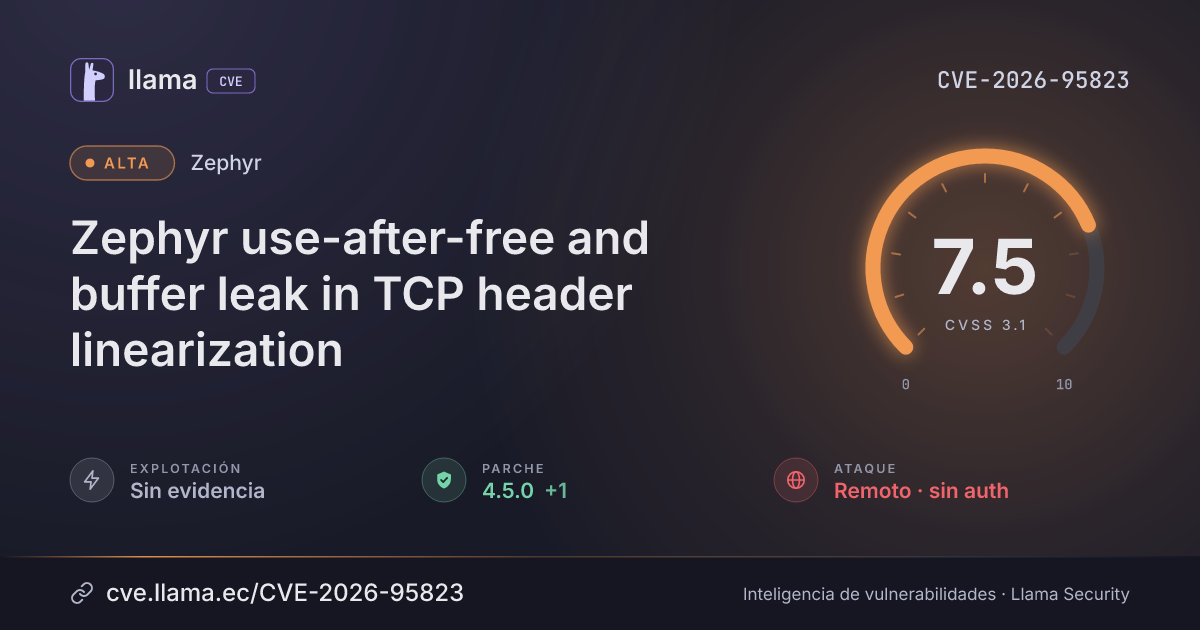
CVE-2026-95823
Zephyr use-after-free and buffer leak in TCP header linearization
A remote attacker can send one crafted TCP segment to exhaust receive buffers and cause a denial of service.
CVSS:3.1/AV:N/AC:L/PR:N/UI:N/S:U/C:N/I:N/A:H
Fuente: CNA
Ciclo de vida de la vulnerabilidad
| Fecha | Fase | Evento | Detalle |
|---|---|---|---|
| Divulgación | Publicada | CVE-2026-95823 divulgada · CVSS 7.5 (CNA) | |
| Monitoreo | Detectada | Ingresó al índice | |
| Monitoreo | Fuente: NIST NVD | Registro visto por primera vez en NIST NVD | |
| Divulgación | Evaluación SSVC | CISA-ADP · explotación ninguna | |
| Divulgación | Modificada | Última actualización del registro | |
| Monitoreo | Verificada | Última verificación contra las fuentes |
Zephyr's TCP header handling frees memory that is still in use and leaks receive buffers when a TCP header is split across buffer fragments. An attacker can remotely, without logging in, send a single crafted TCP segment, using an IPv6 extension header to place the header across a buffer boundary, to exhaust the receive buffer pool and cause a denial of service.
Zephyr from 2.3.0 before 4.3.2, and from 4.4.0 before 4.5.0, when a received TCP header straddles a net_buf boundary. Fixed in 4.3.2 and 4.5.0.
Descripción original del registro (zephyr)
tcp_pkt_linearize() in subsys/net/ip/tcp.c is used by th_get() whenever a received TCP header is not contiguous in a single net_buf. While pulling the header bytes out of the following fragments, the loop called net_buf_unref() on an emptied fragment without first detaching its frags pointer. net_buf_unref() walks the whole fragment list, so the payload buffers still linked behind that fragment were freed as well, and the stale pointer was then reinstalled into the packet as buf->frags, producing a use-after-free and a later double free during packet teardown. The same loop also advanced to second->frags unconditionally: when the fragment still held payload after the header remainder was pulled, it was spliced out of the packet without ever being unreferenced, permanently leaking that buffer and silently dropping the data it carried. The defect is reached from tcp_recv() via th_get() on every received TCP segment, before connection lookup or any header validation, so a single unauthenticated segment that matches a listening socket is sufficient. An attacker only needs the TCP header to straddle a net_buf boundary, which they can arrange from off-link: IPv6 extension headers are accepted on receive and their length is added to the header offset by th_get(), so a Destination Options header of a suitable length places the TCP header across the boundary of the fixed-size receive buffers (CONFIG_NET_BUF_DATA_SIZE). Packet chains assembled from several sources - IPv4/IPv6 reassembly, 6LoWPAN/802.15.4 reassembly, tunnel or virtual interfaces that strip an outer header, or drivers producing scatter-gather chains - can additionally present a short interior fragment that the loop empties exactly, which is the case that frees the remainder of the packet while it is still in use. The reliably reachable consequence is exhaustion of the receive buffer pool: each crafted segment leaks one net_buf from the fixed CONFIG_NET_BUF_RX_COUNT pool, the buffers are never reclaimed, and once the pool is empty the device can no longer receive network traffic until it is rebooted. Where a fragment is emptied exactly, the impact rises to memory corruption: freed pool buffers are written through by the remainder of the loop, their contents may be delivered to the application, and the packet is double-freed on teardown. The fix saves and clears second->frags before the net_buf_unref() so only the emptied header fragment is released, and advances to the next fragment only when second->len == 0, keeping any fragment that still holds payload in the packet. This restores the detach-before-unref ownership pattern used elsewhere in the stack, for example in net_pkt_trim_buffer().
Condiciones y alcance
Desglose de métricas
Rangos afectados
Estado del parche por paquete
| Paquete / producto | Estado | Corregida en | Desde divulgación | Última versión |
|---|---|---|---|---|
zephyr |
Corregida | 4.3.2, 4.5.0 | — | — |
4.3.24.5.0Arsenal público
Sin exploits, módulos ni PoC públicos conocidos a la fecha de verificación.
https://github.com/zephyrproject-rtos/zephyr/security/advisories/GHSA-5g8m-jj22-82f5https://github.com/zephyrproject-rtos/zephyr/commit/c66e7c6cc0c01492a423fa94fa0e5005308799b6Las referencias externas se muestran para copiar: cve.llama.ec no lo redirige a otros sitios.