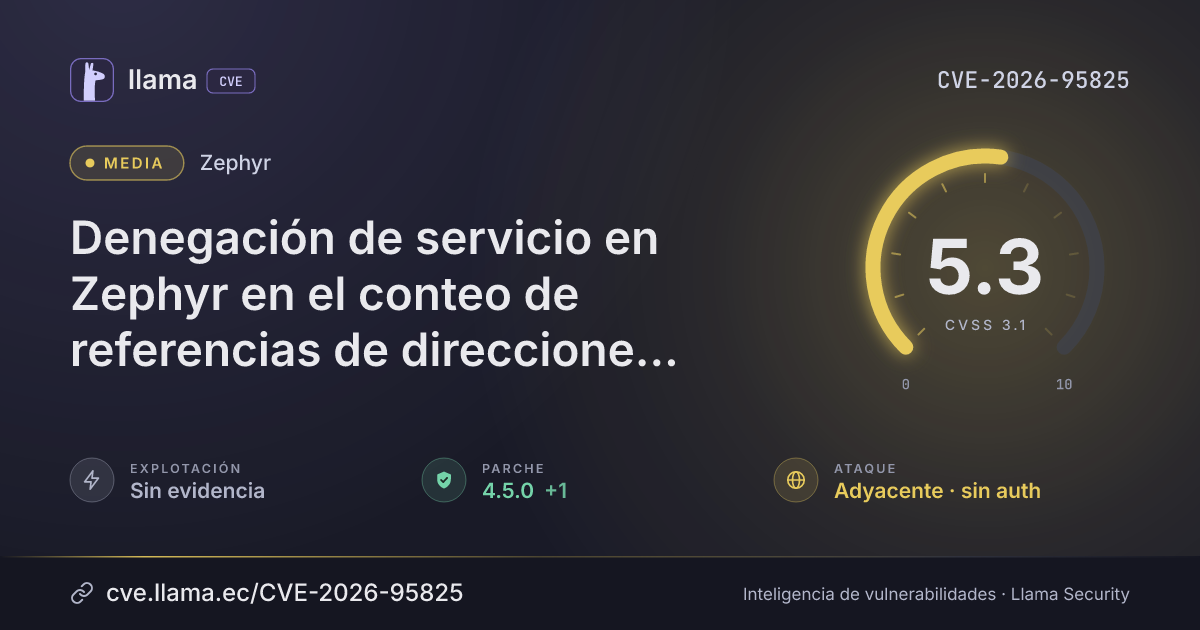
CVE-2026-95825
Zephyr denial of service in IP address reference counting
A local network attacker can release an IP address still in use, disrupting connections without logging in.
Texto original en inglés · Ver en español
CVSS:3.1/AV:A/AC:H/PR:N/UI:N/S:U/C:N/I:N/A:H
Fuente: CNA
Ciclo de vida de la vulnerabilidad
| Fecha | Fase | Evento | Detalle |
|---|---|---|---|
| Divulgación | Publicada | CVE-2026-95825 divulgada · CVSS 5.3 (CNA) | |
| Monitoreo | Detectada | Ingresó al índice | |
| Monitoreo | Fuente: NIST NVD | Registro visto por primera vez en NIST NVD | |
| Divulgación | Evaluación SSVC | CISA-ADP · explotación ninguna | |
| Divulgación | Modificada | Última actualización del registro | |
| Monitoreo | Verificada | Última verificación contra las fuentes |
Zephyr can release a configured IP address while connections are still using it, which corrupts the address's reference count. An attacker on the same local network can trigger this without logging in and without any user action.
Descripción original del registro (zephyr)
net_if_ipv4_addr_rm() and net_if_ipv6_addr_rm() in subsys/net/ip/net_if.c unconditionally called net_if_addr_unref() on the target address. When an earlier removal could not complete because another subsystem still held a reference (the TCP stack takes one on the local address of every connection, in tcp_conn_new() and on connect()), the address is left in place with is_added cleared and is_used still set. A second removal of such an address decremented the reference count again, consuming a reference owned by that other holder. When it was the last one, the address slot was released, its NET_EVENT_IPV*_ADDR_DEL event fired, and the slot became reusable while the holder still believed it owned a reference. Every address lookup helper matches on is_used and not on is_added, so a half-removed address stays visible to the rest of the stack and repeat removals are readily reachable from remote input. Under IPv6 SLAAC, an on-link node that sends a Router Advertisement with a short valid lifetime causes the address to expire into the deferred state; a refreshing Router Advertisement is handled by net_if_ipv6_addr_update_lifetime(), which re-arms the lifetime timer without restoring the reference, so the next expiry performs the second, reference-stealing removal. With CONFIG_NET_IPV4_ACD and DHCPv4, repeated spoofed ARP conflicts for the device's lease drive dhcpv4_acd_event_handler() into calling net_if_ipv4_addr_rm() more than once on the same address. Where CONFIG_USERSPACE is enabled, the net_if_ipv4_addr_rm_by_index() and net_if_ipv6_addr_rm_by_index() system calls let an unprivileged user-mode thread trigger the same kernel-side release deterministically. The impact is loss of a configured IP address while connections are still using it, and a corrupted reference count that propagates: the slot can be handed to a newly added address, and when the stale holder later tears down, net_if_addr_unref() resolves the address by value and drops the new incarnation's only reference, removing a live address a second time. The affected objects are static array slots and the counter is never decremented below zero, so there is no memory corruption or information disclosure; the consequence is denial of service against the device's network connectivity, repeatable at the attacker's pace. The fix resolves the address before touching the reference count and returns false without calling net_if_addr_unref() when the address is already marked as removed, so the public removal API can no longer consume a reference it does not own.
Desglose de métricas
Rangos afectados
Estado del parche por paquete
| Paquete / producto | Estado | Corregida en | Desde divulgación | Última versión |
|---|---|---|---|---|
zephyr |
Corregida | 4.3.2, 4.5.0 | — | — |
4.3.24.5.0Arsenal público
Sin exploits, módulos ni PoC públicos conocidos a la fecha de verificación.
https://github.com/zephyrproject-rtos/zephyr/security/advisories/GHSA-gfv3-7jx7-4jhchttps://github.com/zephyrproject-rtos/zephyr/commit/6c90a4581c492802e4f83f1a0b429e9bb0374f33Las referencias externas se muestran para copiar: cve.llama.ec no lo redirige a otros sitios.