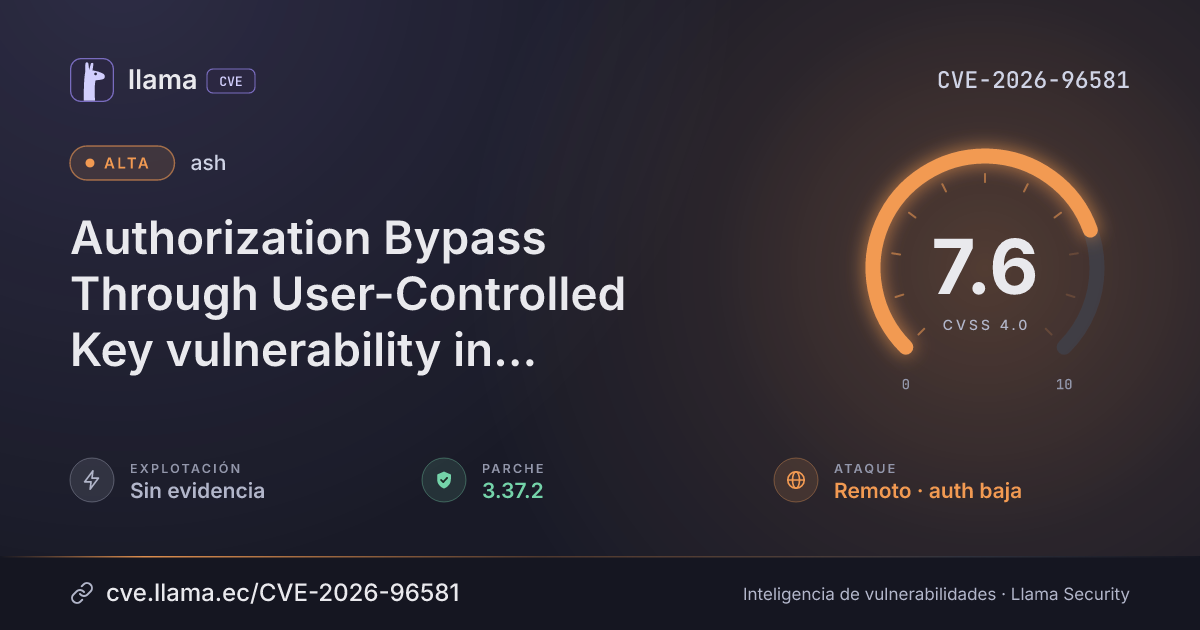
Authorization Bypass Through User-Controlled Key vulnerability in ash-project ash allows a user of one tenant to read, overwrite and take over another tenant's records via an upserting create action
Specific setups onlyParche disponibleinsecure direct object reference (IDOR)
ExplotaciónSin evidenciaSSVC: none · no figura en CISA KEV
Exploits públicos0Ninguno conocido
Parche1 versión3.37.2
Exposición24 dDesde la divulgación, 26 oct 2026, 2:20 a. m.
Detección25 minDesde la divulgación hasta su ingreso al índice
Decisión SSVCSeguir de cerca
Monitorear y programar la remediación
Sin explotación conocida, no automatizable e impacto técnico total. Hay versiones corregidas disponibles.
Timeline
Ciclo de vida de la vulnerabilidad
Hoy
Divulgación
Publicada +1
Modificada
Explotación
Remediación
Monitoreo
Detectada +2
Fuente: OSV
Verificada
26 oct 26
3 nov 26
19 nov 26
26 oct 26
1 nov 26
7 nov 26
13 nov 26
19 nov 26
Fecha
Fase
Evento
Detalle
Divulgación
Publicada
CVE-2026-96581 divulgada · CVSS 7.6 (CNA)
Monitoreo
Detectada
Ingresó al índice
Monitoreo
Fuente: NIST NVD
Registro visto por primera vez en NIST NVD
Monitoreo
Fuente: ENISA EUVD
Registro visto por primera vez en ENISA EUVD
Divulgación
Evaluación SSVC
CISA-ADP · explotación ninguna
Monitoreo
Fuente: OSV
Registro visto por primera vez en OSV
Divulgación
Modificada
Última actualización del registro
Monitoreo
Verificada
Última verificación contra las fuentes
Resumen
Resumen generado por IA · CC-BY 4.0
The Ash framework (the Elixir `ash` library, versions from 1.22.0 up to but not including 3.37.2) is affected. An attacker who can use a create action with upserts enabled on a multitenant resource could read, overwrite, and take over records that belong to another tenant, breaking the data isolation between tenants.
Affects Ash resources from 1.22.0 up to 3.37.2 that use attribute multitenancy and a create action with upsert? true that upserts on the primary key. Fixed in 3.37.2.
¿Qué significa?An upsert on the primary key ignores attribute multitenancy, so a caller in one tenant can read, overwrite and take over another tenant's records. With default upsert fields, a record can also be moved into the caller's own tenant.
¿Quién está afectado?Ash versions from 1.22.0 up to but not including 3.37.2 are in the affected range. The setup also needs attribute multitenancy and a create action with upsert? true that upserts on the primary key (without upsert_identity) and accepts it, or upserts on an all_tenants? identity. To check, look at the Ash version in your dependency lock file and review your create actions for these settings.
¿Qué hacer?Upgrade Ash to 3.37.2 or later. If you cannot upgrade yet, the advisory's workaround is to add upsert_condition expr(<tenant attribute> == ^tenant()) to every affected create action and not combine it with return_skipped_upsert?.
Descripción original del registro (EEF)
Authorization Bypass Through User-Controlled Key vulnerability in ash-project ash allows a user of one tenant to read, overwrite and take over another tenant's records via an upserting create action.
Under attribute multitenancy, Ash.Actions.Create (lib/ash/actions/create/create.ex) and Ash.Actions.Create.Bulk (lib/ash/actions/create/bulk.ex) upserted on the primary key, or on an all_tenants? identity, without scoping the conflicting record to the request's tenant. A caller of a create action with upsert? true that accepts the primary key, supplying a record id from another tenant, updated that record's upsert fields and received all of its attributes in the result. With the default upsert fields the tenant attribute was written too, moving the record into the caller's tenant. Read and update policies do not run for upserts, and tenant-scoped create policies pass because the tenant is the caller's own.
This issue affects ash: from 1.22.0 before 3.37.2.
Contexto
Condiciones y alcance
Condiciones necesarias para que el fallo sea explotable
01
The resource uses attribute multitenancy.“Reachable when a resource uses attribute multitenancy”
02
A create action with upsert? true that upserts on the primary key (no upsert_identity) and accepts it, or upserts on an all_tenants? identity.“a create action with upsert? true that either upserts on the primary key”
03
The caller knows or can enumerate a key belonging to another tenant.“the caller knows or can enumerate a key belonging to another tenant”
¿Quién debe revisar?Teams running the Hex package ash from 1.22.0 before 3.37.2 that use attribute multitenancy with upserting create actions (upsert? true) on primary keys or all_tenants? identities.
No protegeUpsert conditions do not help on the Mnesia data layer.
MitigaciónAdd upsert_condition expr(<tenant attribute> == ^tenant()) to every create action that upserts on the primary key or on an all_tenants? identity, and do not combine it with return_skipped_upsert?.
Vector CVSS 4.0
Desglose de métricas
Opción resaltada = valor del vector · izquierda = peor caso · CNA
Vector de ataqueAV:N
RedAdyacenteLocalFísica
ComplejidadAC:L
BajaAlta
Requisitos de ataqueAT:P
NingunoPresentes
PrivilegiosPR:L
NingunoBajosAltos
InteracciónUI:N
NingunaPasivaActiva
Confid. (sistema)VC:H
AltoBajoNinguno
Integridad (sistema)VI:H
AltoBajoNinguno
Disponib. (sistema)VA:N
AltoBajoNinguno
Confid. (posterior)SC:N
AltoBajoNinguno
Integridad (posterior)SI:N
AltoBajoNinguno
Disponib. (posterior)SA:N
AltoBajoNinguno
Versiones
Rangos afectados
AfectadaCorregida
ash≥ 1.22.0 < 3.37.2
1.22.0
3.37.2
Remediación
Estado del parche por paquete
Paquete / producto
Estado
Corregida en
Desde divulgación
Última versión
ash
Corregida
3.37.2
—
—
Versiones corregidas3.37.2
Explotación
Arsenal público
Sin exploits, módulos ni PoC públicos conocidos a la fecha de verificación.
Registro
EscenarioGENERALEEF
configurationReachable when a resource uses attribute multitenancy and exposes to callers of one tenant a create action with upsert? true that either upserts on the primary key (no upsert_identity) and accepts it, or upserts on an all_tenants? identity, and the caller knows or can enumerate a key belonging to another tenant (for example a serial integer id, or an id from a shared link or export).EEF
MitigaciónAdd upsert_condition expr(<tenant attribute> == ^tenant()) to every create action that upserts on the primary key or on an all_tenants? identity, and do not combine it with return_skipped_upsert?. An upsert into another tenant's record then fails with Ash.Error.Changes.StaleRecord (or is skipped in a bulk create) and leaves that record unchanged. This does not help on the Mnesia data layer, which ignores upsert conditions in affected versions.EEF
Usamos cookies propias estrictamente necesarias para que el sitio funcione y sea seguro. Con tu permiso, también usamos almacenamiento local para recordar tus preferencias y medir el uso del sitio de forma agregada. Puedes aceptar, rechazar o configurar cada categoría, y cambiar tu decisión cuando quieras desde el enlace “Preferencias de cookies” del pie de página. Más información
Preferencias de cookies
Elige qué permites
Solo usamos tecnologías propias de este dominio. Sin publicidad ni rastreadores de terceros. Detalle en la Política de cookies.