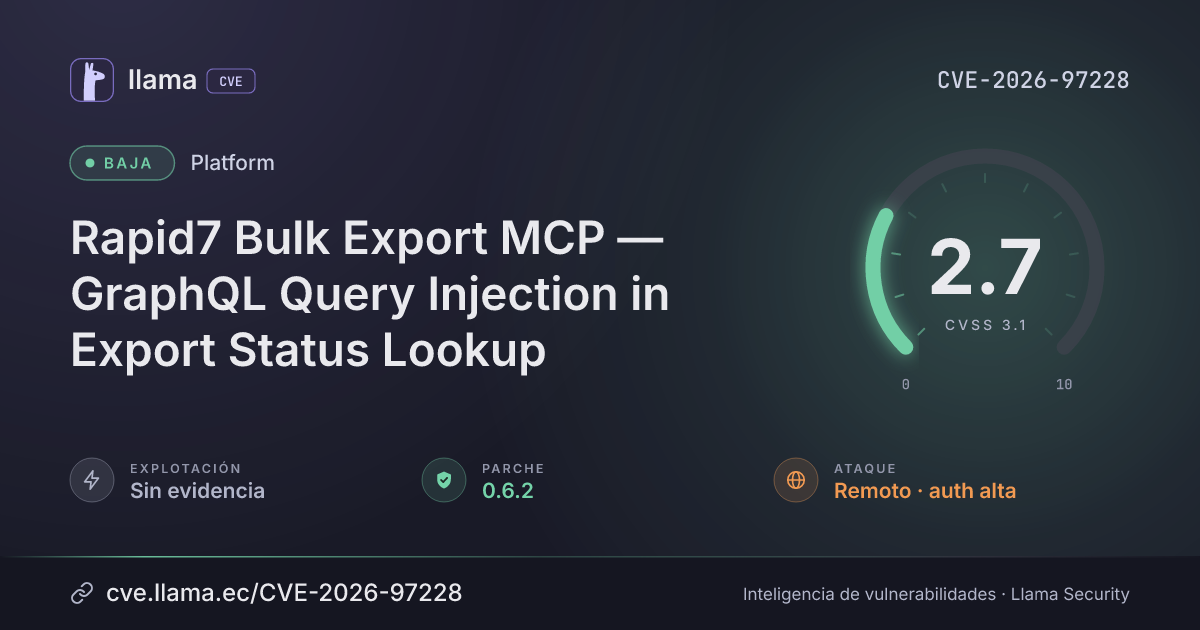
CVE-2026-97228
Rapid7 Bulk Export MCP — GraphQL Query Injection in Export Status Lookup
CVSS:3.1/AV:N/AC:L/PR:H/UI:N/S:U/C:L/I:N/A:N
Fuente: CNA
Ciclo de vida de la vulnerabilidad
| Fecha | Fase | Evento | Detalle |
|---|---|---|---|
| Divulgación | Publicada | CVE-2026-97228 divulgada · CVSS 2.7 (CNA) | |
| Divulgación | Evaluación SSVC | CISA-ADP · explotación ninguna | |
| Divulgación | Modificada | Última actualización del registro | |
| Monitoreo | Detectada | Ingresó al índice | |
| Monitoreo | Fuente: OSV | Registro visto por primera vez en OSV |
Rapid7 Bulk Export MCP versions 0.2.5 through 0.6.1 suffer from a GraphQL query injection issue in the export-status component (`get_export_status` in `src/export_manager.py`), whereby the `export_id` value — an unvalidated MCP tool argument reaching the function via the `check_rapid7_export_status` and `download_rapid7_export` tools — is interpolated directly into the GraphQL query string. A crafted `export_id` containing quote and brace characters can terminate the intended `export(id: "...")` selection early and append attacker-controlled root-level selections (for example, schema introspection), producing a single well-formed GraphQL document that is then sent to the Rapid7 export API under the operator's own API key. Notably, this issue does not grant an existing actor any access they do not already have: every injected query executes within the operator's own already-authenticated API scope, using the operator's own valid API key, and cannot cross a tenant or account boundary. A directly-malicious operator gains nothing they could not already do by calling the API directly; the realistic exposure is limited to a compromised or careless upstream MCP client, or indirect prompt injection forwarding an unvalidated identifier. This is fixed in version 0.6.2, which passes `export_id` as a parameterized GraphQL variable (`$exportId: ID!`).
Desglose de métricas
Rangos afectados
Estado del parche por paquete
| Paquete / producto | Estado | Corregida en | Desde divulgación | Última versión |
|---|---|---|---|---|
Platform |
Corregida | 0.6.2 | — | — |
0.6.2Arsenal público
Sin exploits, módulos ni PoC públicos conocidos a la fecha de verificación.
https://github.com/rapid7/rapid7-bulk-export-mcp/releases/tag/v0.6.2Las referencias externas se muestran para copiar: cve.llama.ec no lo redirige a otros sitios.