llamaCVEVulnerability Intelligence
/
Eclipse Kura

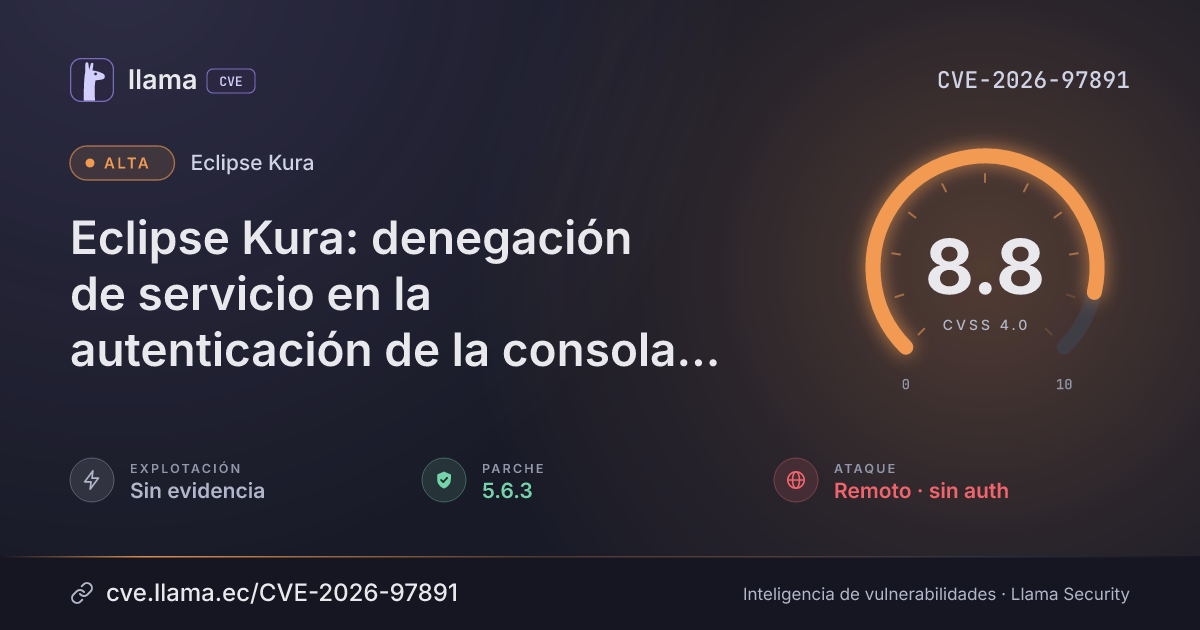
CVE-2026-97891

Eclipse Kura denial of service in web console authentication

An unauthenticated attacker can crash the console by sending login requests that exhaust the server's memory.

UnclearParche disponibledenial of service
Descargar PNG JSON
CVSS 4.0
8.8
Alta
CVSS:4.0/AV:N/AC:L/AT:N/PR:N/UI:N/VC:N/VI:L/VA:H/SC:N/SI:L/SA:N Fuente: CNA
ExplotaciónSin evidenciaSSVC: ninguna · no figura en CISA KEV
Exploits públicos0Ninguno conocido
Parche1 versión5.6.3
Exposición10 dDesde la divulgación, 10 nov 2026, 11:55 a. m.
Detección6 minDesde la divulgación hasta su ingreso al índice
Decisión SSVCSeguir
Remediar en la ventana regular de mantenimiento
Sin explotación conocida, automatizable e impacto técnico parcial. Hay versiones corregidas disponibles.
Timeline

Ciclo de vida de la vulnerabilidad

Hoy
Divulgación
Publicada
Evaluación SSVC
Modificada
Explotación
Remediación
Monitoreo
Detectada +1
Fuente: OSV
Verificada
10 nov 26
12 nov 26
16 nov 26
18 nov 26
21 nov 26
10 nov 26
13 nov 26
15 nov 26
18 nov 26
21 nov 26
FechaFaseEventoDetalle
Divulgación Publicada CVE-2026-97891 divulgada · CVSS 8.8 (CNA)
Monitoreo Detectada Ingresó al índice
Monitoreo Fuente: NIST NVD Registro visto por primera vez en NIST NVD
Monitoreo Fuente: OSV Registro visto por primera vez en OSV
Divulgación Evaluación SSVC CISA-ADP · explotación ninguna
Divulgación Modificada Última actualización del registro
Monitoreo Verificada Última verificación contra las fuentes
Resumen
Resumen generado por IA · CC-BY 4.0 · 10 nov 2026

Eclipse Kura's Web Console, in versions 5.0.0 through 5.6.2, can be made to crash by an attacker who sends unauthenticated requests over the network to its login endpoints, which causes it to allocate an unlimited number of HTTP sessions and exhaust the JVM heap. The attack requires no login and no user action.

¿Qué significa?The Web Console creates a new HTTP session for every request sent to its built-in authentication endpoints, so repeated requests can use up the JVM heap. When the heap is exhausted, the Kura process crashes, which is a denial of service.
¿Quién está afectado?Eclipse Kura versions 5.0.0 through 5.6.2 are affected when the Web Console (org.eclipse.kura.web2 bundle 2.0.600 to 2.6.2) is in use, with requests reaching /admin/auth, /admin/login/password, or /admin/login/cert. To check, look at the Kura version and whether the Web Console bundle is present and at a version in that range.
¿Qué hacer?Upgrade Eclipse Kura to version 5.6.3, which is the listed fix. Until you can upgrade, use a firewall to reduce external and uncontrolled access to the Eclipse Kura endpoint.
Descripción original del registro (eclipse)

In Eclipse Kura version 5.0.0 to 5.6.2, the Web Console allocates a new HTTP session for every request to its built-in authentication endpoints (/admin/auth, /admin/login/password, /admin/login/cert) before checking the HTTP method, parsing the request, or validating any submitted credentials, and does not limit how many such sessions can be allocated. An unauthenticated client that sends requests to these endpoints without honoring the returned session cookie can cause the server to allocate an unbounded number of sessions, exhausting the JVM heap and crashing the Kura process.

Contexto

Condiciones y alcance

Condiciones necesarias para que el fallo sea explotable
01
Eclipse Kura 5.0.0 to 5.6.2 with the Web Console (org.eclipse.kura.web2 bundle 2.0.600 to 2.6.2)“Web Console (org.ecliipse.kura.web2 bundle [2.0.600, 2.6.2])”
02
Requests sent to the Web Console built-in authentication endpoints (/admin/auth, /admin/login/password, /admin/login/cert)“the Web Console allocates a new HTTP session for every request to its built-in authentication endpoints”
¿Quién debe revisar?Teams running Eclipse Kura 5.0.0 to 5.6.2 with the Web Console (org.eclipse.kura.web2 2.0.600 to 2.6.2) reachable over the network
MitigaciónUse the firewall to reduce the external and uncontrolled access to the Eclipse Kura endpoint
Vector CVSS 4.0

Desglose de métricas

Opción resaltada = valor del vector · izquierda = peor caso · CNA
Vector de ataqueAV:N
RedAdyacenteLocalFísica
ComplejidadAC:L
BajaAlta
Requisitos de ataqueAT:N
NingunoPresentes
PrivilegiosPR:N
NingunoBajosAltos
InteracciónUI:N
NingunaPasivaActiva
Confid. (sistema)VC:N
AltoBajoNinguno
Integridad (sistema)VI:L
AltoBajoNinguno
Disponib. (sistema)VA:H
AltoBajoNinguno
Confid. (posterior)SC:N
AltoBajoNinguno
Integridad (posterior)SI:L
AltoBajoNinguno
Disponib. (posterior)SA:N
AltoBajoNinguno
Score de explotaciónQué tan fácil y probable es que la exploten
10.0/ 10Muy alto
Vector 10.0 (muy fácil) · sin evidencia de explotación.
Versiones

Rangos afectados

Afectada Corregida
org.eclipse.kura:org.eclipse.kura.web2≥ 2.0.600 ≤ 2.6.2
Eclipse Kura≥ 5.0.0 ≤ 5.6.2
2.0.600
2.6.2
5.0.0
5.6.2
Remediación

Estado del parche por paquete

Paquete / productoEstadoCorregida enDesde divulgaciónÚltima versión
Eclipse Kura
Corregida 5.6.3 — —
Versiones corregidas5.6.3
Explotación

Arsenal público

Sin exploits, módulos ni PoC públicos conocidos a la fecha de verificación.

Registro
EscenarioGENERALeclipse
Referencias
Fabricantehttps://github.com/eclipse-kura/kura/security/advisories/GHSA-4pwp-99h8-c44j
Fabricantehttps://gitlab.eclipse.org/security/cve-assignment/-/work_items/325

Las referencias externas se muestran para copiar: cve.llama.ec no lo redirige a otros sitios.