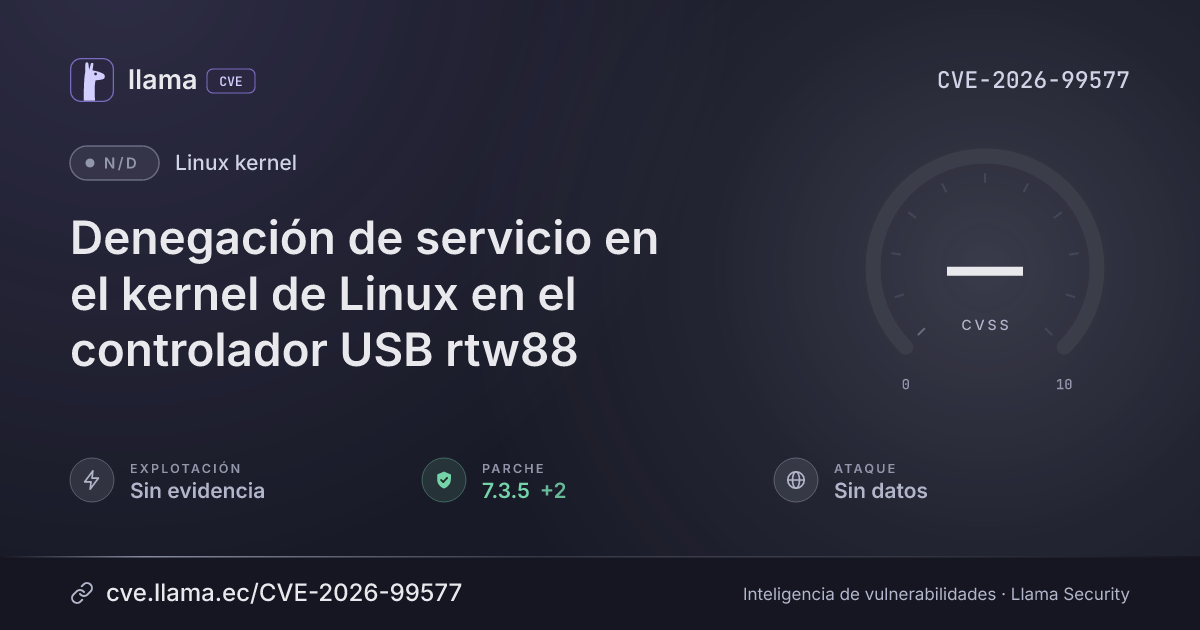
CVE-2026-99577
Linux kernel denial of service in rtw88 USB driver
A nearby attacker can flood broadcast traffic so an access point stops sending other frames until it reboots.
Texto original en inglés · Ver en español
Ciclo de vida de la vulnerabilidad
| Fecha | Fase | Evento | Detalle |
|---|---|---|---|
| Divulgación | Publicada | CVE-2026-99577 divulgada | |
| Monitoreo | Detectada | Ingresó al índice | |
| Monitoreo | Fuente: NIST NVD | Registro visto por primera vez en NIST NVD | |
| Monitoreo | Verificada | Última verificación contra las fuentes |
The Linux kernel's rtw88 USB Wi-Fi driver lets sustained broadcast or multicast traffic exhaust its transmit buffers while a client is in power save mode, so the access point stops sending other frames and only a reboot restores it. The driver hands an unlimited number of frames to the after-DTIM queue, which fills the shared transmit page pool.
Descripción original del registro (Linux)
In the Linux kernel, the following vulnerability has been resolved: wifi: rtw88: usb: bound what the driver feeds the after-DTIM queue Frames routed to the high queue are transmitted right after DTIM beacons only, inside the ATIM window, while they wait in the shared TX page pool. The driver puts no limit on how many it hands over, so as long as one station dozes, any sustained broadcast or multicast traffic outruns the drain and empties the pool: measured on an RTL8822BU AP with a single client in power save and ~40 frames/s of mDNS chatter, the free page count at 0x240 goes from 1803 to 16 in about 100 seconds and stays there for as long as the traffic lasts. From that point every other transmit queues behind the backlog, authentication responses arrive too late for anyone to join, and the reserved page download fails ("error beacon valid"). The AP keeps beaconing and only a reboot recovers. Feed the high queue through a small budget that refills below the measured drain rate (about 3 frames per DTIM, ~15/s at dtim_period 2 on the default 2 TU ATIM window); whatever exceeds the budget leaves on its access category queue right away. The high queue backlog is now bounded by the burst size under any load, so the page pool cannot run dry, at the price that a dozing station may miss part of a broadcast storm.
Rangos afectados
Estado del parche por paquete
| Paquete / producto | Estado | Corregida en | Desde divulgación | Última versión |
|---|---|---|---|---|
Linux |
Corregida | 6.12.118, 6.18.64, 7.3.5 | — | — |
6.12.1186.18.647.3.5Arsenal público
Sin exploits, módulos ni PoC públicos conocidos a la fecha de verificación.
https://git.kernel.org/stable/c/9f7c09a830398003de105004035ed7aa0185b65fhttps://git.kernel.org/stable/c/0bd2548fee3ae403550a394b5270d914bc2b76e9https://git.kernel.org/stable/c/99085c31b8521eb588b66b726ca6d08338e3a14ehttps://git.kernel.org/stable/c/04cc8c59a3d79ef7ec2341f1c7aef1d40a0ce7dfLas referencias externas se muestran para copiar: cve.llama.ec no lo redirige a otros sitios.