GHSA-23RF-6693-G89P
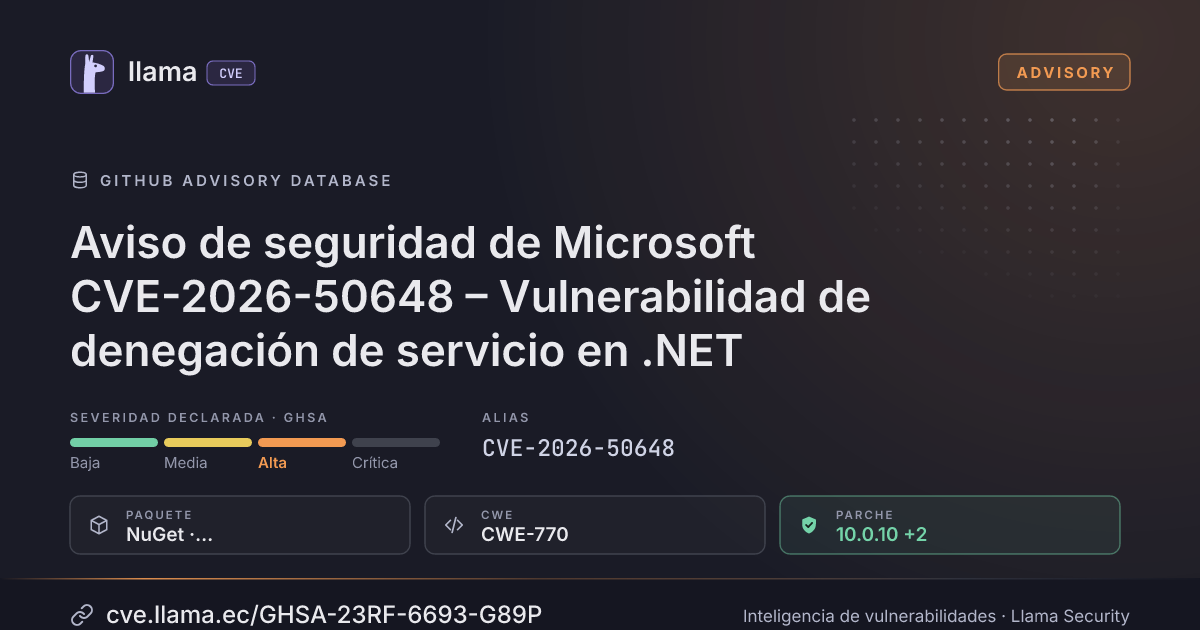
Microsoft Security Advisory CVE-2026-50648 – .NET Denial of Service Vulnerability
Ciclo de vida de la vulnerabilidad
| Fecha | Fase | Evento | Detalle |
|---|---|---|---|
| Remediación | Parche 8.0.4 | System.Security.Cryptography.Xml · -6 d desde divulgación | |
| Remediación | Parche 9.0.18 | System.Security.Cryptography.Xml · -6 d desde divulgación | |
| Remediación | Parche 10.0.10 | System.Security.Cryptography.Xml · -6 d desde divulgación | |
| Divulgación | Publicada | GHSA-23RF-6693-G89P divulgada | |
| Divulgación | Modificada | Última actualización del registro | |
| Monitoreo | Detectada | Ingresó al índice |
Executive summary
Microsoft is releasing this security advisory to provide information about a vulnerability in .NET XML Encryption (System.Security.Cryptography.Xml). This advisory also provides guidance on what developers can do to update their applications to remove this vulnerability.
A denial of service vulnerability exists in the XML encryption implementation (EncryptedXml) in .NET 8, .NET 9, and .NET 10. An attacker could exploit this vulnerability by supplying crafted encrypted XML that causes uncontrolled resource consumption, resulting in denial of service.
Announcement
Announcement for this issue can be found at https://github.com/dotnet/announcements/issues/416
CVSS Details
- Version: 3.1
- Severity: High
- Score: 7.5
- Vector: `CVSS:3.1/AV:N/AC:L/PR:N/UI:N/S:U/C:N/I:N/A:H`
- Weakness: CWE-770 (Allocation of Resources Without Limits or Throttling)
Affected Platforms
- Platforms: All
- Architectures: All
## <a name="affected-packages"></a>Affected Packages
The vulnerability affects any Microsoft .NET project if it uses any of affected package versions listed below
### <a name=".NET 10.0"></a>.NET 10.0
Package name | Affected version | Patched version
------------ | ---------------- | -------------------------
System.Security.Cryptography.Xml https://www.nuget.org/packages/System.Security.Cryptography.Xml | >= 10.0.0, <= 10.0.9 | 10.0.10
### <a name=".NET 9.0"></a>.NET 9.0
Package name | Affected version | Patched version
------------ | ---------------- | -------------------------
System.Security.Cryptography.Xml https://www.nuget.org/packages/System.Security.Cryptography.Xml | >= 9.0.0, <= 9.0.17 | 9.0.18
### <a name=".NET 8.0"></a>.NET 8.0
Package name | Affected version | Patched version
------------ | ---------------- | -------------------------
System.Security.Cryptography.Xml https://www.nuget.org/packages/System.Security.Cryptography.Xml | >= 8.0.0, <= 8.0.3 | 8.0.4
Advisory FAQ
<a name="how-affected"></a>How do I know if I am affected?
If using a package listed in [affected packages](#affected-packages), you're exposed to the vulnerability.
<a name="how-fix"></a>How do I fix the issue?
To update the System.Security.Cryptography.Xml NuGet package, use one of the following methods:
NuGet Package Manager UI in Visual Studio:
- Open your project in Visual Studio.
- Right-click on your project in Solution Explorer and select "Manage NuGet Packages..." or navigate to "Project > Manage NuGet Packages".
- In the NuGet Package Manager window, select the "Updates" tab. This tab lists packages with available updates from your configured package sources.
- Select the package(s) you wish to update. You can choose a specific version from the dropdown or update to the latest available version.
- Click the "Update" button.
Using the NuGet Package Manager Console in Visual Studio:
- Open your project in Visual Studio.
- Navigate to "Tools > NuGet Package Manager > Package Manager Console".
- To update a specific package to its latest version, use the following Update-Package command:
```Update-Package -Id System.Security.Cryptography.Xml```
Using the .NET CLI (Command Line Interface):
- Open a terminal or command prompt in your project's directory.
- To update a specific package to its latest version, use the following add package command:
```dotnet add package System.Security.Cryptography.Xml```
Once you have updated the nuget package reference you must recompile and deploy your application. Additionally we recommend you update your runtime and/or SDKs, but it is not necessary to patch the vulnerability.
Other Information
Reporting Security Issues
If you have found a potential security issue in a supported version of .NET, please report it to the Microsoft Security Response Center (MSRC) via the MSRC Researcher Portal https://msrc.microsoft.com/report/vulnerability/new. Further information can be found in the MSRC Report an Issue FAQ https://www.microsoft.com/msrc/faqs-report-an-issue.
Security reports made through MSRC may qualify for the Microsoft .NET Bounty. Details of the Microsoft .NET Bounty Program including terms and conditions are at https://aka.ms/corebounty.
Support
You can ask questions about this issue on GitHub in the .NET GitHub organization. The main repos are located at https://github.com/dotnet/runtime. The Announcements repo (https://github.com/dotnet/Announcements) will contain this bulletin as an issue and will include a link to a discussion issue. You can ask questions in the linked discussion issue.
Disclaimer
The information provided in this advisory is provided "as is" without warranty of any kind. Microsoft disclaims all warranties, either express or implied, including the warranties of merchantability and fitness for a particular purpose. In no event shall Microsoft Corporation or its suppliers be liable for any damages whatsoever including direct, indirect, incidental, consequential, loss of business profits or special damages, even if Microsoft Corporation or its suppliers have been advised of the possibility of such damages. Some states do not allow the exclusion or limitation of liability for consequential or incidental damages so the foregoing limitation may not apply.
External Links
[CVE-2026-50648]( https://www.cve.org/CVERecord?id=CVE-2026-50648)
Acknowledgements
41ae55e9310ff27fa6f26af4727e5590
Revisions
V1.0 (July 14, 2026): Advisory published.
Incluye detalles técnicos publicados por el investigador. Úselos solo para validar y corregir sus propios sistemas.
Rangos afectados
Estado del parche por paquete
| Paquete / producto | Estado | Corregida en | Desde divulgación | Última versión |
|---|---|---|---|---|
nugetSystem.Security.Cryptography.Xml |
Corregida | 8.0.4, 9.0.18, 10.0.10 | -6 d · -6 d · -6 d | 11.0.0 no afectada |
8.0.49.0.1810.0.10Arsenal público
Sin exploits, módulos ni PoC públicos conocidos a la fecha de verificación.
https://nvd.nist.gov/vuln/detail/CVE-2026-50648https://github.com/dotnet/runtime/security/advisories/GHSA-23rf-6693-g89phttps://github.com/dotnet/announcements/issues/419https://github.com/dotnet/runtime/issues/130714https://github.com/dotnet/runtimehttps://msrc.microsoft.com/update-guide/vulnerability/CVE-2026-50648Las referencias externas se muestran para copiar: cve.llama.ec no lo redirige a otros sitios.