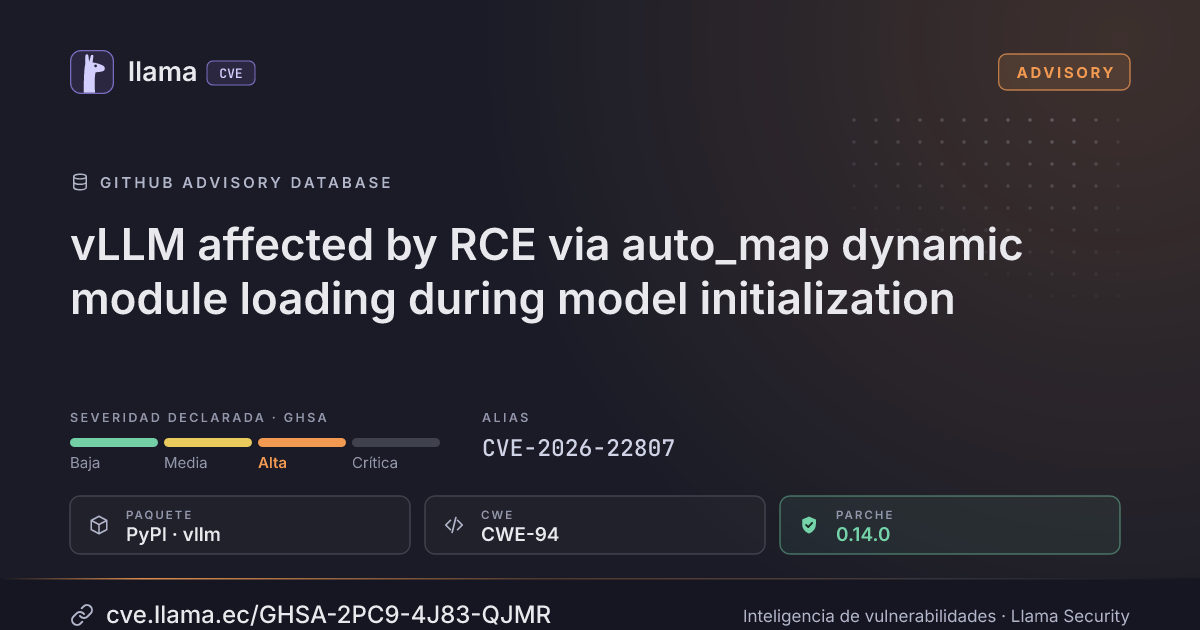
GHSA-2PC9-4J83-QJMR
vLLM affected by RCE via auto_map dynamic module loading during model initialization
Ciclo de vida de la vulnerabilidad
| Fecha | Fase | Evento | Detalle |
|---|---|---|---|
| Remediación | Parche 0.14.0 | vllm · -1 d desde divulgación | |
| Divulgación | Publicada | GHSA-2PC9-4J83-QJMR divulgada | |
| Divulgación | Modificada | Última actualización del registro | |
| Monitoreo | Detectada | Ingresó al índice |
Summary
vLLM loads Hugging Face `auto_map` dynamic modules during model resolution without gating on `trust_remote_code`, allowing attacker-controlled Python code in a model repo/path to execute at server startup.
---
Impact
An attacker who can influence the model repo/path (local directory or remote Hugging Face repo) can achieve arbitrary code execution on the vLLM host during model load.
This happens before any request handling and does not require API access.
---
Affected Versions
All versions where `vllm/model_executor/models/registry.py` resolves `auto_map` entries with `try_get_class_from_dynamic_module` without checking `trust_remote_code` (at least current `main`).
---
Details
During model resolution, vLLM unconditionally iterates `auto_map` entries from the model config and calls `try_get_class_from_dynamic_module`, which delegates to Transformers’ `get_class_from_dynamic_module` and executes the module code.
This occurs even when `trust_remote_code` is `false`, allowing a malicious model repo to embed code in a referenced module and have it executed during initialization.
Relevant code
- `vllm/model_executor/models/registry.py:856` — auto_map resolution
- `vllm/transformers_utils/dynamic_module.py:13` — delegates to `get_class_from_dynamic_module`, which executes code
---
Fixes
- https://github.com/vllm-project/vllm/pull/32194
Credits
Reported by bugbunny.ai
Rangos afectados
Estado del parche por paquete
| Paquete / producto | Estado | Corregida en | Desde divulgación | Última versión |
|---|---|---|---|---|
pypivllm |
Corregida | 0.14.0 | -1 d | 0.34.0 no afectada |
0.14.0Arsenal público
Sin exploits, módulos ni PoC públicos conocidos a la fecha de verificación.
https://nvd.nist.gov/vuln/detail/CVE-2026-22807https://github.com/advisories/GHSA-2pc9-4j83-qjmrhttps://github.com/vllm-project/vllm/security/advisories/GHSA-2pc9-4j83-qjmrhttps://github.com/vllm-project/vllm/pull/32194https://github.com/vllm-project/vllm/commit/78d13ea9de4b1ce5e4d8a5af9738fea71fb024e5https://security.access.redhat.com/data/csaf/v2/vex/2026/cve-2026-22807.jsonhttps://pypi.org/project/vllmhttps://github.com/vllm-project/vllm/releases/tag/v0.14.0https://github.com/vllm-project/vllmhttps://github.com/pypa/advisory-database/tree/main/vulns/vllm/PYSEC-2026-2010.yamlhttps://bugzilla.redhat.com/show_bug.cgi?id=2431865https://access.redhat.com/security/cve/CVE-2026-22807Ver 10 referencias más
https://access.redhat.com/errata/RHSA-2026:5119https://access.redhat.com/errata/RHSA-2026:42644https://access.redhat.com/errata/RHSA-2026:3782https://access.redhat.com/errata/RHSA-2026:3713https://access.redhat.com/errata/RHSA-2026:3462https://access.redhat.com/errata/RHSA-2026:3461https://access.redhat.com/errata/RHSA-2026:30089https://access.redhat.com/errata/RHSA-2026:30088https://access.redhat.com/errata/RHSA-2026:30087https://access.redhat.com/errata/RHSA-2026:10184Las referencias externas se muestran para copiar: cve.llama.ec no lo redirige a otros sitios.