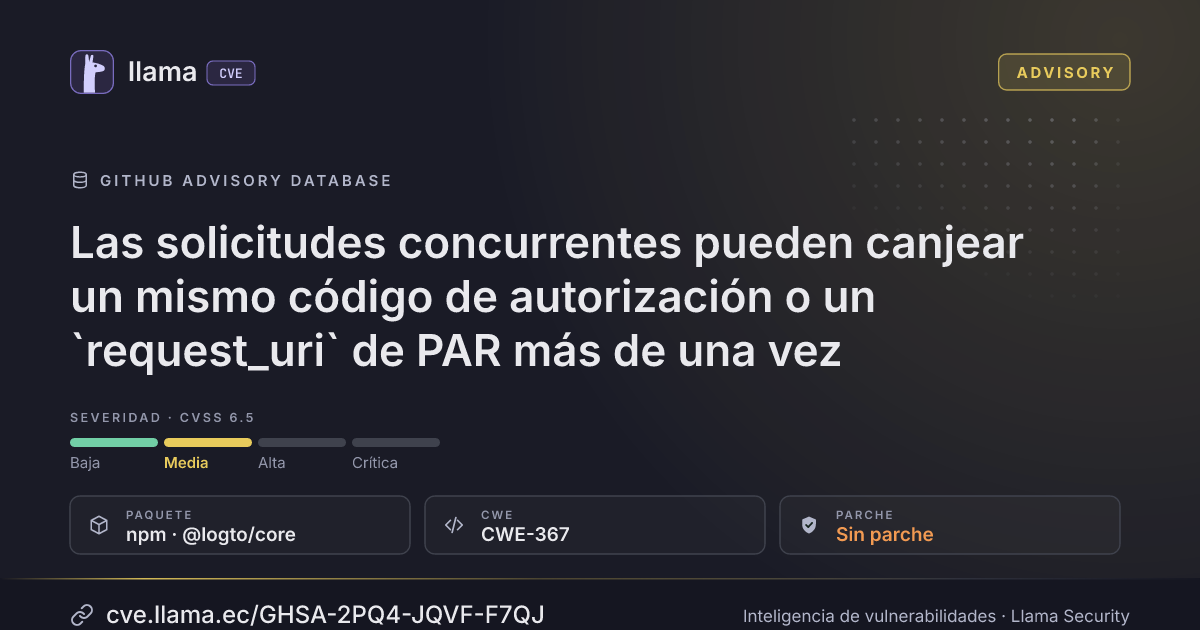
GHSA-2PQ4-JQVF-F7QJ
Concurrent requests can redeem one authorization code or pushed request_uri more than once
Texto original en inglés · Ver en español
CVSS:3.1/AV:N/AC:H/PR:N/UI:N/S:U/C:H/I:L/A:N
Fuente: GitHub
Ciclo de vida de la vulnerabilidad
| Fecha | Fase | Evento | Detalle |
|---|---|---|---|
| Divulgación | Publicada | GHSA-2PQ4-JQVF-F7QJ divulgada · CVSS 6.5 (GitHub) | |
| Monitoreo | Detectada | Ingresó al índice | |
| Monitoreo | Verificada | Última verificación contra las fuentes |
> [!NOTE]
> Also covers GHSA-5w7f-g655-933c (PAR `request_uri`), consolidated here: same root cause, same reporter, same fix. Concurrent requests can redeem one authorization code, or complete authorization with one pushed `request_uri`, more than once.
>
> Severity reconciled to Medium. Every variant needs the attacker to already hold the single-use artifact: PKCE is required for all clients except `client_secret_basic`, so a code is redeemable only with its verifier or the client secret, and a pushed `request_uri` is completed only through the victim's authenticated session. What the race adds is a second redemption that evades single-use and replay detection.
---
### Summary
A Time-of-Check to Time-of-Use (TOCTOU) race condition in Logto's OIDC database adapter allows an attacker to bypass the single-use restriction of OAuth 2.0 Authorization Codes. By sending concurrent token exchange requests, an attacker can redeem a single intercepted authorization code multiple times, resulting in the issuance of multiple distinct access and refresh tokens bound to the victim's identity. This violates RFC 6749 §4.1.2.
### Details
The vulnerability stems from a non-atomic check-then-consume pattern in the OIDC provider's grant handler and Logto's Postgres adapter.
- In the grant handler (`authorization_code.js`), the code checks if `code.consumed` is true (based on a prior `SELECT` query). If false, it calls `code.consume()`.
- In Logto's adapter (`packages/core/src/queries/oidc-model-instance.ts:167-174`), `consumeInstanceById` executes an `UPDATE` statement without a Compare-And-Swap (CAS) guard:
const consumeInstanceById = async (modelName: string, id: string) => {
  await pool.query(sql`
    update ${table}
    set ${fields.consumedAt}=${convertToTimestamp()}
    where ${fields.modelName}=${modelName}
    and ${fields.id}=${id}
    // MISSING: AND ${fields.consumedAt} IS NULL
  `);
};
Under high concurrency, multiple threads can pass the JS-level check before any `UPDATE` commits. Because the `UPDATE` is idempotent and lacks a row-level lock or CAS condition, all concurrent requests succeed, minting distinct tokens for the same code.
PoC
- Victim authenticates and obtains an authorization code via the standard OIDC flow.
- Attacker intercepts the authorization code (e.g., via malicious browser extension, referer leakage, or compromised native app).
- Attacker uses a script to send 8 concurrent `POST /oidc/token` requests using the same code and PKCE verifier, synchronized via a threading barrier.
- Observe: 2 to 3 requests return HTTP 200 with distinct `access_token`, `refresh_token`, and `id_token` values. All minted tokens carry the victim's `sub` claim.
### Impact
Any attacker who can intercept an authorization code can multiply their access by racing the token exchange. This defeats the single-use guarantee, allowing the attacker to establish multiple concurrent sessions as the victim, bypassing downstream rate-limiting or single-session enforcement mechanisms.
Incluye detalles técnicos publicados por el investigador. Úselos solo para validar y corregir sus propios sistemas.
Desglose de métricas
Rangos afectados
Estado del parche por paquete
| Paquete / producto | Estado | Corregida en | Desde divulgación | Última versión |
|---|---|---|---|---|
npm@logto/core |
Sin parche | — | — | — |
Arsenal público
Sin exploits, módulos ni PoC públicos conocidos a la fecha de verificación.
https://github.com/logto-io/logto/security/advisories/GHSA-2pq4-jqvf-f7qjLas referencias externas se muestran para copiar: cve.llama.ec no lo redirige a otros sitios.