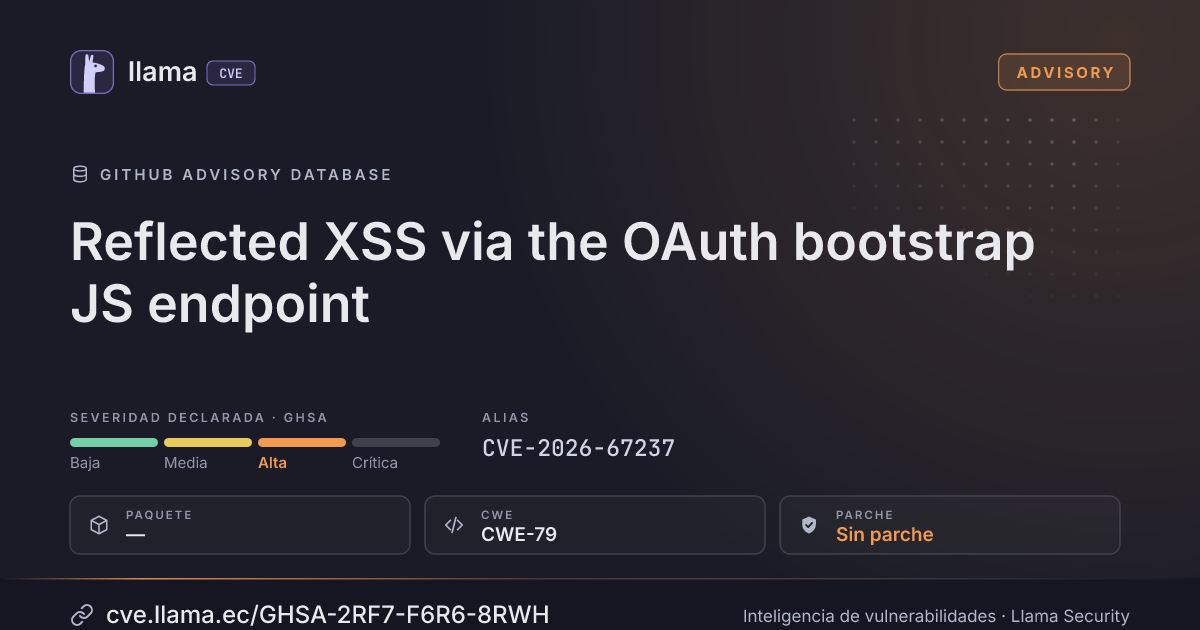
GHSA-2RF7-F6R6-8RWH
Reflected XSS via the OAuth bootstrap JS endpoint
Ciclo de vida de la vulnerabilidad
| Fecha | Fase | Evento | Detalle |
|---|---|---|---|
| Divulgación | Publicada | GHSA-2RF7-F6R6-8RWH divulgada | |
| Divulgación | Modificada | Última actualización del registro | |
| Monitoreo | Detectada | Ingresó al índice | |
| Monitoreo | Verificada | Última verificación contra las fuentes |
Origin
This vulnerability was identified by Team RabbitMQ and/or other teams at Broadcom, not via a responsible disclosure from an external researcher.
Impact
Arbitrary JavaScript execution in the management UI's origin when the victim's browser fetches `bootstrap.js`. The script runs in the same JavaScript realm as the rest of the management UI, giving it full HTTP-API access via the administrator's existing session, including creating new administrator users, exfiltrating definitions, and modifying policies. This is the same blast radius as V-00011 and V-00044 (stored cert-DN XSS) and the canonical browser-side worst case for the management UI.
The endpoint runs unauthenticated by design, because it bootstraps the OAuth UI before login, so the cross-site scripting is reachable pre-auth in OAuth-enabled deployments. Any deployment with `management.oauth_enabled = true` is exposed when an attacker can place a cookie on the host.
Description
`set_token_auth/2` emits JavaScript by string-concatenating an attacker-influenced bearer token directly between single quotes:
%% Before (vulnerable)
["set_token_auth('", Token, "');"]
The `Token` flows from one of two untrusted inputs without any escaping or validation: the `Authorization: Bearer <Token>` header parsed by `cowboy_req:parse_header(<<"authorization">>, Req0)`, whose value is untouched after parsing, and the `access_token` cookie parsed by `cowboy_req:parse_cookies/1`, whose value is also untouched. Any token containing `'`, `</script>`, or a newline breaks out of the JavaScript string literal and yields arbitrary JavaScript executed in the management-UI origin.
Preconditions
Exploitation requires an attacker who can plant an `access_token` cookie on the management host, for example via a sibling subdomain that can write a host-only cookie, or by tricking a victim into visiting a controlled page that performs a cookie-setting redirect through a permissive parent endpoint. The Authorization-header path is harder to weaponise from the browser, but is reachable from any non-browser client that mediates an attacker-controlled request.
---
## CVSS
CVSS v4.0: `CVSS:4.0/AV:N/AC:L/AT:P/PR:N/UI:A/VC:H/VI:H/VA:H/SC:N/SI:N/SA:N` (7.5, High). Fixed in `4.2.8`, `4.3.2`.
Incluye detalles técnicos publicados por el investigador. Úselos solo para validar y corregir sus propios sistemas.
Estado del parche por paquete
La fuente no informa paquetes ni versiones corregidas.
Arsenal público
Sin exploits, módulos ni PoC públicos conocidos a la fecha de verificación.
https://github.com/rabbitmq/rabbitmq-server/security/advisories/GHSA-2rf7-f6r6-8rwhLas referencias externas se muestran para copiar: cve.llama.ec no lo redirige a otros sitios.