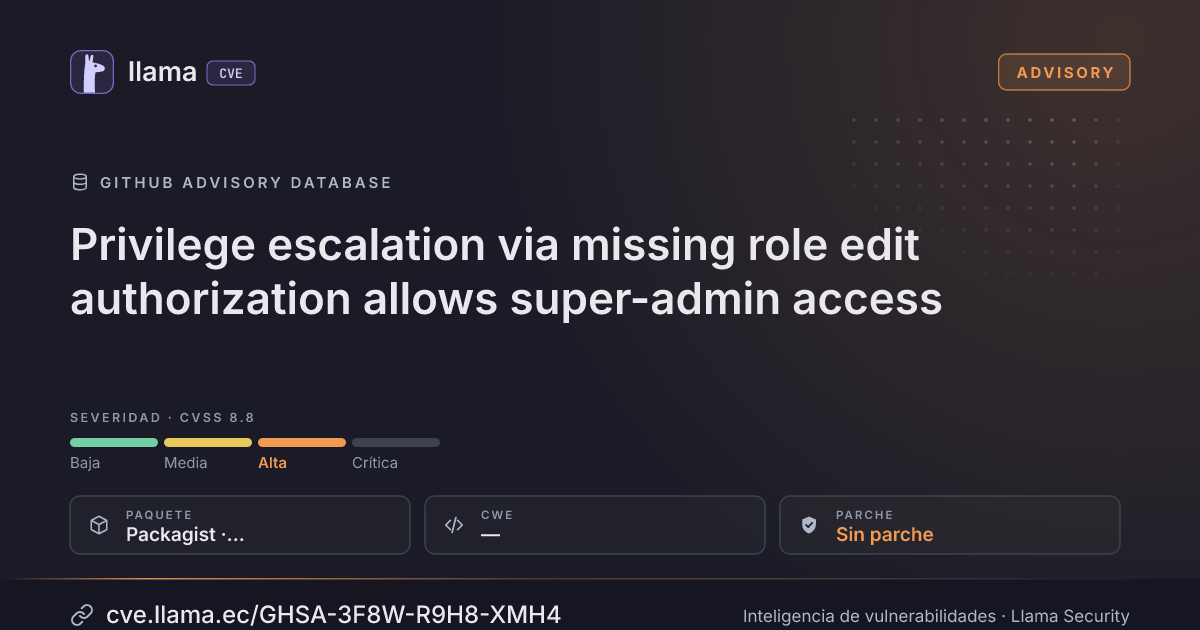
GHSA-3F8W-R9H8-XMH4
Privilege escalation via missing role edit authorization allows super-admin access
CVSS:3.1/AV:N/AC:L/PR:L/UI:N/S:U/C:H/I:H/A:H
Fuente: GitHub
Ciclo de vida de la vulnerabilidad
| Fecha | Fase | Evento | Detalle |
|---|---|---|---|
| Divulgación | Publicada | GHSA-3F8W-R9H8-XMH4 divulgada · CVSS 8.8 (GitHub) | |
| Monitoreo | Detectada | Ingresó al índice | |
| Monitoreo | Verificada | Última verificación contra las fuentes |
Summary
An authenticated admin-panel user with only `admin.roles.viewAny` permission can escalate their privileges to full super-admin by editing their own role and enabling the `All Permissions` option.
`RoleResource::canEdit()` overrides Filament's default authorization behavior and allows editing any role except the protected role with ID 1, without checking the `admin.roles.update` permission.
As a result, a low-privileged staff user can gain unrestricted administrative access, modify customer and financial data, and potentially execute arbitrary server-side code through editable notification templates.
Technical Details
`app/Admin/Resources/RoleResource.php` overrides the default `canEdit()` authorization method:
public static function canEdit(Model $record): bool
{
    return $record->id !== 1;
}
This bypasses the normal `RolePolicy::update()` authorization check, which requires `admin.roles.update`.
Filament's `EditRecord` page relies on `canEdit()` to authorize access and saving:
protected function authorizeAccess(): void
{
    abort_unless(static::getResource()::canEdit($this->getRecord()), 403);
}
Consequently, a staff user with only `admin.roles.viewAny` can access `/admin/roles/{record}/edit` for any role except ID 1, including their own.
The role editor exposes the `All Permissions` (`*`) option, which grants unrestricted permissions through `app/Models/User.php`:
if (in_array('*', $this->role->permissions)) {
    return true;
}
By assigning this permission to their own role, the attacker gains full administrative access without requiring `admin.roles.update`.
Additionally, administrative access includes editing notification templates whose content is processed by the Blade compiler in `app/Mail/Mail.php`:
subject: BladeCompiler::render(
    $this->emailTemplate->subject,
    $this->data
),
Because attacker-controlled Blade templates are rendered server-side, this creates a potential path to arbitrary server-side code execution.
Impact
A low-privileged admin-panel user with only role-viewing permissions can escalate their privileges to full super-admin.
This grants unrestricted access to administrative functionality, including customer accounts, invoices, payment gateways, application settings, extensions, and other sensitive resources.
The attacker can modify or delete financial and customer data, manipulate billing operations, and potentially execute arbitrary server-side code through notification templates.
Exploitation requires an authenticated admin-panel account with `admin.roles.viewAny` permission and an editable role whose ID is not 1. No existing role-editing or super-admin permissions are required.
Incluye detalles técnicos publicados por el investigador. Úselos solo para validar y corregir sus propios sistemas.
Desglose de métricas
Rangos afectados
Estado del parche por paquete
| Paquete / producto | Estado | Corregida en | Desde divulgación | Última versión |
|---|---|---|---|---|
PackagistPaymenter/Paymenter |
Sin parche | — | — | — |
Arsenal público
Sin exploits, módulos ni PoC públicos conocidos a la fecha de verificación.
https://github.com/Paymenter/Paymenter/security/advisories/GHSA-3f8w-r9h8-xmh4Las referencias externas se muestran para copiar: cve.llama.ec no lo redirige a otros sitios.