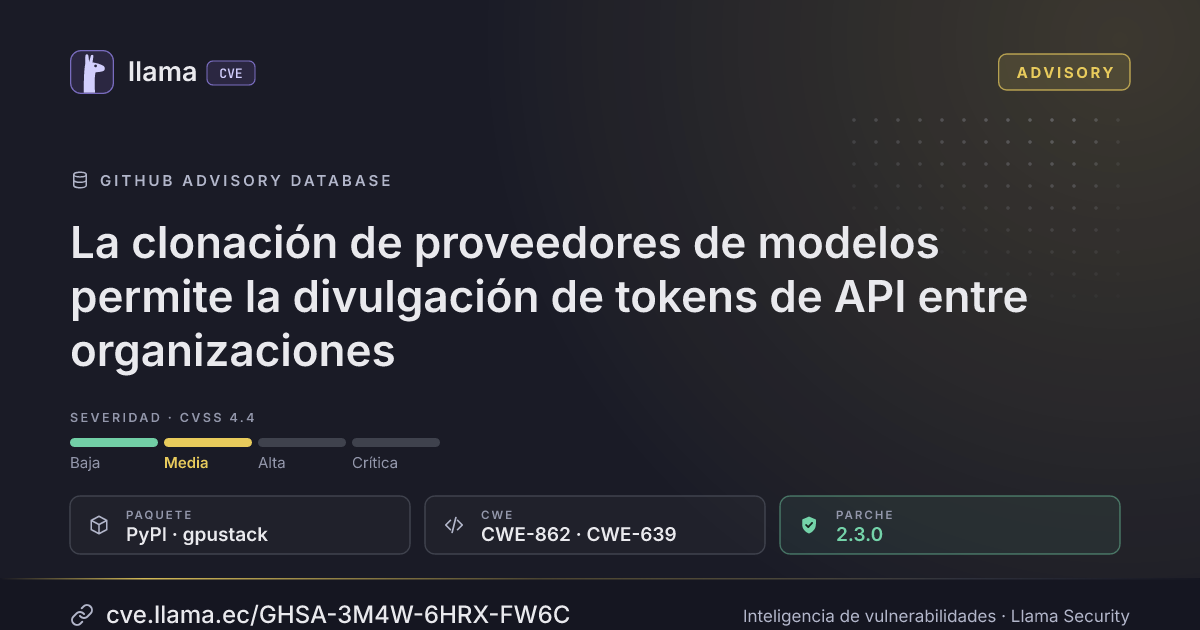
GHSA-3M4W-6HRX-FW6C
Model provider cloning allows cross-organization API token disclosure
Texto original en inglés · Ver en español
CVSS:3.1/AV:N/AC:H/PR:H/UI:N/S:U/C:H/I:N/A:N
Fuente: GitHub
Ciclo de vida de la vulnerabilidad
| Fecha | Fase | Evento | Detalle |
|---|---|---|---|
| Remediación | Parche 2.3.0 | gpustack · -3 d desde divulgación | |
| Divulgación | Publicada | GHSA-3M4W-6HRX-FW6C divulgada · CVSS 4.4 (GitHub) | |
| Monitoreo | Detectada | Ingresó al índice | |
| Monitoreo | Verificada | Última verificación contra las fuentes |
Summary
A missing authorization check in model provider cloning allows an authenticated Organization Owner to copy API tokens from a model provider belonging to another organization on the same GPUStack instance.
Exploitation requires knowledge of the source provider's ID and the SHA-256 hash of a token stored by that provider. The attacker can associate the copied token with an attacker-controlled provider endpoint and cause GPUStack to disclose the plaintext credential.
Deployment scope
This vulnerability affects cross-organization isolation in deployments with multiple organizations.
The open-source UI does not expose multi-organization management. However, the backend includes organization management APIs, so the absence of this UI does not by itself exclude a deployment from the affected scope. Organization creation requires platform administrator privileges; this vulnerability does not allow ordinary users to create organizations.
Deployments operating solely within a single organization are not affected by the cross-organization attack described here.
Details
The model provider creation API accepts a `clone_from_id` parameter. In affected versions, it loads the source provider without verifying that the caller is authorized to access it before reusing its API tokens.
The token reuse mechanism identifies stored tokens by their SHA-256 hashes. Because the new provider's configuration is supplied independently by the caller, a copied token can be associated with an attacker-controlled endpoint. Subsequent provider requests can disclose the plaintext token to that endpoint.
The vulnerable clone path also accepts soft-deleted source providers whose tokens remain stored.
Exploitation requirements
An attacker must:
- Hold the Organization Owner role in an organization on the same GPUStack instance.
- Know the target provider's ID and the SHA-256 hash of a token still stored by that provider.
- Be able to cause GPUStack to send a provider request to an endpoint controlled by the attacker.
Provider API responses represent stored tokens by their SHA-256 hashes. An attacker may retain these values from previously authorized access or obtain them through a separate information disclosure vulnerability.
Knowing a provider ID alone is insufficient to recover its tokens. Each token selected for copying requires its corresponding hash.
Impact
Successful exploitation exposes the plaintext of the selected upstream provider API token. The attacker can use that credential outside GPUStack with the permissions granted by the upstream provider, potentially including unauthorized API usage and charges to the victim.
Removing a user's membership in the source organization does not prevent exploitation if the user remains an Organization Owner elsewhere on the instance and retains the required provider ID and token hash.
Affected versions and patches
The affected backend authorization boundary was introduced in GPUStack v2.2.0. Deployments running affected versions with the configuration and prerequisites described above are vulnerable.
The vulnerability is fixed in v2.3.0. The fix verifies the caller's access to the source provider before copying any tokens and rejects soft-deleted source providers.
Upgrade to v2.3.0 or another release containing the fix.
Workarounds
Until an upgrade is possible, restrict the Organization Owner role to trusted users. This reduces exposure but does not correct the missing authorization check.
Where operationally feasible, restrict outbound connections from GPUStack to trusted upstream provider endpoints. This can reduce opportunities for credential exfiltration but does not prevent unauthorized token copying.
Credential recovery
If exposure is suspected, revoke affected credentials at the upstream provider and replace them in GPUStack. Updating or deleting a provider in GPUStack does not revoke its upstream credentials.
Upgrading prevents further unauthorized cloning but does not invalidate credentials already copied or disclosed. Credential rotation alone is not a substitute for applying the fix.
Incluye detalles técnicos publicados por el investigador. Úselos solo para validar y corregir sus propios sistemas.
Desglose de métricas
Rangos afectados
Estado del parche por paquete
| Paquete / producto | Estado | Corregida en | Desde divulgación | Última versión |
|---|---|---|---|---|
pypigpustack |
Corregida | 2.3.0 | -3 d | 2.3.1 no afectada |
2.3.0Arsenal público
Sin exploits, módulos ni PoC públicos conocidos a la fecha de verificación.
https://github.com/gpustack/gpustack/security/advisories/GHSA-3m4w-6hrx-fw6cLas referencias externas se muestran para copiar: cve.llama.ec no lo redirige a otros sitios.