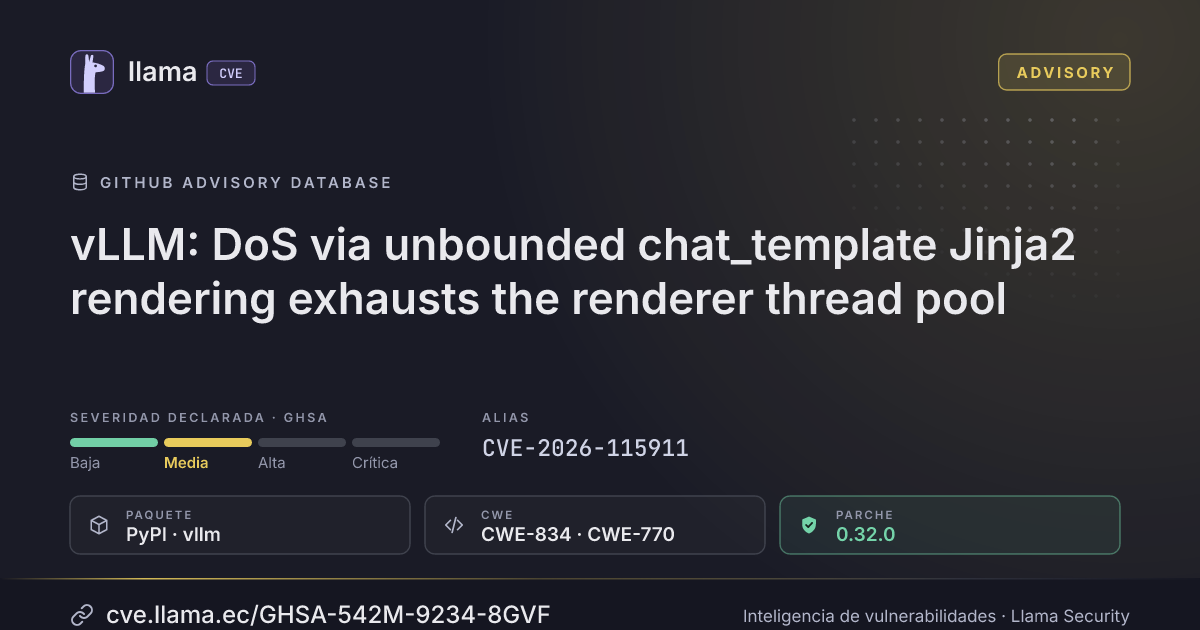
GHSA-542M-9234-8GVF
vLLM: DoS via unbounded chat_template Jinja2 rendering exhausts the renderer thread pool
Ciclo de vida de la vulnerabilidad
| Fecha | Fase | Evento | Detalle |
|---|---|---|---|
| Remediación | Parche 0.32.0 | vllm · -10 d desde divulgación | |
| Divulgación | Publicada | GHSA-542M-9234-8GVF divulgada | |
| Divulgación | Modificada | Última actualización del registro | |
| Monitoreo | Detectada | Ingresó al índice |
### Summary
vLLM renders chat templates by passing the resolved Jinja2 source to `tokenizer.apply_chat_template()`, which compiles and `.render()`s it in an `ImmutableSandboxedEnvironment`. The sandbox prevents code-execution escapes but imposes no wall-clock timeout, no output-size cap, and no nested-loop or binop limit. The render runs in a `ThreadPoolExecutor` whose `max_workers` defaults to 1, and CPython worker threads cannot be interrupted. An authenticated API client (or a malicious model repo loaded with `trust_remote_code=False`) can therefore submit a single short template and permanently wedge all chat-style endpoints (`/v1/chat/completions`, `/v1/responses`, `/tokenize`, `/pooling`-chat, `/invocations`-chat) for every tenant until the process is restarted. A string-multiplication variant instead OOM-kills the API-server process. Because of a separately-reported (GHSA-jmjw-q4x3-hmc2) gate omission on `/v1/responses`, the remote authenticated attacker vector works in default `vllm serve` configuration with no operator opt-in.
### Impact
A single authenticated request of <100 bytes permanently denies all chat-style inference (`/v1/chat/completions`, `/v1/responses`, `/tokenize`, `/pooling`-chat, `/invocations`-chat) to every tenant of the API-server replica until the operator restarts the process. The string-multiplication variant OOM-kills the process. In a multi-tenant deployment this is a cross-tenant denial-of-service from any one tenant. From the malicious-model angle, a model repo whose `tokenizer_config.json` carries the hostile template wedges every replica that loads it on the first legitimate chat request, with `trust_remote_code=False`.
Preconditions: any non-harmony model (`model_type != gpt_oss`); `renderer_num_workers` at its default of 1; for the default-config authenticated API attacker vector, `--chat-template` must be unset (the default because most HF models ship their own).
Blast radius: API-server process, per replica. Engine/worker processes unaffected by the CPU variant (event loop survives); affected by the memory variant (process OOM).
Persistence: until process restart. Survives client disconnect.
This advisory was fixed in MR50300 https://github.com/vllm-project/vllm/pull/50300.
Rangos afectados
Estado del parche por paquete
| Paquete / producto | Estado | Corregida en | Desde divulgación | Última versión |
|---|---|---|---|---|
pypivllm |
Corregida | 0.32.0 | -10 d | 0.34.0 no afectada |
0.32.0Arsenal público
Sin exploits, módulos ni PoC públicos conocidos a la fecha de verificación.
https://nvd.nist.gov/vuln/detail/CVE-2026-115911https://github.com/vllm-project/vllm/security/advisories/GHSA-542m-9234-8gvfhttps://github.com/vllm-project/vllm/pull/50300https://github.com/vllm-project/vllm/commit/cff08b461e086523cee8bba5bd3c66d302625134https://github.com/vllm-project/vllmhttps://github.com/vllm-project/vllm/releases/tag/v0.32.0Las referencias externas se muestran para copiar: cve.llama.ec no lo redirige a otros sitios.