GHSA-57QX-69P6-3W3G
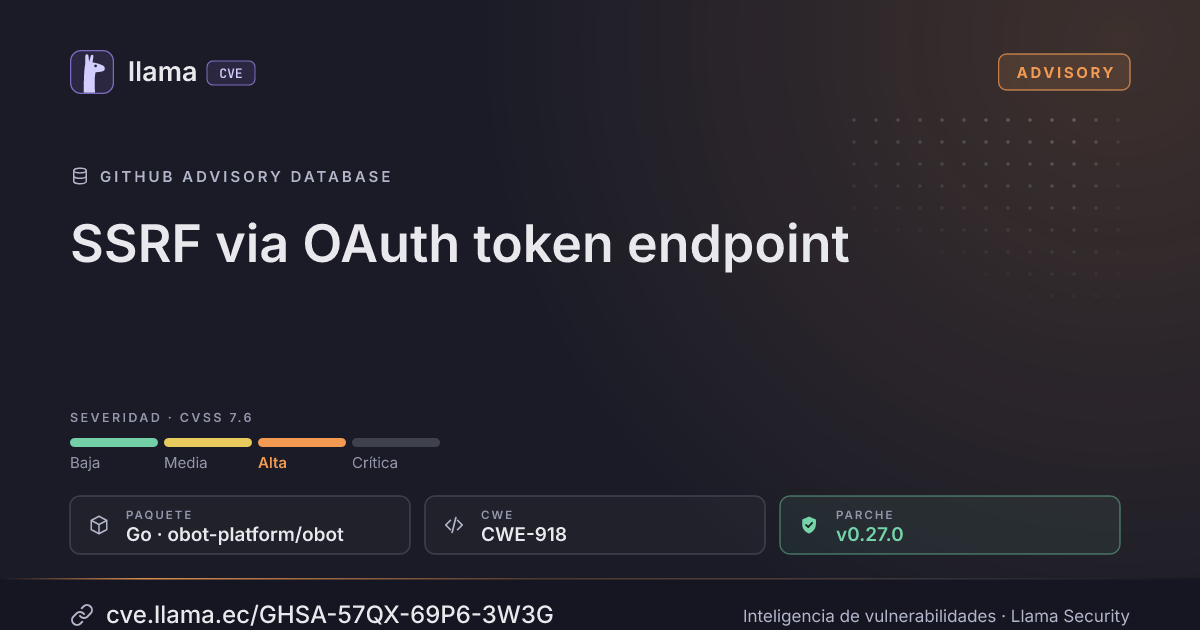
SSRF via OAuth token endpoint
CVSS:3.1/AV:N/AC:L/PR:H/UI:N/S:C/C:H/I:L/A:N
Fuente: GitHub
Ciclo de vida de la vulnerabilidad
| Fecha | Fase | Evento | Detalle |
|---|---|---|---|
| Remediación | Parche v0.27.0 | github.com/obot-platform/obot · -11 d desde divulgación | |
| Divulgación | Publicada | GHSA-57QX-69P6-3W3G divulgada · CVSS 7.6 (GitHub) | |
| Divulgación | Modificada | Última actualización del registro | |
| Monitoreo | Detectada | Ingresó al índice | |
| Monitoreo | Verificada | Última verificación contra las fuentes |
Summary
When Obot exchanged or refreshed OAuth tokens for a remote MCP server, it sent the request to the token endpoint advertised by that server's OAuth metadata without applying Obot's outbound network protections. A user able to register a remote MCP server could advertise a token endpoint on an internal address, such as a cloud metadata service or a private-network host, and cause Obot to send requests to it. If the internal service answered with an error status, its response body was returned to the attacker in the resulting error message.
Am I affected?
You are affected if you run Obot <= v0.26.3. Exploiting it requires an account that can add remote MCP servers (Power User or higher), pointing at a host the attacker controls. The attacker can complete the OAuth flow themselves, and no action by another user is required.
Details
The fix for GHSA-jgh3-fggc-mcpm put egress checks on remote MCP connections and OAuth metadata discovery, but the OAuth token exchange and token refresh requests did not get them. They used an unrestricted default HTTP client, which also followed redirects. The token endpoint URL comes from the metadata document returned by the remote server and was never validated, so a server that passed the registration checks could still direct token requests to an internal address. Token refresh repeated the request each time a token expired. Releases before v0.23.0 had no outbound protections for these requests at all.
Impact
An attacker could make the Obot server send requests to hosts on its internal network or to a cloud instance metadata service. When the internal service responded with a non-success status, the attacker could read its response body in the error returned by the OAuth callback; successful responses were not returned. The attacker controls the full destination URL. The request is an OAuth token POST, but because redirects were followed, the attacker's endpoint could also redirect Obot into sending GET requests to internal addresses. The attacker cannot set arbitrary request headers.
Mitigation
Upgrade to v0.27.0 or later. In that release, all OAuth discovery, client registration, token exchange and token refresh requests go through Obot's egress-checked client, which applies the administrator's egress policy (or the server's tunnel, if one is configured) and blocks internal destinations by default. These requests also no longer carry the MCP server's configured headers or the backend-specific egress exceptions used for MCP connections. If a token request has no client configured, Obot uses a strict egress client instead of the default client.
Severity
CVSS v3.1 Score: 7.6/10 (High) — `CVSS:3.1/AV:N/AC:L/PR:H/UI:N/S:C/C:H/I:L/A:N`
Credits
The Obot team would like to thank @manus-use https://github.com/manus-use for responsibly disclosing this issue in accordance with our security policy https://github.com/obot-platform/obot/?tab=security-ov-file.
Incluye detalles técnicos publicados por el investigador. Úselos solo para validar y corregir sus propios sistemas.
Desglose de métricas
Rangos afectados
Estado del parche por paquete
| Paquete / producto | Estado | Corregida en | Desde divulgación | Última versión |
|---|---|---|---|---|
gogithub.com/obot-platform/obot |
Corregida | v0.27.0 | -11 d | v0.28.1 no afectada |
v0.27.0Arsenal público
Sin exploits, módulos ni PoC públicos conocidos a la fecha de verificación.
https://github.com/obot-platform/obot/security/advisories/GHSA-57qx-69p6-3w3gLas referencias externas se muestran para copiar: cve.llama.ec no lo redirige a otros sitios.