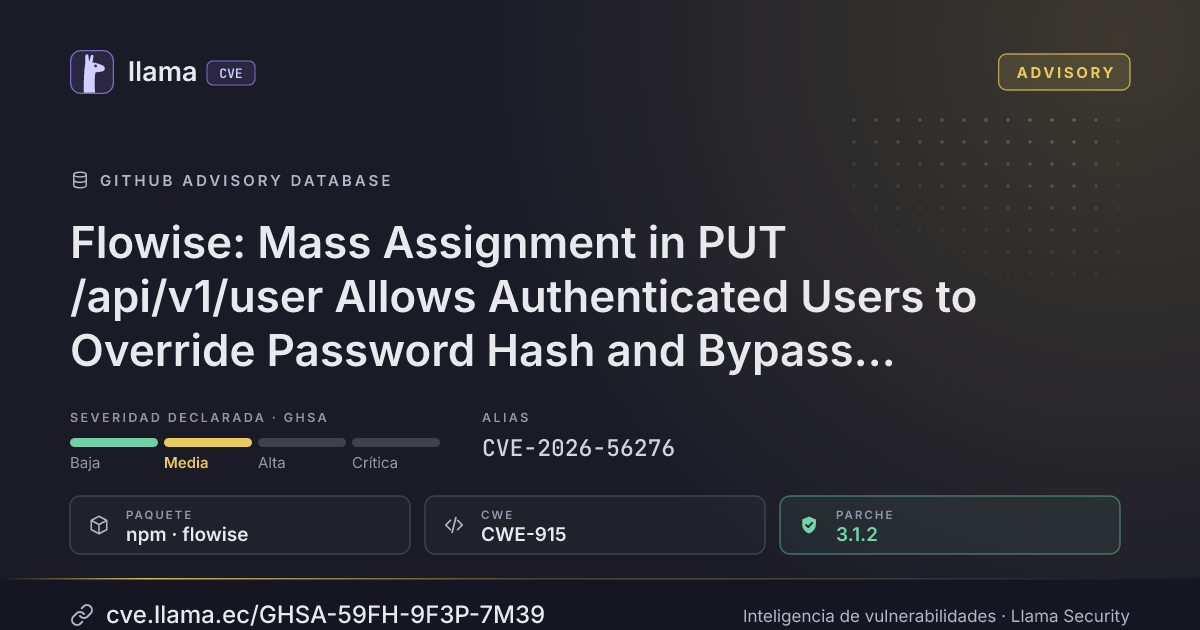
GHSA-59FH-9F3P-7M39
Flowise: Mass Assignment in PUT /api/v1/user Allows Authenticated Users to Override Password Hash and Bypass Password Change Verification
Ciclo de vida de la vulnerabilidad
| Fecha | Fase | Evento | Detalle |
|---|---|---|---|
| Remediación | Parche 3.1.2 | flowise · -36 d desde divulgación | |
| Divulgación | Publicada | GHSA-59FH-9F3P-7M39 divulgada | |
| Divulgación | Modificada | Última actualización del registro | |
| Monitoreo | Detectada | Ingresó al índice |
### Summary
A Mass Assignment vulnerability in the PUT /api/v1/user endpoint allows authenticated users to directly modify restricted user fields, including the credential (password hash), bypassing the intended password change workflow.
Because the endpoint forwards the entire request body to the service layer without filtering, an attacker can override the credential field without providing the current password.
This bypasses several security protections including:
- old password verification
- password hashing enforcement
- password policy validation
- session invalidation on password change
While the vulnerability cannot be used to modify other users due to an ID check in the controller, it allows attackers who obtain a temporary session (e.g., via token theft or XSS) to establish persistent account access.
### Details
The endpoint PUT /api/v1/user allows authenticated users to update their user profile.
The controller checks that the authenticated user matches the provided id, preventing direct IDOR:
const currentUser = req.user
const { id } = req.body

if (currentUser.id !== id) {
    throw new InternalFlowiseError(StatusCodes.FORBIDDEN)
}
However, the controller forwards the entire request body directly to the service layer without filtering:
const user = await userService.updateUser(req.body)Inside UserService.updateUser, the incoming data is merged into the existing user entity:
updatedUser = queryRunner.manager.merge(User, oldUserData, newUserData)Because newUserData is derived from req.body and there is no field allowlist, any field present in the User entity may be modified.
This includes sensitive fields such as:
- credential
- tempToken
- tokenExpiry
- status
The service implements a secure password change workflow that requires the following fields:
oldPassword
newPassword
confirmPassword
Example code:
if (newUserData.oldPassword && newUserData.newPassword && newUserData.confirmPassword) {
    if (!compareHash(newUserData.oldPassword, oldUserData.credential)) {
        throw new InternalFlowiseError(StatusCodes.BAD_REQUEST)
    }

    newUserData.credential = this.encryptUserCredential(newUserData.newPassword)
}
However, this logic can be bypassed by directly supplying a credential value in the request body.
Because the merge operation applies all fields from newUserData, the supplied credential hash will overwrite the stored password hash.
### PoC
Step 1 - Authenticate
Login as any normal user and obtain a valid JWT token.
POST /api/v1/auth/login
Step 2 - Generate a password hash
Generate a bcrypt hash for a password you control.
Example:
bcrypt("attacker_password")
Example hash:
$2b$10$abc123examplehashvalue...
Step 3 - Send crafted update request
PUT /api/v1/user
Authorization: Bearer <JWT_TOKEN>
Content-Type: application/json

{
  "id": "<your-user-id>",
  "credential": "$2b$10$abc123examplehashvalue..."
}
Step 4 - Login with attacker password
The password hash in the database is replaced by the supplied value.
The attacker can now authenticate using:
attacker_password
without ever providing the previous password.
### Impact
This vulnerability allows authenticated users to bypass the password change security controls.
Security protections that are bypassed include:
current password verification
password hashing enforcement
password policy validation
session invalidation on password change
Although the controller prevents modification of other users' accounts, the vulnerability enables persistence after account compromise.
Example attack scenario:
- An attacker temporarily obtains a user's session (XSS, token leak, shared device, etc.)
- The attacker sends the crafted update request with a new password hash
- The attacker now permanently controls the account
- Authentication logic bypass
- Privilege persistence after compromise
- Weak account recovery guarantees
Incluye detalles técnicos publicados por el investigador. Úselos solo para validar y corregir sus propios sistemas.
Rangos afectados
Estado del parche por paquete
| Paquete / producto | Estado | Corregida en | Desde divulgación | Última versión |
|---|---|---|---|---|
npmflowise |
Corregida | 3.1.2 | -36 d | 3.1.4 no afectada |
3.1.2Arsenal público
Sin exploits, módulos ni PoC públicos conocidos a la fecha de verificación.
https://github.com/FlowiseAI/Flowise/security/advisories/GHSA-59fh-9f3p-7m39https://github.com/FlowiseAI/FlowiseLas referencias externas se muestran para copiar: cve.llama.ec no lo redirige a otros sitios.