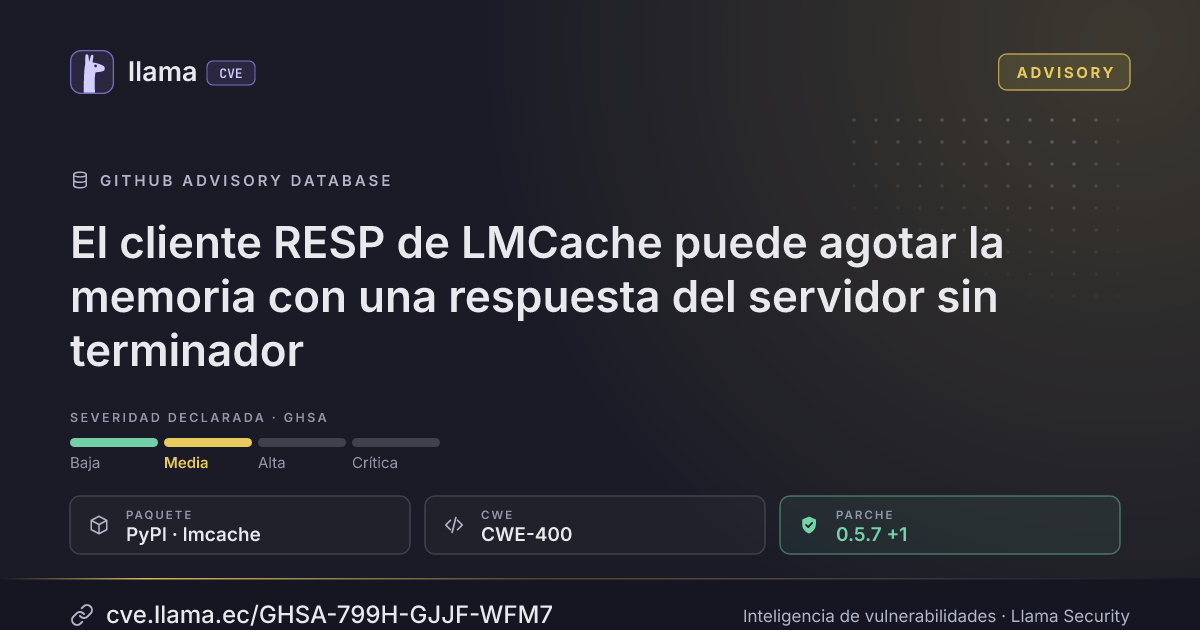
GHSA-799H-GJJF-WFM7
LMCache RESP client can exhaust memory on unterminated server response
Texto original en inglés · Ver en español
Ciclo de vida de la vulnerabilidad
| Fecha | Fase | Evento | Detalle |
|---|---|---|---|
| Remediación | Parche 0.5.7.post1 | lmcache · -6 d desde divulgación | |
| Divulgación | Publicada | GHSA-799H-GJJF-WFM7 divulgada | |
| Monitoreo | Detectada | Ingresó al índice | |
| Monitoreo | Verificada | Última verificación contra las fuentes |
Summary
The C++ RESP client reads a response line without a maximum length. A server reached through a configured resp:// endpoint can send data without CRLF indefinitely, causing unbounded memory growth and process-level denial of service. Moderate severity; exploitation requires control or interception of the configured Redis endpoint. redis:// deployments using redis-py are not affected.
Details
In csrc/redis/resp.cpp, WorkerConn::recv_line() reads one byte at a time and appends it to std::string until CRLF, with no size limit. This is called while authenticating a RESP connection. A malicious endpoint can respond to AUTH with a continuous stream lacking CRLF, causing the client to keep allocating memory. See Jira report LM-944 for the original reproduction and call path.
Proof of concept
Configure LMCache to use a resp:// endpoint with authentication. Point it at a TCP server that accepts the AUTH command and continuously sends bytes without a CRLF terminator. The RESP client's recv_line() continues appending the response; observe steadily increasing process memory until the connection closes or the process is terminated. The Jira report includes a Python socket-based reproduction of the same unbounded-read algorithm.
Impact
An attacker able to control or intercept the Redis server endpoint used by an LMCache deployment can cause the client process to consume unbounded memory and become unavailable or be killed by the OOM killer. This affects deployments using the C++ resp:// protocol path; redis:// connections using redis-py are not affected. The report identifies denial of service as the supported impact; no evidence establishes code execution.
Incluye detalles técnicos publicados por el investigador. Úselos solo para validar y corregir sus propios sistemas.
Rangos afectados
Estado del parche por paquete
| Paquete / producto | Estado | Corregida en | Desde divulgación | Última versión |
|---|---|---|---|---|
pypilmcache |
Corregida | 0.5.7.post1 | -6 d | 0.5.7.post1 no afectada |
0.5.7.post10.5.7Arsenal público
Sin exploits, módulos ni PoC públicos conocidos a la fecha de verificación.
https://github.com/LMCache/LMCache/security/advisories/GHSA-799h-gjjf-wfm7Las referencias externas se muestran para copiar: cve.llama.ec no lo redirige a otros sitios.