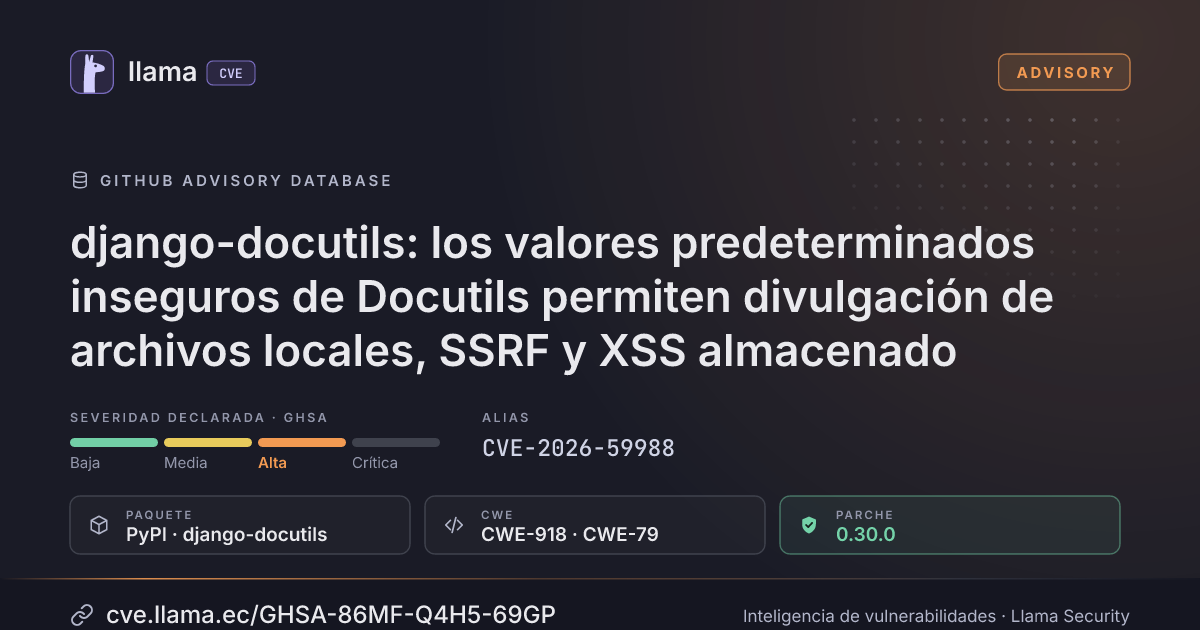
GHSA-86MF-Q4H5-69GP
django-docutils unsafe Docutils defaults allow local file disclosure, SSRF, and stored XSS
Ciclo de vida de la vulnerabilidad
| Fecha | Fase | Evento | Detalle |
|---|---|---|---|
| Divulgación | Publicada | GHSA-86MF-Q4H5-69GP divulgada | |
| Divulgación | Modificada | Última actualización del registro | |
| Monitoreo | Detectada | Ingresó al índice | |
| Monitoreo | Verificada | Última verificación contra las fuentes |
Summary
django-docutils before `0.30.0` rendered reStructuredText through Docutils without protected web-safe defaults. Public rendering paths, including `publish_doctree`, `publish_html_from_source`, `publish_html_from_doctree`, `publish_parts_from_doctree`, the `{% rst %}` template tag, the `rst` template filter, `DocutilsTemplates`, and `DocutilsView`, could process attacker-controlled RST with Docutils directives that read local files, fetch URL-backed content, or emit raw HTML.
The issue is fixed in `0.30.0` by disabling Docutils file insertion, raw directives, local `docutils.conf` processing, and unsafe URI schemes by default, and by sanitizing doctrees before HTML is emitted.
Applications are affected when they render attacker-controlled or lower-trust RST through django-docutils without their own safe Docutils configuration. Applications that only render trusted static RST are not affected unless that content can be influenced by an attacker.
Impact
An attacker who can influence RST rendered by a vulnerable django-docutils integration may be able to read files readable by the Django worker process, trigger server-side requests through URL-backed directives, or inject raw HTML/JavaScript into rendered output.
Examples of affected application patterns include comments, wiki pages, blog bodies, profile or biography fields, CMS fields, uploaded RST documents, API-supplied RST, or overridden view content methods that return user-supplied RST.
Potential impact includes disclosure of application configuration, environment files, credentials, source files, templates, mounted secrets, and logs readable by the process. UI escaping after rendering is not sufficient for file disclosure because the server-side read occurs before HTML reaches the client.
Affected versions
Affected package: `django-docutils` on PyPI
Affected versions: `<= 0.29.0`
Patched versions: `>= 0.30.0`
Technical details
Before `0.30.0`, django-docutils handed RST content to Docutils without forcing these web-safe settings:
{
    "file_insertion_enabled": False,
    "raw_enabled": False,
    "_disable_config": True,
}
Docutils treats file insertion and raw content as legitimate features for trusted documents. In a web application that renders lower-trust RST, those defaults can expose server-side data or emit attacker-controlled HTML unless the application disables the features.
The vulnerable behavior included:
- `.. include:: <file>` reading local files
- `.. include:: <url>` fetching URL-backed content server-side
- `.. csv-table:: :file:` reading local files
- `.. csv-table:: :url:` fetching URL-backed content server-side
- `.. raw:: html` emitting unescaped HTML
- `.. raw:: html :file:` reading and emitting file-backed raw content
- local `docutils.conf` configuration re-enabling unsafe behavior
Proof of concept
This minimal harness uses the public `{% rst %}` template tag. On vulnerable versions, the include directive expands server-side and the raw directive emits unescaped HTML. On fixed versions, both directives are disabled under the default configuration.
import django
from django.conf import settings

settings.configure(
    INSTALLED_APPS=["django_docutils"],
    TEMPLATES=[{
        "BACKEND": "django.template.backends.django.DjangoTemplates",
        "DIRS": [], "APP_DIRS": False,
        "OPTIONS": {"libraries": {"dj": "django_docutils.templatetags.django_docutils"}},
    }],
    # DJANGO_DOCUTILS_LIB_RST intentionally unset == default install.
)
django.setup()

from django.template import engines

dj = engines["django"]

def render_user_rst(rst: str) -> str:
    return dj.from_string("{% load dj %}{% rst content %}").render({"content": rst})

print(render_user_rst(".. include:: /etc/passwd\n"))
print(render_user_rst(".. raw:: html\n\n   <b>x</b>\n"))
Expected behavior on vulnerable releases such as `0.28.0` and `0.29.0`:
The include directive emits readable file contents.
The raw directive emits <b>x</b> as HTML.
Expected behavior on fixed releases such as `0.30.0` and later:
The include directive is disabled.
The raw directive is disabled.
Remediation
Upgrade to django-docutils `0.30.0` or later.
For trusted static RST that intentionally depends on unsafe Docutils features, opt in explicitly:
DJANGO_DOCUTILS_LIB_RST = {
    "allow_unsafe_docutils_settings": True,
    "docutils": {
        "raw_enabled": True,
        "file_insertion_enabled": True,
        "_disable_config": False,
    },
}
Do not enable unsafe Docutils settings for comments, profile text, CMS fields, uploaded files, API request data, or other lower-trust content.
Note: `django-docutils==0.30.0` has an undeclared runtime dependency on `typing-extensions`; install it alongside if your environment doesn't already provide it (tracked separately as a packaging fix).
Related
- django-docutils documentation: <https://django-docutils.git-pull.com>
- django-docutils 0.30.0:
- <https://django-docutils.git-pull.com/history/#django-docutils-0-30-0-2026-06-07>
- <https://github.com/tony/django-docutils/blob/v0.30.0/CHANGES#django-docutils-0300-2026-06-07>
- django-docutils security topic: <https://django-docutils.git-pull.com/topics/security/>
- django-docutils changelog: <https://django-docutils.git-pull.com/history/>
- django-docutils PyPI: <https://pypi.org/project/django-docutils/>
- django-docutils source repository: <https://github.com/tony/django-docutils>
- Docutils security guide: <https://docutils.sourceforge.io/docs/howto/security.html>
- Docutils configuration reference: <https://docutils.sourceforge.io/docs/user/config.html>
- Django security overview: <https://docs.djangoproject.com/en/stable/topics/security/>
- Related NiceGUI advisory for the same Docutils sink pattern: <https://github.com/advisories/GHSA-jfrm-rx66-g536>
- Related NiceGUI CVE entry: <https://nvd.nist.gov/vuln/detail/CVE-2026-45553>
Credit
Thanks to the reporters who disclosed and helped characterize this issue.
Incluye detalles técnicos publicados por el investigador. Úselos solo para validar y corregir sus propios sistemas.
Rangos afectados
Estado del parche por paquete
| Paquete / producto | Estado | Corregida en | Desde divulgación | Última versión |
|---|---|---|---|---|
PyPIdjango-docutils |
Corregida | 0.30.0 | — | — |
0.30.0Arsenal público
Sin exploits, módulos ni PoC públicos conocidos a la fecha de verificación.
https://nvd.nist.gov/vuln/detail/CVE-2026-59988https://github.com/tony/django-docutils/security/advisories/GHSA-86mf-q4h5-69gphttps://github.com/tony/django-docutils/pull/457https://github.com/tony/django-docutils/commit/274caaf14c2368fafeb45f178094a34ba538f067https://github.com/tony/django-docutils/commit/57fd751a10ce2969e4ca2bde6a9094fa2e2ba0ddhttps://github.com/tony/django-docutilshttps://github.com/tony/django-docutils/blob/v0.30.0/CHANGESLas referencias externas se muestran para copiar: cve.llama.ec no lo redirige a otros sitios.