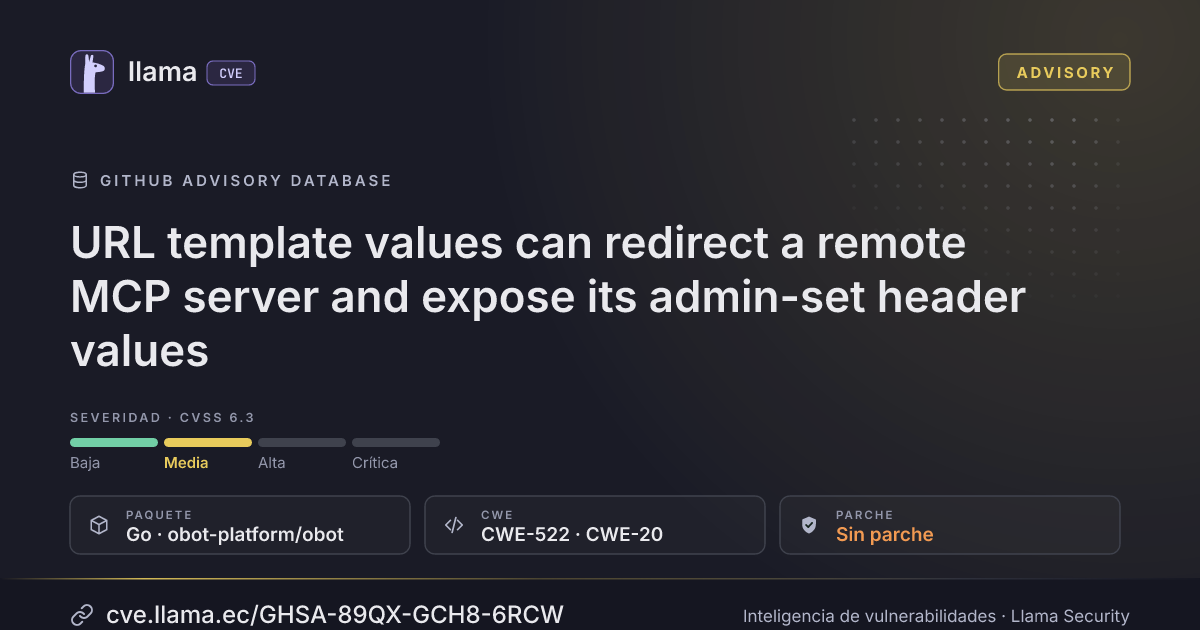
GHSA-89QX-GCH8-6RCW
URL template values can redirect a remote MCP server and expose its admin-set header values
CVSS:3.1/AV:N/AC:H/PR:L/UI:N/S:C/C:H/I:N/A:N
Fuente: GitHub
Ciclo de vida de la vulnerabilidad
| Fecha | Fase | Evento | Detalle |
|---|---|---|---|
| Divulgación | Publicada | GHSA-89QX-GCH8-6RCW divulgada · CVSS 6.3 (GitHub) | |
| Monitoreo | Detectada | Ingresó al índice | |
| Monitoreo | Verificada | Última verificación contra las fuentes |
Summary
When a remote MCP catalog entry used a URL template, Obot substituted user-supplied values into the template without checking that the resulting URL still pointed at the host the admin intended. A user granted such an entry could supply a value that moved the connection to a host they control, and Obot sent the entry's admin-set static header values, such as a shared API key or bearer token, to that host.
Am I affected?
Obot releases `>= v0.12.0, <= v0.28.1` are affected if you have a remote catalog entry that meets all of these conditions:
- It uses a URL template with a user-supplied variable in the host part of the URL, such as `https://${REGION}.api.example.com/mcp`.
- It has at least one header with an admin-set static value.
- It is available to users who should not see that header value.
Entries with a fixed URL or a hostname restriction are not affected, and neither are template variables limited to a list of options.
Details
Entries that let users supply a full URL under a fixed hostname check the user's URL against that hostname, but URL templates had no equivalent check. Template values were inserted into the URL as plain text, so a value containing URL syntax, such as `attacker.example/x?`, could change which host the URL pointed to. A value that completed the end of a hostname could also change its domain. Obot then attached all of the entry's admin-configured headers to the connection. GHSA-q5wf-87f5-cxgq stopped returning static header values through the API; this issue exposes the same values through the outbound connection instead, so it remained exploitable after that fix.
Impact
A user who may use an affected entry could obtain the values of its admin-set headers and use them outside Obot with whatever access they grant on the upstream service. The attacker can only obtain header values attached to entries they are already allowed to use. Servers that authenticate each user with their own OAuth tokens are not affected, and the attacker gains no additional access within Obot.
Mitigation
Upgrade to v0.28.2 or later. The fixed release requires a URL built from a template to keep the scheme and host the admin wrote: values may fill a host label or port, but cannot add a new host or path. Unless the template makes the entire host a variable, the hostname's domain must come from the admin's literal template text. The check is applied when configuration is submitted and when a connection is built, so values saved before the upgrade are also rejected. Templates that intentionally let users choose the entire host, such as `https://${SERVER}`, still accept any host, so admins should not attach static header values to them.
Severity
CVSS v3.1 Score: 6.3/10 (Medium) — `CVSS:3.1/AV:N/AC:H/PR:L/UI:N/S:C/C:H/I:N/A:N`
Credits
The Obot team would like to thank @jakub2929 https://github.com/jakub2929 for responsibly disclosing this issue in accordance with our security policy https://github.com/obot-platform/obot/?tab=security-ov-file.
Incluye detalles técnicos publicados por el investigador. Úselos solo para validar y corregir sus propios sistemas.
Desglose de métricas
Rangos afectados
Estado del parche por paquete
| Paquete / producto | Estado | Corregida en | Desde divulgación | Última versión |
|---|---|---|---|---|
gogithub.com/obot-platform/obot |
Sin parche | — | — | v0.28.1 afectada |
Arsenal público
Sin exploits, módulos ni PoC públicos conocidos a la fecha de verificación.
https://github.com/obot-platform/obot/security/advisories/GHSA-89qx-gch8-6rcwLas referencias externas se muestran para copiar: cve.llama.ec no lo redirige a otros sitios.