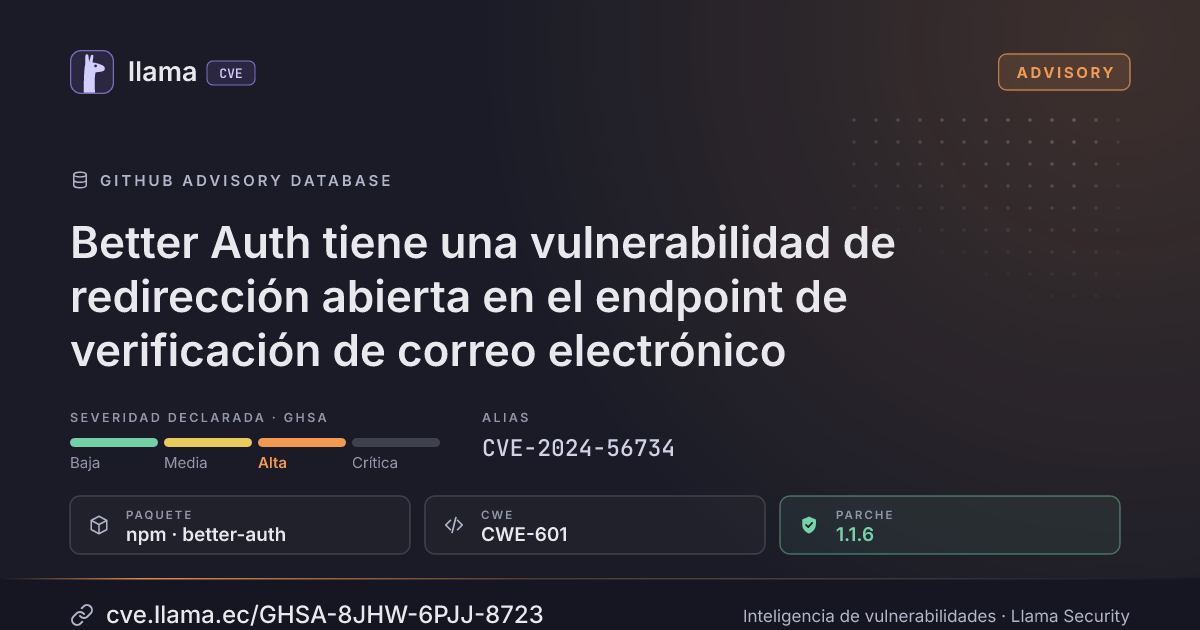
GHSA-8JHW-6PJJ-8723
Better Auth has an Open Redirect Vulnerability in Verify Email Endpoint
Ciclo de vida de la vulnerabilidad
| Fecha | Fase | Evento | Detalle |
|---|---|---|---|
| Divulgación | Publicada | GHSA-8JHW-6PJJ-8723 divulgada | |
| Remediación | Parche 1.1.6 | better-auth · 0 d desde divulgación | |
| Divulgación | Modificada | Última actualización del registro | |
| Monitoreo | Detectada | Ingresó al índice |
## Summary
An open redirect vulnerability has been identified in the verify email endpoint of Better Auth, potentially allowing attackers to redirect users to malicious websites. This issue affects users relying on email verification links generated by the library.
## Affected Versions
- All versions prior to v1.1.6.
## Impact
Attackers could craft malicious email verification links that exploit the redirect functionality to send users to untrusted domains. This can result in:
- Phishing attacks – Users may unknowingly enter sensitive information on fake login pages.
- Reputation damage – Trust issues for applications using Better Auth.
## Vulnerability Details
The verify email callback endpoint accepts a `callbackURL` parameter. Unlike other verification methods, email verification only uses JWT to verify and redirect without proper validation of the target domain. The origin checker is bypassed in this scenario because it only checks for `POST` requests. An attacker can manipulate this parameter to redirect users to arbitrary URLs controlled by the attacker.
Example Exploit:
https://example.com/auth/verify-email?token=abcd1234&callbackURL=https://malicious-site.com## Patches
Upgrade to Better Auth v1.1.6 or later. This version enforces domain validation for `callbackURL` for `/verify-email` path and for all other `GET` endpoints.
## Workarounds
You can also use hooks to pre-check URLs in your auth instance to prevent this without upgrading:
const auth = betterAuth({
    hooks: {
         before: (ctx) => {
            if (ctx.path === "/verify-email") {
               const callbackURL = ctx.query.callbackURL; // Check if this is a trusted callback URL or not
            }
         }
    }
})
Incluye detalles técnicos publicados por el investigador. Úselos solo para validar y corregir sus propios sistemas.
Rangos afectados
Estado del parche por paquete
| Paquete / producto | Estado | Corregida en | Desde divulgación | Última versión |
|---|---|---|---|---|
npmbetter-auth |
Corregida | 1.1.6 | 0 d | 1.7.26 no afectada |
1.1.6Arsenal público
Sin exploits, módulos ni PoC públicos conocidos a la fecha de verificación.
https://nvd.nist.gov/vuln/detail/CVE-2024-56734https://github.com/better-auth/better-auth/security/advisories/GHSA-8jhw-6pjj-8723https://github.com/better-auth/better-auth/commit/deb3d73aea90d0468d92723f4511542b593e522fhttps://github.com/better-auth/better-authLas referencias externas se muestran para copiar: cve.llama.ec no lo redirige a otros sitios.