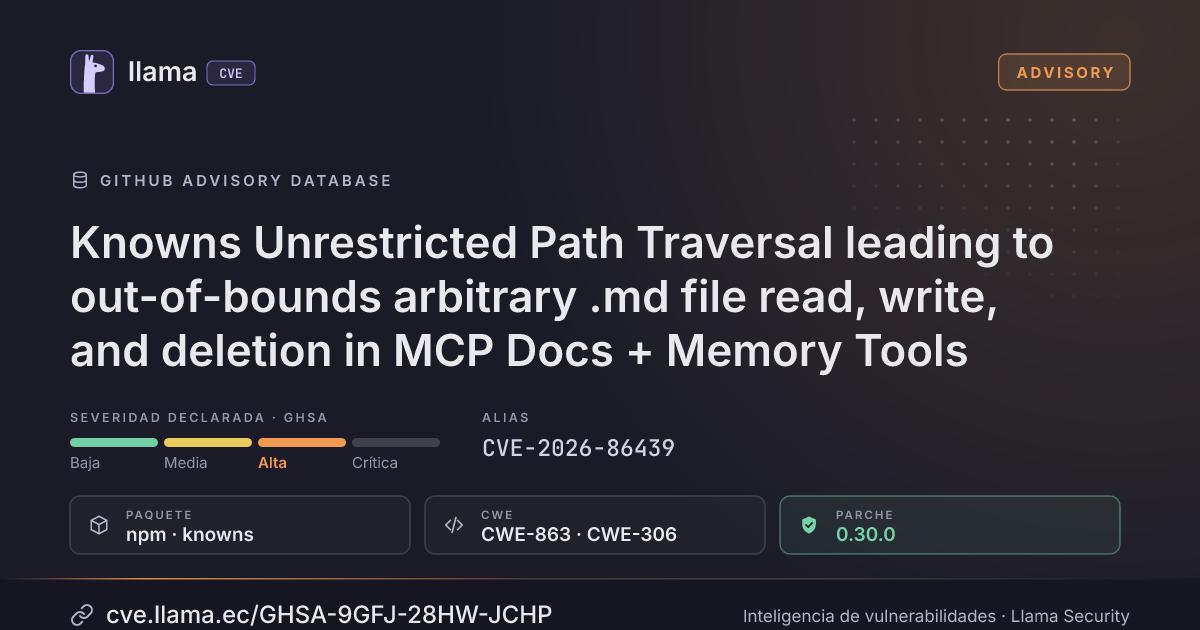
GHSA-9GFJ-28HW-JCHP
Knowns Unrestricted Path Traversal leading to out-of-bounds arbitrary .md file read, write, and deletion in MCP Docs + Memory Tools
Ciclo de vida de la vulnerabilidad
| Fecha | Fase | Evento | Detalle |
|---|---|---|---|
| Remediación | Parche 0.30.0 | knowns · -40 d desde divulgación | |
| Divulgación | Publicada | GHSA-9GFJ-28HW-JCHP divulgada | |
| Divulgación | Modificada | Última actualización del registro | |
| Monitoreo | Detectada | Ingresó al índice |
Overview
Verified. Multiple Unrestricted Path Traversal vulnerabilities exist in the Knowns MCP `docs` and `memory` tools, allowing arbitrary file read, write, and deletion operations outside the project sandbox. The storage layer functions (`Get`, `Create`, `Update`, `Rename`, `Delete`) in both `doc_store.go` and `memory_store.go` concatenate user-controlled paths with `filepath.Join()` without any containment validation.
Additionally, the `docs.update` action with a `newPath` parameter performs a file deletion via `Rename()`, but is classified as `CapWrite` in the permission registry rather than `CapDelete`. This allows an attacker with a `read-write-no-delete` preset to bypass deletion restrictions and destroy arbitrary files outside the project root.
Affected paths
| File Path | Role | Vulnerability & Execution Impact |
| :--- | :--- | :--- |
| `internal/storage/doc_store.go` | Vulnerable Sink (Docs) | Path Traversal in File Operations (CWE-22): `Get()`, `Create()`, `Update()`, `Rename()`, `Delete()` join user-controlled `path` with `filepath.Join(ds.docsDir(), ...)` without validating path containment. |
| `internal/storage/memory_store.go` | Vulnerable Sink (Memory) | Path Traversal in Memory Operations (CWE-22): `GetInLayer()`, `Create()`, `Update()`, `Delete()` join user-controlled `id` with `filepath.Join(dir, models.MemoryFileName(id))` without validation. |
| `internal/mcp/handlers/doc.go` | Pass-Through Handler | Unsanitized Input Propagation: MCP handlers pass user-supplied `path`, `folder`, `newPath` directly to storage layer without sanitization. |
| `internal/mcp/handlers/memory.go` | Pass-Through Handler | Unsanitized Input Propagation: MCP handlers pass user-supplied `id` directly to storage layer without sanitization. |
| `internal/permissions/registry.go` | Authorization Bypass | Capability Misclassification (CWE-863): `docs.update` with `newPath` performs file deletion but is classified as `CapWrite`, bypassing `CapDelete` restrictions. |
Root Cause
Missing Path Containment in DocStore
In `internal/storage/doc_store.go`, all file operations use `filepath.Join()` to construct absolute paths without validating that the resolved path remains within `docsDir()`:
// Get retrieves a doc by its relative path (without .md extension).
func (ds *DocStore) Get(path string) (*models.Doc, error) {
    path = strings.TrimPrefix(path, "/")
    path = strings.TrimSuffix(path, ".md")

    // VULNERABLE: No containment check
    absPath := filepath.Join(ds.docsDir(), filepath.FromSlash(path)+".md")
    if _, err := os.Stat(absPath); err == nil {
        // ...
        return ds.parseFile(absPath, path, folder, false, "")
    }
    // ...
}

// Create writes a new doc to .knowns/docs/{path}.md.
func (ds *DocStore) Create(doc *models.Doc) error {
    if doc.Path == "" {
        return fmt.Errorf("doc path is required")
    }
    // VULNERABLE: No containment check
    absPath := filepath.Join(ds.docsDir(), filepath.FromSlash(doc.Path)+".md")
    if err := os.MkdirAll(filepath.Dir(absPath), 0755); err != nil {
        return fmt.Errorf("create doc dir: %w", err)
    }
    return ds.writeFile(absPath, doc)
}

// Rename rewrites a doc to a new path and removes the old file.
func (ds *DocStore) Rename(oldPath string, doc *models.Doc) error {
    // ...
    oldAbsPath := filepath.Join(ds.docsDir(), filepath.FromSlash(strings.TrimSuffix(oldPath, ".md"))+".md")
    newAbsPath := filepath.Join(ds.docsDir(), filepath.FromSlash(strings.TrimSuffix(doc.Path, ".md"))+".md")
    // ...
    if err := ds.writeFile(newAbsPath, doc); err != nil {
        return err
    }
    if oldAbsPath != newAbsPath {
        // VULNERABLE: Deletes file at oldAbsPath (can be outside docsDir)
        if err := os.Remove(oldAbsPath); err != nil && !os.IsNotExist(err) {
            return err
        }
    }
    return nil
}

// Delete removes a doc file.
func (ds *DocStore) Delete(path string) error {
    path = strings.TrimSuffix(path, ".md")
    // VULNERABLE: No containment check
    absPath := filepath.Join(ds.docsDir(), filepath.FromSlash(path)+".md")
    return os.Remove(absPath)
}
Critical Flaws:
- `filepath.Join` resolves `../` sequences natively
- No post-Join prefix check (e.g., `strings.HasPrefix(absPath, ds.docsDir())`)
- No rejection of absolute paths or path traversal sequences
- `Rename()` performs file deletion via `os.Remove(oldAbsPath)`, which can target files outside the docs directory
Missing Path Containment in MemoryStore
In `internal/storage/memory_store.go`, memory operations similarly lack path validation:
// GetInLayer retrieves a memory entry by ID from a specific layer only.
func (ms *MemoryStore) GetInLayer(id, layer string) (*models.MemoryEntry, error) {
    // ...
    dir, err := ms.dirForLayer(layer)
    if err != nil {
        return nil, err
    }
    // VULNERABLE: No containment check for id containing "../"
    absPath := filepath.Join(dir, models.MemoryFileName(id))
    if _, err := os.Stat(absPath); err != nil {
        return nil, fmt.Errorf("memory %q not found in %s layer", id, layer)
    }
    return ms.parseFile(absPath, layer)
}

// Create writes a new memory entry to the appropriate layer directory.
func (ms *MemoryStore) Create(entry *models.MemoryEntry) error {
    // ...
    dir, err := ms.dirForLayer(entry.Layer)
    if err != nil {
        return err
    }
    if err := os.MkdirAll(dir, 0755); err != nil {
        return fmt.Errorf("create memory dir: %w", err)
    }

    // VULNERABLE: No containment check for entry.ID containing "../"
    absPath := filepath.Join(dir, models.MemoryFileName(entry.ID))
    return atomicWrite(absPath, []byte(renderMemory(entry)))
}

// Delete removes a memory entry by ID.
func (ms *MemoryStore) Delete(id string) error {
    // ...
    filename := models.MemoryFileName(id)

    dirs := []string{ms.projectDir(), ms.globalDir()}
    for _, dir := range dirs {
        // VULNERABLE: No containment check
        absPath := filepath.Join(dir, filename)
        if _, err := os.Stat(absPath); err == nil {
            return os.Remove(absPath)
        }
    }

    return fmt.Errorf("memory %q not found", id)
}
Authorization Bypass via Rename-as-Delete
In `internal/mcp/handlers/doc.go`, the `handleDocUpdate()` function accepts a `newPath` parameter that triggers a rename operation:
func handleDocUpdate(getStore func() *storage.Store, req mcp.CallToolRequest) (*mcp.CallToolResult, error) {
    // ...
    if v, ok := stringArg(args, "newPath"); ok && strings.TrimSpace(v) != "" {
        doc.Path = strings.Trim(strings.TrimSuffix(v, ".md"), "/")
    }
    // ...
    if oldPath != doc.Path {
        if err := store.Docs.Rename(oldPath, doc); err != nil {
            return errFailed("rename doc", err)
        }
        // ...
    }
    // ...
}
The `Rename()` function in `doc_store.go` performs file deletion:
if oldAbsPath != newAbsPath {
    if err := os.Remove(oldAbsPath); err != nil && !os.IsNotExist(err) {
        return err
    }
}
However, in `internal/permissions/registry.go`, `docs.update` is classified as `CapWrite`:
"docs.update": {Capability: CapWrite, Target: TargetDoc, Risk: RiskMedium},This allows an attacker with a `read-write-no-delete` preset (which permits `CapWrite` but denies `CapDelete`) to delete files by using `docs.update` with a `newPath` parameter.
Attack Vector
| Phase | Request / Action | Effect |
| :--- | :--- | :--- |
| 1. Arbitrary File Read | `docs.get` with `path="../../../victim/secret"` | Server reads file outside project root via path traversal in `DocStore.Get()`. |
| 2. Arbitrary File Write | `docs.create` with `folder="../../../victim"` | Server writes file outside project root via path traversal in `DocStore.Create()`. |
| 3. Arbitrary File Delete | `docs.update` with `path="../outside/secret.md"` and `newPath="../../../victim/renamed.md"` | Server deletes file outside project root via path traversal in `DocStore.Rename()`. Bypasses `CapDelete` restriction because `docs.update` is classified as `CapWrite`. |
| 4. Memory File Read/Write | `memory.update` with `id="x/../../../../victim/secret"` | Server reads and overwrites file outside project root via path traversal in `MemoryStore.Update()`. |
Analysis
Classic Path Traversal Pattern
Both `DocStore` and `MemoryStore` follow the same vulnerable pattern: user-controlled input is concatenated with a base directory using `filepath.Join()`, then passed directly to file system operations (`os.ReadFile`, `os.WriteFile`, `os.Remove`, `os.Stat`) without any validation.
absPath := filepath.Join(baseDir, filepath.FromSlash(userInput))
// No containment check: strings.HasPrefix(absPath, baseDir)
// No rejection of ".." or absolute paths
`filepath.Join` resolves `../` sequences, allowing attackers to escape the intended directory:
- Input: `"../../../etc/passwd"`
- Result: `/project/.knowns/docs/../../../etc/passwd` → `/etc/passwd`
Rename-as-Delete Authorization Bypass
The `Rename()` function performs two operations:
1. Write the file to the new location (`newAbsPath`)
2. Delete the file from the old location (`oldAbsPath`)
Both paths are vulnerable to traversal. An attacker can:
- Set `path` to a file outside the project (e.g., `"../../../victim/target.md"`)
- Set `newPath` to another location outside the project
- The `Rename()` function will delete the file at `path` (outside the project)
Because `docs.update` is classified as `CapWrite` rather than `CapDelete`, this operation bypasses deletion restrictions in `read-write-no-delete` presets.
Compounding Factor - Unauthenticated Access
Due to the previously identified Auth Bypass vulnerability, all MCP tools are accessible without credentials when the server is started without a password, making this a zero-credential attack.
Fix
*Patch is available right now at New Release https://github.com/knowns-dev/knowns/releases.*
Rangos afectados
Estado del parche por paquete
| Paquete / producto | Estado | Corregida en | Desde divulgación | Última versión |
|---|---|---|---|---|
npmknowns |
Corregida | 0.30.0 | -40 d | 0.35.0 no afectada |
0.30.0Arsenal público
Sin exploits, módulos ni PoC públicos conocidos a la fecha de verificación.
https://nvd.nist.gov/vuln/detail/CVE-2026-86439https://github.com/knowns-dev/knowns/security/advisories/GHSA-9gfj-28hw-jchphttps://github.com/knowns-dev/knowns/commit/09c5a96fd5817b941dc86669278c1a17db10ed4ehttps://github.com/knowns-dev/knownshttps://github.com/knowns-dev/knowns/blob/v0.29.1/internal/storage/doc_store.go#L124-L129https://github.com/knowns-dev/knowns/blob/v0.29.1/internal/storage/memory_store.go#L203-L211https://github.com/knowns-dev/knowns/releases/tag/v0.30.0https://www.vulncheck.com/advisories/knowns-before-0.30.0-path-traversal-via-mcp-doc-and-memory-toolsLas referencias externas se muestran para copiar: cve.llama.ec no lo redirige a otros sitios.