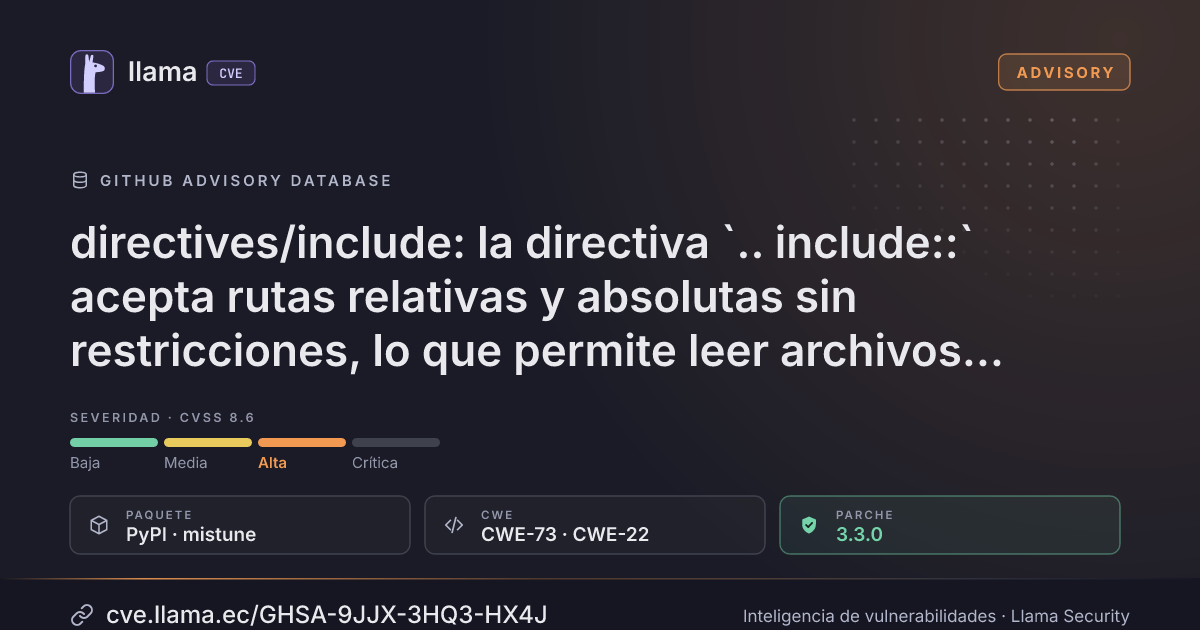
GHSA-9JJX-3HQ3-HX4J
directives/include: `.. include::` directive accepts unconstrained relative and absolute paths, allowing arbitrary file read by any markdown the renderer processes
CVSS:3.1/AV:N/AC:L/PR:N/UI:N/S:C/C:H/I:N/A:N
Fuente: GitHub
Ciclo de vida de la vulnerabilidad
| Fecha | Fase | Evento | Detalle |
|---|---|---|---|
| Divulgación | Publicada | GHSA-9JJX-3HQ3-HX4J divulgada · CVSS 8.6 (GitHub) | |
| Remediación | Parche 3.3.0 | mistune · 0 d desde divulgación | |
| Monitoreo | Detectada | Ingresó al índice | |
| Monitoreo | Verificada | Última verificación contra las fuentes |
Summary
Type: Path traversal in the `.. include::` RST directive. The plugin reads any file readable by the rendering process and embeds the content in the output. There is no allowlist, no chroot, no `..` rejection, no absolute-path rejection.
File: `src/mistune/directives/include.py`, lines 28-46.
Root cause: `relpath = self.parse_title(m)` takes the directive argument verbatim from the markdown source. `dest = os.path.normpath(os.path.join(os.path.dirname(source_file), relpath))` resolves `..` segments and normalises but does not constrain the result to the source file's directory or any other base. `os.path.join(base, '/etc/passwd')` returns `/etc/passwd` (because `os.path.join` discards prior components when the next is absolute). The only guards are: (a) reject self-include, (b) require `os.path.isfile(dest)`. Both pass for `/etc/passwd`, `~/.ssh/id_rsa`, the renderer process's `.bash_history`, the surrounding application's `.env`, etc. The file content is then either parsed as markdown (if `.md`/`.markdown`/`.mkd`), embedded as raw HTML (if `.html`/`.xhtml`/`.htm`), or wrapped in a `<pre class="directive-include">` block (any other extension) and dumped into the rendered HTML output.
Affected Code
File: `src/mistune/directives/include.py`, lines 12-64.
class Include(DirectivePlugin):
    def parse(self, block, m, state):
        source_file = state.env.get("__file__")
        if not source_file:
            return {"type": "block_error", "raw": "Missing source file"}

        # ... encoding parse ...

        relpath = self.parse_title(m)                                       # <-- BUG: attacker-controlled string from markdown
        dest = os.path.join(os.path.dirname(source_file), relpath)          # <-- BUG: '/etc/passwd' as relpath bypasses base via os.path.join
        dest = os.path.normpath(dest)                                       # <-- BUG: normpath resolves '..' but does not enforce base containment

        if os.path.abspath(dest) == os.path.abspath(source_file):
            return {"type": "block_error", "raw": "Could not include self: " + relpath}

        if not os.path.isfile(dest):
            return {"type": "block_error", "raw": "Could not find file: " + relpath}

        with open(dest, "rb") as f:
            content = f.read().decode(encoding)

        ext = os.path.splitext(relpath)[1]
        if ext in {".md", ".markdown", ".mkd"}:
            # ... render markdown content into output tokens ...
        elif ext in {".html", ".xhtml", ".htm"}:
            return {"type": "block_html", "raw": content}                   # <-- combined with escape=False, HTML inclusion is stored XSS
        # ... other ext: wrapped in <pre class="directive-include"> ...
Why it's wrong: the `os.path.normpath` + `os.path.join` pattern is a well-known traversal anti-pattern; it normalises but does not contain. `os.path.join(base, '/etc/passwd')` returns `/etc/passwd` (Python documents this behaviour explicitly: a subsequent absolute path discards prior components). Even for relative inputs, `../../../etc/passwd` is normalised to a path outside the base. The plugin should compare `os.path.commonpath([os.path.realpath(base), os.path.realpath(dest)]) == os.path.realpath(base)` (or use `pathlib.Path.resolve().is_relative_to(base.resolve())` on Python 3.9+) before opening the file. None of those checks exist. Callers that legitimately want to render markdown trees with the `Include` plugin enabled have no way to constrain what the renderer can read.
Exploit Chain
- Application uses mistune to render user-supplied markdown and has the directives + `Include` plugin enabled (a documented configuration; the include directive ships in the package and the only set-up is `RSTDirective([Include()])` in the plugin list).
- Application sets `state.env['__file__']` to the markdown's source path. This is the documented integration: rendering a `.md` file from disk requires `__file__` to be set so relative includes resolve against the file's directory. Many users set this for any markdown that lives on the filesystem.
- Attacker submits markdown containing:
- Plugin opens the file (any file readable by the renderer process — `/etc/passwd`, the application's `.env`, `~/.aws/credentials`, the running web server's session DB, log files containing tokens, etc.), reads it, and embeds the content in the output token stream.
- Final state: the rendered HTML contains `<pre class="directive-include">\n<contents of /etc/passwd>\n</pre>`. The attacker can read it back from whatever surface the application uses to display the rendered HTML (return body of an HTTP request, generated static page, email body, chat message, Slack post, etc.).
A second attack mode applies when the application also uses `escape=False` (a common opt-in for trusting one's own markdown corpus): including an attacker-supplied `.html` file embeds the content as `block_html` with no escaping. With `escape=False` the result is stored XSS.
Security Impact
Severity: sec-high. Information disclosure of any file readable by the rendering process. Combined with `escape=False`, also a stored XSS primitive via the `.html` extension branch.
Attacker capability: read any file the rendering process can `open()`. On a typical web stack that includes: `/etc/passwd`, `/proc/self/environ` (process environment, often containing API keys / DB credentials), the application's own `.env` / `config.py` / `settings.local.py` (database creds, session secrets, JWT signing keys), log files (request URLs that may contain bearer tokens, error tracebacks with PII), home-directory files of the user the renderer runs as (`~/.aws/credentials`, `~/.ssh/id_rsa` if readable, `~/.bash_history`). Combined with `escape=False`: arbitrary HTML injection by uploading a `.html` file alongside the markdown and including it.
Preconditions: application uses mistune with the `Include` directive enabled (`RSTDirective([Include()])` in plugins). `state.env['__file__']` must be set, which is the documented setup for rendering markdown files from disk and is done by every framework integration that supports the directive (Sphinx-style docs renderers, MkDocs-mistune integrations, JupyterLite previewers, any tool that says "renders markdown including `.. include::` directives").
Differential: PoC-verified against mistune@3.2.1, default config:
import os, mistune
from mistune.directives import RSTDirective, Include

os.makedirs('/tmp/mistune-include-test', exist_ok=True)
md = mistune.create_markdown(plugins=[RSTDirective([Include()])])

state = md.block.state_cls()
state.env['__file__'] = '/tmp/mistune-include-test/index.md'

# Relative traversal
print(md.parse('.. include:: ../../../etc/passwd', state=state)[0][:300])
# => <pre class="directive-include">
#    root:x:0:0:root:/root:/bin/bash
#    daemon:x:1:1:daemon:/usr/sbin:/usr/sbin/nologin
#    ...

# Absolute path bypass
state2 = md.block.state_cls()
state2.env['__file__'] = '/tmp/mistune-include-test/index.md'
print(md.parse('.. include:: /etc/passwd', state=state2)[0][:300])
# => same /etc/passwd contents
The patched build (with the suggested fix below) returns `{"type": "block_error", "raw": "Could not find file: ..."}` (or analogous) for any path that resolves outside the base directory. The vulnerable build returns the file contents.
Suggested Fix
Containment check via `os.path.realpath` + `os.path.commonpath` after normalisation. Reject any path whose real path is not a subpath of the base directory:
--- a/src/mistune/directives/include.py
+++ b/src/mistune/directives/include.py
@@ -27,12 +27,21 @@ class Include(DirectivePlugin):
         else:
             attrs = {}

         relpath = self.parse_title(m)
-        dest = os.path.join(os.path.dirname(source_file), relpath)
-        dest = os.path.normpath(dest)
+        base = os.path.realpath(os.path.dirname(source_file))
+        dest = os.path.realpath(os.path.join(base, relpath))
+
+        # Reject absolute paths and any traversal that escapes `base`. This
+        # mirrors the constraint a templating engine like Jinja2 enforces on
+        # its filesystem loader: an "include" only sees siblings of the
+        # source file, never the rest of the disk.
+        if os.path.isabs(relpath) or os.path.commonpath([base, dest]) != base:
+            return {
+                "type": "block_error",
+                "raw": "Could not include outside source dir: " + relpath,
+            }

         if os.path.abspath(dest) == os.path.abspath(source_file):
             return {
                 "type": "block_error",
This rejects `..` traversal, absolute paths, and symlink-following escapes (because `realpath` resolves symlinks). Optional defense-in-depth (separate change): also drop the `.html`/`.xhtml`/`.htm` branch entirely, or always escape included HTML even when the document's `escape=False`. The HTML-inclusion-with-escape-False combination has no safe use case for an untrusted markdown corpus; an opt-in flag like `Include(allow_html=True)` would force callers to acknowledge the risk.
Add a regression test:
def test_include_rejects_traversal():
    md = mistune.create_markdown(plugins=[RSTDirective([Include()])])
    state = md.block.state_cls()
    state.env['__file__'] = '/tmp/mistune-test/index.md'
    out = md.parse('.. include:: ../../../etc/passwd', state=state)
    assert 'root:' not in out[0]
    out = md.parse('.. include:: /etc/passwd', state=state)
assert 'root:' not in out[0]Incluye detalles técnicos publicados por el investigador. Úselos solo para validar y corregir sus propios sistemas.
Desglose de métricas
Rangos afectados
Estado del parche por paquete
| Paquete / producto | Estado | Corregida en | Desde divulgación | Última versión |
|---|---|---|---|---|
pypimistune |
Corregida | 3.3.0 | 0 d | 3.4.0 no afectada |
3.3.0Arsenal público
Sin exploits, módulos ni PoC públicos conocidos a la fecha de verificación.
https://github.com/lepture/mistune/security/advisories/GHSA-9jjx-3hq3-hx4jLas referencias externas se muestran para copiar: cve.llama.ec no lo redirige a otros sitios.