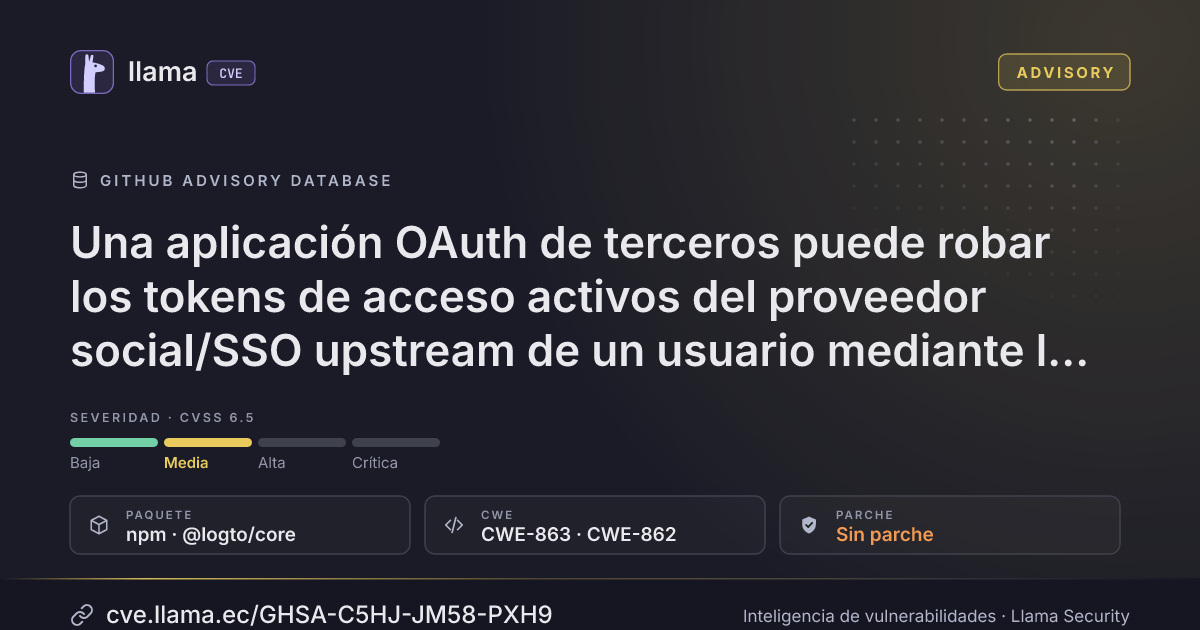
GHSA-C5HJ-JM58-PXH9
Third-party OAuth app can steal a user's live upstream social/SSO provider access tokens via the Account API (missing assertFirstPartyClient on the third-party-token endpoints)
Texto original en inglés · Ver en español
CVSS:3.1/AV:N/AC:H/PR:L/UI:R/S:C/C:H/I:L/A:N
Fuente: GitHub
Ciclo de vida de la vulnerabilidad
| Fecha | Fase | Evento | Detalle |
|---|---|---|---|
| Divulgación | Publicada | GHSA-C5HJ-JM58-PXH9 divulgada · CVSS 6.5 (GitHub) | |
| Monitoreo | Detectada | Ingresó al índice | |
| Monitoreo | Verificada | Última verificación contra las fuentes |
> [!NOTE]
> Fixed in Logto 1.46.0 (https://github.com/logto-io/logto/pull/9855). The third-party token endpoints of the Account API now reject access tokens issued to third-party applications, as the other Account API routes already do.
>
> GHSA-mg64-x3xv-96rc and GHSA-cvjg-j6fr-vcjv reported the same issue and were consolidated here; their reporters are credited.
---
Summary
Third-party OAuth app can steal a user's live upstream social/SSO provider access tokens via the Account API (missing assertFirstPartyClient on the third-party-token endpoints)
Affected code
`packages/core/src/routes/account/third-party-tokens.ts`:118
third-party-tokens.ts (GET social, no first-party/step-up check):
L112 async (ctx, next) => {
L113 const { id: userId, scopes } = ctx.auth;
L114 const { target } = ctx.guard.params;
L118 assertThat(scopes.has(UserScope.Identities), 'auth.forbidden', 403);
L120 const tokenSetSecret = await secretsQueries.findSocialTokenSetSecretByUserIdAndTarget(userId, target);
L132 ctx.body = await getAccessToken(libraries, queries, tokenSetSecret); // returns decrypted UPSTREAM token
(no assertFirstPartyClient anywhere in this file)
getAccessToken returns the plaintext upstream token (third-party-tokens.ts:55-74):
L55 const { access_token, refresh_token } = decryptTokens({ iv, encryptedDek, ciphertext, authTag });
L72 if (!expiresAt || now < expiresAt) { return formatTokenResponse(access_token, metadata, now); }
The boundary these endpoints skip (assert-first-party-client.ts:19-23):
L19 export const assertFirstPartyClient = async (queries, clientId?) => {
L20 if (clientId !== undefined && (await isThirdPartyApplication(queries, clientId))) {
L21 throw new RequestError({ code: 'auth.third_party_application_forbidden', status: 403 });
Auth chain imposes no first-party restriction:
koa-oidc-auth.ts:91 assertThat(scopes.has('openid'), ...403); // any app has openid
koa-account-center.ts:23 assertThat(accountCenter.enabled, 'account_center.not_enabled'); // tenant toggle only
Every sibling account route DOES call it, e.g. identities.ts:126,161,194 ; email-and-phone.ts:52,98,139,181 ; mfa-verifications.ts:109,280,424,468 ; sessions.ts:93 ; grants.ts:90 ; logto-config.ts:79 ; index.ts:104,167,192,275 — third-party-tokens.ts has zero occurrences.
The route's own test confirms the only gate is the scope (third-party-tokens.test.ts:86-95): a token with just {openid, identities} and no clientId 'passes the scope gate for GET social access-token' (proceeds to reading the stored secret).
Attacker model
Operator of a third-party (non-first-party) OAuth application registered in the Logto tenant, which the victim end-user has signed into and consented the `identities` user scope to. The attacker holds only a normal opaque OIDC access token issued to that app (scopes `openid identities`). No admin, no Management API scope, no server access.
Details
Every account-mutating/identity endpoint on the userRouter enforces the triad `scopes.has(...)` + (often) `identityVerified` + `assertFirstPartyClient(queries, clientId)`. `assertFirstPartyClient` is the documented boundary that keeps third-party OAuth apps (which always carry `openid`) out of account-management data: its own docstring says enabling a claim scope like `email` for a third-party app only tells the app it may *read* that claim, not act on the account. The two GET handlers (and the PUT) in third-party-tokens.ts break this pattern: they gate ONLY on `scopes.has(UserScope.Identities)` and never call `assertFirstPartyClient`, nor do they require `identityVerified`. The handlers then decrypt and return the *upstream provider's* live access token (the Google/Microsoft/SSO IdP token Logto stored during social/SSO login, refreshing it via the connector if expired). The `identities` scope's semantic grant is 'your social and SSO identity details' (userinfo claims `identities`/`sso_identities`), not the live upstream bearer credential — so returning that token exceeds what the consent conveyed. koaOidcAuth (koa-oidc-auth.ts:91) only requires `openid`; koaAccountCenter (koa-account-center.ts:23) only requires the tenant toggle `enabled`; neither restricts to first-party clients. That the sibling GET `/api/account` profile read (index.ts:52-64) also omits the first-party check confirms third-party apps genuinely reach account GET routes — so these token GETs are reachable by them.
Note: the same missing `assertFirstPartyClient` guard affects every handler in `packages/core/src/routes/account/third-party-tokens.ts` (both the GET handlers at lines 118 and 132 and the PUT variant), not just a single route — the guard is absent from the router registration, so it applies file-wide.
Proof of concept
Entrypoint: `GET /api/account/identities/:target/access-token, GET /api/account/sso-identities/:connectorId/access-token, and the corresponding PUT /api/account/identities/:target/access-token variant (registered on the userRouter via accountRoutes; reachable with a third-party OAuth app's access token)`
- Tenant admin enables the `identities` user scope on the attacker's third-party app (routine for apps that want social identity info) and has a social/SSO connector with token storage enabled; the victim previously linked that identity, so Logto has an encrypted upstream token set for the user.
- Victim signs into the attacker's third-party app and consents to 'Your social and SSO identity details'.
- The app receives an opaque access token with scopes `openid identities`.
- Attacker calls `GET https://{tenant}.logto.app/api/account/identities/google/access-token` with `Authorization: Bearer <that token>` (or `/api/account/sso-identities/{connectorId}/access-token`).
- koaOidcAuth passes (openid present) -> koaAccountCenter passes (enabled) -> handler passes the `identities` scope gate -> NO first-party check, NO step-up check -> getAccessToken() decrypts the stored token set and returns the upstream provider access_token (refreshed if expired).
- Attacker now holds the victim's live Google/Microsoft/SSO access token and can call those provider APIs as the victim — a capability the `identities` consent never granted.
Impact
A consented third-party application escalates a narrow 'read identity details' consent into possession of the user's live upstream IdP/social provider access tokens (with connector-side refresh), enabling impersonation of the victim at the external provider (reading mail/contacts/drive, calling downstream APIs, etc.). This is exactly the trust boundary assertFirstPartyClient exists to protect, and it is the only thing missing on these endpoints.
Verification notes
Cited line third-party-tokens.ts:118 (scope gate on GET social) is accurate, as are the getAccessToken decrypt/return lines and the assert-first-party-client.ts / koa-oidc-auth.ts / koa-account-center.ts citations. Nuance: the test at third-party-tokens.test.ts:86-95 uses a token with NO clientId, so it demonstrates the scope-only gate but does not itself prove a third-party clientId would slip through — the actual proof is the total absence of assertFirstPartyClient in the file combined with the middleware chain that never restricts to first-party. The PUT endpoint additionally requires a verified Social verification record whose identity target and userInfo.id match the current user, but still performs no first-party client check. The two GET endpoints have no step-up (identityVerified) requirement at all. Note the feature also requires the non-default connector 'store token' setting to be enabled for any token to exist to steal.
Incluye detalles técnicos publicados por el investigador. Úselos solo para validar y corregir sus propios sistemas.
Desglose de métricas
Rangos afectados
Estado del parche por paquete
| Paquete / producto | Estado | Corregida en | Desde divulgación | Última versión |
|---|---|---|---|---|
npm@logto/core |
Sin parche | — | — | — |
Arsenal público
Sin exploits, módulos ni PoC públicos conocidos a la fecha de verificación.
https://github.com/logto-io/logto/security/advisories/GHSA-c5hj-jm58-pxh9Las referencias externas se muestran para copiar: cve.llama.ec no lo redirige a otros sitios.