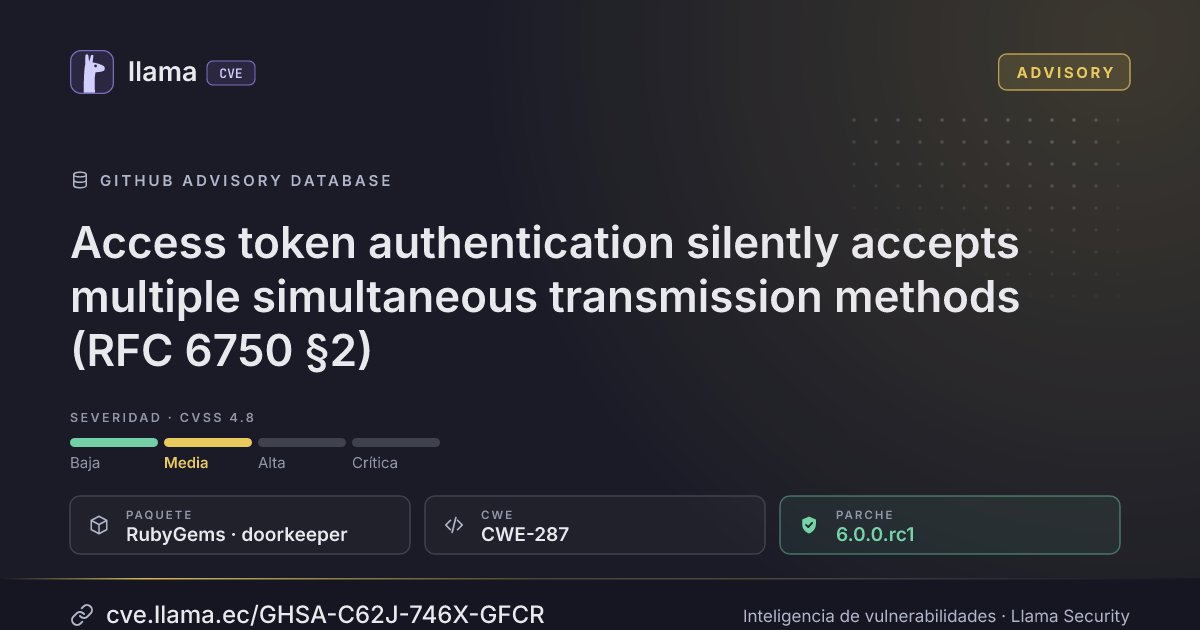
GHSA-C62J-746X-GFCR
Access token authentication silently accepts multiple simultaneous transmission methods (RFC 6750 §2)
CVSS:3.1/AV:N/AC:H/PR:N/UI:N/S:U/C:L/I:L/A:N
Fuente: GitHub
Ciclo de vida de la vulnerabilidad
| Fecha | Fase | Evento | Detalle |
|---|---|---|---|
| Remediación | Parche 6.0.0.rc1 | doorkeeper · -41 d desde divulgación | |
| Divulgación | Publicada | GHSA-C62J-746X-GFCR divulgada · CVSS 4.8 (GitHub) | |
| Divulgación | Modificada | Última actualización del registro | |
| Monitoreo | Detectada | Ingresó al índice | |
| Monitoreo | Verificada | Última verificación contra las fuentes |
Impact
Doorkeeper accepts an access token through three transmission methods — the `Authorization: Bearer` header, a form-encoded body parameter, and a URI query parameter (`access_token` / `bearer_token`) — as configured by `access_token_methods`. RFC 6750 §2 requires that a client "MUST NOT use more than one method to transmit the token in each request", and §3.1 requires a resource server to answer such a request with `invalid_request`.
Doorkeeper instead authorized the request with the first configured method that yielded a token and silently discarded every other token presented in the same request. Which token authorizes the request was therefore decided by the server's configured method order, not by what the caller sent, and the form-encoded body and the URI query were never told apart at all, because both Rails and Rack merge them into a single parameter hash before Doorkeeper reads it (Rails lets the query win, Rack lets the body win).
This affects every resource protected with `doorkeeper_authorize!` (Rails and Grape, and controllers built on Doorkeeper's own base classes), `GET /oauth/token/info`, and the bearer-token authorization path of `POST /oauth/introspect`.
Two consequences:
- Confused deputy. A gateway or service mesh that attaches its own `Authorization: Bearer` while forwarding a caller-controlled `access_token` parameter runs the request under the gateway's identity; the caller's token is discarded without any error or log entry. Attribution, rate limiting and `resource_owner_id` resolution are then wrong.
- Layer desync. A WAF, gateway or custom middleware that inspects one transmission method while Doorkeeper authorizes on another reaches a different verdict about the same request: a request that passed a scope check on one token executes under another.
No privilege beyond holding the presented tokens is needed, and the impact depends on a proxy/gateway topology in front of Doorkeeper, which is why the severity is Medium.
Details
Measured on v5.9.6 with two access tokens for two different applications and two different resource owners, default `access_token_methods`:
| Request | Result |
| --- | --- |
| `Authorization: Bearer <A>` + `?access_token=<B>` | 200 — served under A, B discarded |
| `?access_token=<A>&bearer_token=<B>` | 200 — served under A, B discarded |
| `Authorization: Bearer <revoked B>` + `?access_token=<valid A>` | 401 — the valid token is discarded |
| same request as row 1 with `access_token_methods` order reversed | 403 — now the parameter wins |
| `POST` with `access_token=<A>` in the body and `?access_token=<B>` in the query | 200 — served under B on Rails, under A on Grape |
Patches
The fix counts how many transmission methods carry a token and refuses the request when there is more than one. Only the built-in extraction methods take part in the check; a custom callable configured in `access_token_methods` keeps the historical first-wins behaviour, mirroring the exemption client authentication gives its legacy callable extractors.
- 6.0.0 refuses such a request with the `invalid_request` (HTTP 400) response RFC 6750 §3.1 prescribes, at every affected surface. The body and the query count as two methods, and the same token repeated across two methods is refused as well. `Doorkeeper.authenticate` and the `doorkeeper_token` helpers keep their token-or-nil contract; under `handle_auth_errors :raise` the request raises `Doorkeeper::Errors::InvalidRequest` (a sibling of `Doorkeeper::Errors::InvalidToken`, not a subclass). A new `doorkeeper_bad_request_render_options` controller hook customizes the 400 body. See the 6.0.0 CHANGELOG and upgrade guide.
- 5.9.7 fails closed instead: a request that transmits different tokens by more than one method is treated as carrying no usable token and answered `invalid_token` (HTTP 401), with no change to any public method's contract. The stricter `invalid_request` answer is 6.0-only.
Workarounds
If you cannot upgrade, reduce `access_token_methods` to a single method (for example `access_token_methods :from_bearer_authorization`) so that only one transmission method is read, and make any gateway, WAF or middleware in front of Doorkeeper read the same one. Note that this does not detect the body/query collision for the parameter methods; only upgrading does.
References
- RFC 6750 §2 (transmission methods), §2.2 / §2.3 (form body and URI query), §3.1 (`invalid_request`)
- GHSA-c8r6-23w7-5q9p — the same first-wins shape on the client authentication side (RFC 6749 §2.3)
Desglose de métricas
Rangos afectados
Estado del parche por paquete
| Paquete / producto | Estado | Corregida en | Desde divulgación | Última versión |
|---|---|---|---|---|
rubygemsdoorkeeper |
Corregida | 6.0.0.rc1 | -41 d | 5.9.9 no afectada |
6.0.0.rc1Arsenal público
Sin exploits, módulos ni PoC públicos conocidos a la fecha de verificación.
https://github.com/doorkeeper-gem/doorkeeper/security/advisories/GHSA-c62j-746x-gfcrLas referencias externas se muestran para copiar: cve.llama.ec no lo redirige a otros sitios.