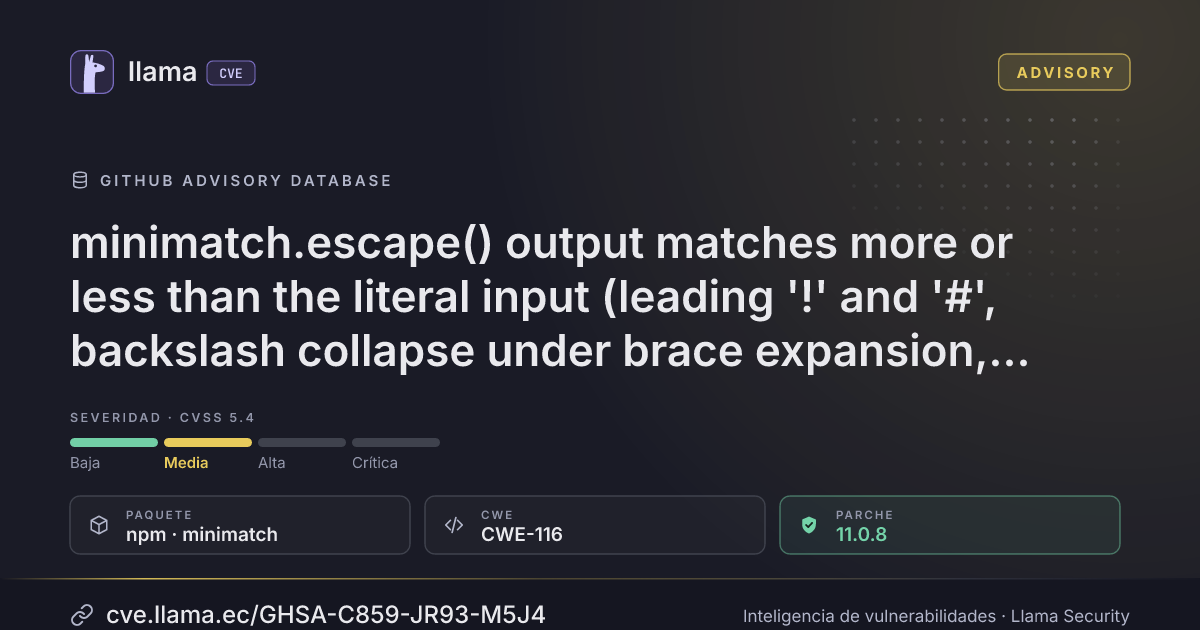
GHSA-C859-JR93-M5J4
minimatch.escape() output matches more or less than the literal input (leading '!' and '#', backslash collapse under brace expansion, windowsPathsNoEscape + magicalBraces)
CVSS:3.1/AV:N/AC:L/PR:L/UI:N/S:U/C:L/I:L/A:N
Fuente: GitHub
Ciclo de vida de la vulnerabilidad
| Fecha | Fase | Evento | Detalle |
|---|---|---|---|
| Divulgación | Publicada | GHSA-C859-JR93-M5J4 divulgada · CVSS 5.4 (GitHub) | |
| Remediación | Parche 11.0.8 | minimatch · 0 d desde divulgación | |
| Monitoreo | Detectada | Ingresó al índice | |
| Monitoreo | Verificada | Última verificación contra las fuentes |
Summary
`minimatch.escape()` is documented to "Escape all magic characters in a glob pattern, so that it will only ever match literal strings." (README, section `minimatch.escape(pattern, options = {})`). In minimatch 11.0.5 (latest release; `main` is at the `v11.0.5` tag, commit `ea0a4a6`) four classes of input break that contract:
- A leading `!` is left unescaped. `escape('!secret.txt')` returns `'!secret.txt'`, which is a negated pattern. It matches every path except `secret.txt`, for example `passwd`. This holds in POSIX mode and in `windowsPathsNoEscape` mode.
- A leading `#` is left unescaped. `escape('#notes.md')` returns `'#notes.md'`, which is a comment pattern. It matches nothing, including `#notes.md`. This holds in both modes.
- An escaped backslash does not survive brace expansion. For the user text `x\*` (x, backslash, star), `escape()` returns `x\\\*`. Alone, that pattern matches only the literal. When the pattern also contains a brace group, brace-expansion turns `\\` back into a single `\`, so the `*` becomes a live wildcard. The brace group can come from the caller (`escape(u) + '.{js,ts}'`) or, with default options, from the user text itself (`escape('x\\*{,}')`).
- With `{ windowsPathsNoEscape: true, magicalBraces: true }`, `escape('x{a,b}')` returns `x[{]a,b[}]`. Brace-expansion does not know `[...]` classes and expands it to `x[]a]` and `x[b[]`. The pattern matches `xa` and does not match `x{a,b}`.
The README documents negation and comments for patterns in general (README lines 484-493). The `escape()` section does not mention them, and its contract ("only ever match literal strings") is what callers rely on. The README warns that building a matcher from untrusted user patterns is unsafe. `escape()` is the documented way to make text match only as a literal (README.md:213-214), which is how callers embed untrusted text. These cases are inside that boundary. Behaviors 1 and 3 widen a match (fail open for an allowlist). Behavior 2 empties a match (fail open for a denylist or ignore list). Behavior 4 does both.
Details
All line numbers refer to tag `v11.0.5`. brace-expansion line numbers refer to brace-expansion 5.0.12, the version installed under `^5.0.12` at test time, file `dist/commonjs/index.js`.
Behavior 1: leading `!`.
- `src/escape.ts:22-24`: the comment states that `!` needs no escaping because the parens that make extglobs magic are escaped. That is true for `!(...)`. It ignores pattern-level negation.
- `src/escape.ts:25-32`: none of the four branches escapes `!`. They escape `?*()[]`, plus `\` in POSIX mode and `{}` with `magicalBraces`. A leading `!` passes through.
- `src/index.ts:1360-1374` (`parseNegate`, called from `make()` at `src/index.ts:730`): every leading `!` toggles `this.negate` and is stripped. `match()` then inverts the result.
- `\!` is already a supported way to write a literal `!`. `test/patterns.js:260` has the entry `['!\\!a*', ['a!b', 'd', 'e', '\\!a']]`, which excludes `!ab` and `!abc`. The POSIX part of the fix uses that existing syntax, and `unescape()` already reverses it.
- `test/escape-has-magic.js` checks the `unescape()` round trip and `hasMagic() === false` for every entry in `test/patterns.js`. That list includes `'!a*'` (line 251), `'!\\!a*'` (line 260) and `'# ignore this'` (line 327). The test never checks `negate` or `comment`. A negated literal pattern reports `hasMagic() === false`, so the suite passes. Measured on 11.0.5 with the port described under Suggested fix: 811 of 811 upstream assertions pass, and 6 of 784 added `negate`/`comment` assertions fail (`'!a*'`, `'!\\!a*'` and `'# ignore this'`, each in POSIX and Windows mode).
Behavior 2: leading `#`.
- `src/escape.ts:25-32`: no branch handles `#`.
- `src/index.ts:118-120` (`minimatch()` shortcut) and `src/index.ts:719-722` (`make()`): a pattern whose first character is `#` is a comment. `minimatch()` returns `false` and `Minimatch` builds an empty set.
Behavior 3: escaped backslash collapsed by brace expansion.
- `src/escape.ts:28` and `src/escape.ts:32`: a literal `\` is escaped as `\\` and a literal `*` as `\*`. The user text `x\*` becomes `x\\\*`.
- `src/index.ts:733` calls `#expandBraces()`, which reaches `braceExpand()` at `src/index.ts:243-257`. When the pattern contains any `{...}` group, `src/index.ts:256` passes the whole pattern to brace-expansion `expand()`.
- brace-expansion `index.js:16` (`slashPattern = /\\\\/g`) and `index.js:54-61` (`escapeBraces`) replace each `\\` pair with a sentinel. `index.js:62-69` (`unescapeBraces`, applied to every result at `index.js:125`) turns that sentinel into one `\` (line 64). `x\\\*.{js,ts}` therefore expands to `x\\*.js` and `x\\*.ts`. In minimatch syntax that is an escaped backslash followed by a live `*`.
- With default options, `escape()` leaves `{` and `}` as they are (see the related note below). The user text can then supply the brace group, and the caller appends nothing: `escape('x\\*{,}')` returns `x\\\*{,}`, which expands to `x\\*` twice and matches `x\anything`. Commit 0d27f1c, which added `magicalBraces` to `escape()`, states that it resolves #234. Neither that commit nor its tests cover braces that turn an escaped `*` into a wildcard. Its tests in `test/escape-has-magic.js` compare `escape()` and `unescape()` strings only, and none of their inputs contains `*`. With `magicalBraces: true` in POSIX mode the user braces are escaped, so a brace group from the caller is required.
- The same collapse drops a literal backslash in front of an escaped brace: `escape('\\{', { magicalBraces: true }) + '.{js,ts}'` gives `\\\{.{js,ts}`, which does not match `\{.js` on 11.0.5.
- The control case without a brace group is correct. The defect is only in the brace-expansion step.
- A large numeric range such as `{1..5000}` (100 or more values, `src/index.ts:263`) is matched without brace-expansion in 11.0.5, so that suffix alone does not trigger behavior 3.
Behavior 4: `windowsPathsNoEscape` + `magicalBraces`.
- `src/escape.ts:26-27`: in this mode every magic character, including `{` and `}`, is wrapped in a one-character class: `x{a,b}` becomes `x[{]a,b[}]`. The README and the JSDoc at `src/escape.ts:6-10` justify this by saying a character class "can only be satisfied by that exact character".
- `src/index.ts:599-601`: in this mode backslashes are converted to `/` before parsing, so brace-expansion's `\{` escape is not available to `escape()`.
- `src/index.ts:251-256`: the brace check regex and brace-expansion both see `{]a,b[}` as a brace set. brace-expansion splits it at the comma into `x[]a]` and `x[b[]`. `hasMagic()` returns `true` and the literal does not match itself.
Related note (not a numbered behavior): default options leave braces live.
With default options, and with `windowsPathsNoEscape` alone, `escape()` does not escape `{` or `}`. On 11.0.5, `escape('x{a,b}')` returns `x{a,b}`, which matches `xa` and does not match `x{a,b}`. The same holds with `{ windowsPathsNoEscape: true }`. The JSDoc at `src/escape.ts:12-13` says braces are escaped only with `magicalBraces`. The README sentence has no such qualifier. Commit 0d27f1c ("Support `magicalBraces` option in escape/unescape") states that it resolves #234. It made brace escaping opt-in and kept the default. The text of issue #234 itself was not read from this environment. This report treats the gap as a documentation issue, and the fix below does not change it. Either the README should state the `magicalBraces` requirement, or the default should escape braces. The bisection shows the gap in every release from 7.4.0 to 11.0.5.
Suggested fix
Two parts. Behaviors 1 and 2 are fixed in `src/escape.ts`. Behaviors 3 and 4 cannot be fixed in `escape.ts` alone: every encoding of a literal backslash (`\\`, `[\\]`) and every class encoding of a brace (`[{]`) is rewritten by brace-expansion. The fix for those belongs in `braceExpand()` in `src/index.ts`, which is the single path to brace-expansion (`#expandBraces()` and all its fallbacks call it).
`src/escape.ts`:
export const escape = (
  s: string,
  {
    windowsPathsNoEscape = false,
    magicalBraces = false,
  }: Pick<MinimatchOptions, 'windowsPathsNoEscape' | 'magicalBraces'> = {},
) => {
  // Inside the pattern, +@! need no escape because the parens that make
  // them magic are escaped. At the start of the pattern, '!' negates and
  // '#' makes a comment, so the first character is handled below.
  const e =
    magicalBraces ?
      windowsPathsNoEscape ?
        s.replace(/[?*()[\]{}]/g, '[$&]')
      : s.replace(/[?*()[\]\\{}]/g, '\\$&')
    : windowsPathsNoEscape ? s.replace(/[?*()[\]]/g, '[$&]')
    : s.replace(/[?*()[\]\\]/g, '\\$&')
  const c = e.charAt(0)
  if (c === '#') {
    return (windowsPathsNoEscape ? '[#]' : '\\#') + e.slice(1)
  }
  if (c === '!') {
    // '[!]' does not work: '[!' opens a negated class. See options (a)
    // and (b) below for windowsPathsNoEscape mode.
    return (windowsPathsNoEscape ? '@(!)' : '\\!') + e.slice(1)
  }
  return e
}
`src/unescape.ts`, at the top of `unescape()` (option (a) only):
  if (windowsPathsNoEscape && s.startsWith('@(!)')) {
    return '!' + unescape(s.slice(4), { windowsPathsNoEscape, magicalBraces })
  }
`src/index.ts`, `braceExpand()`, replacing the final `return expand(...)`:
  // brace-expansion turns each '\\' into '\'. Double every pair, so an
  // escaped backslash comes back as '\\' and cannot make the next escape
  // a live magic character.
  let p = pattern.replace(/\\\\/g, '\\\\\\\\')
  // brace-expansion does not know [...] classes. In windowsPathsNoEscape
  // mode escape() writes a literal brace as '[{]' or '[}]'. Escape the
  // brace inside the class; brace-expansion removes that backslash again.
  if (options.windowsPathsNoEscape || options.allowWindowsEscape === false) {
    p = p.replace(/\[([{}])\]/g, '[\\$1]')
  }
  return expand(p, { max: options.braceExpandMax })
Why this is safe:
- brace-expansion 5.0.12 matches `\\` pairs left to right before it looks at `\{`, `\}`, `\,` and `\.` (`index.js:54-61`). The doubling regex also works left to right. Each run of backslashes keeps its parity, so a trailing odd backslash still escapes the next character exactly as before. The only change is that `\\` now comes back as `\\`.
- The `[\{]` and `[\}]` rewrite runs only in `windowsPathsNoEscape` mode. On the `Minimatch` path, `src/index.ts:599-601` has already turned every backslash into `/`, so the inserted backslash is the only one in the string. brace-expansion turns `\{` back into `{` (`index.js:62-69`), so the result contains `[{]` again.
- There is no fallback path. The earlier draft of this fix picked two sentinel characters from U+E000..U+F8FF and fell back to the unprotected `expand()` when the input contained all of them. User text could force that fallback. Measured with that earlier `braceExpand()` change applied to 11.0.5: checks 3, 3b, 4 and 4b pass, and P3 and P4 still fail (3 failed assertions; the PoC prints `8 assertion(s) failed` because that build does not include the `escape.ts` change, so checks 1, 1w, 2 and 2w also fail). This version picks no sentinel, so no input can exhaust one, and every pattern goes through the protected path. A fix that does need sentinels must return `[pattern]` (no expansion) when none is free.
- The doubling depends on brace-expansion's current escape handling. minimatch 11.0.5 requires `^5.0.12`. PoC checks 3 and 3b should become tests so a change in brace-expansion is caught.
Windows mode and a leading `!`: there is no clean encoding. `[!` opens a negated class, and backslash is a path separator in this mode. Measured on 11.0.5 in Windows mode with a trailing `a`: `[!]a`, `[\!]a`, `[[=!=]]a`, `[[.!.]]a` and `./!a` do not match `!a`, and `[!-!]a` matches `ba` and not `!a`. Only `@(!)a` matches `!a` and nothing else among `!a`, `ba`, `a`, `!`, `b`, and it needs extglob. The two options, with measured trade-offs (port of `test/escape-has-magic.js`, 811 upstream assertions):
| Option | `escape('!a', win)` | PoC | Upstream assertions | Trade-off |
|---|---|---|---|---|
| (a) `@(!)` plus the `unescape()` change (shown above) | `@(!)a` | all assertions passed | 804 pass, 7 fail | `hasMagic()` returns `true` for the 7 win32 entries that start with `!` (`'!a*'` twice, `'!!a*'`, `'!\\!a*'`, `'!(.a\|js)@(.*)'`, `'!()y'` twice). Those expectations must change. With `noext: true` the pattern matches neither `!a` nor `b` (fails closed). |
| (a0) `@(!)` without the `unescape()` change | `@(!)a` | all assertions passed | 797 pass, 14 fail | The same 7 `hasMagic()` failures plus 7 failed win32 `unescape()` round trips. |
| (b) leave a leading `!` unescaped in Windows mode | `!a` | 1 assertion failed (1w: `passwd` matches) | 811 pass, 0 fail | Behavior 1 remains in Windows mode. Callers must pass `nonegate: true`; with it, `!a` matches `!a` and not `b`. Document this in the README. |
`[#]` for a leading `#` passes the upstream assertions in all three variants. Option (a) is the version verified below.
Behavior change for patterns that do not come from `escape()`: an escaped backslash next to a brace group now stays a literal backslash. On 11.0.5, `{src,lib}/a\\b.js` (intended: the literal file `a\b.js`) expands to `src/a\b.js` and `lib/a\b.js`, matches `src/ab.js` and does not match `src/a\b.js`. With the fix it matches `src/a\b.js` and not `src/ab.js`. Likewise `a\\{b,c}` matched `ab` and now matches `a\b`. This is a correctness bug fix outside the security scope, but it is visible to users and belongs in the changelog. The public `minimatch.braceExpand()` output changes for the same patterns. No pattern in `test/patterns.js` changes (see the differential below).
Local verification. The three changes were applied to a fresh copy of the installed 11.0.5 `dist/commonjs` and `dist/esm` files, with unpatched 11.0.5 as the control. Variants a0 and b were tested the same way. The TypeScript above was not compiled. The upstream `tap` suite was not run.
- PoC (`poc.js` above): unpatched 11.0.5 prints `14 assertion(s) failed`. Patched: `all assertions passed`. That covers all 11 checks: 1, 1w, 2, 2w, 3, 3b (user-supplied braces), 3c, 4, 4b, P3 and P4 (the private-use-character fallback bypass).
- Port of `test/escape-has-magic.js` (the `tap` snapshot is replaced by a comparison of `[set, hasMagic()]` with unpatched 11.0.5):
| Build | Upstream assertions | Snapshot substitute | Added `negate`/`comment` assertions |
|---|---|---|---|
| 11.0.5 | 811 pass, 0 fail | 196 of 196 equal | 778 pass, 6 fail |
| option (a) | 804 pass, 7 fail | 196 of 196 equal | 784 pass, 0 fail |
| option (a0) | 797 pass, 14 fail | 196 of 196 equal | 784 pass, 0 fail |
| option (b) | 811 pass, 0 fail | 196 of 196 equal | 782 pass, 2 fail |
All 7 failures for option (a) are the win32 `hasMagic() === false` assertions listed in the table above.
- Differential over `test/patterns.js` (unpatched 11.0.5 against option (a)): 196 string patterns, matched against the 135 distinct file names in the expected-result lists of that file. `braceExpand()` output: 196 comparisons, 0 differences. Match results: 26,460 comparisons, 0 differences. The script also escapes every pattern in four modes (POSIX, POSIX + `magicalBraces`, Windows, Windows + `magicalBraces`) and checks that the escaped pattern matches its own literal. In Windows mode the literal is compared with backslashes converted to `/`, because backslash is a path separator in that mode. Unpatched: 15, 6, 15 and 15 misses. Patched: 12, 3, 12 and 3. The patch fixes 21 misses and introduces none. The 30 that remain are the related default-brace note (9 brace entries, 8 distinct patterns because `*(a|{b|c,c})` appears twice in `test/patterns.js`, in POSIX and Windows mode without `magicalBraces`: 18 misses) and 3 patterns with `..` segments in all four modes (12 misses), which is path normalization.
- Random inputs: 20,000 inputs of 1 to 6 characters over `!#\*?{},[]()ab.+@-`, with `magicalBraces: true`, POSIX and Windows mode, with and without an appended `.{js,ts}`. Each escaped pattern is checked against its literal and against the probe paths `a`, `ab`, `passwd`, `a.js`, `b.js`, `x` and the empty string. In Windows mode the literal is compared with backslashes converted to `/`, because backslash is a path separator in that mode. In the `.{js,ts}` mode, `.js` is appended to the literal and to each probe path that does not already end in `.js`. A self-miss is a pattern that does not match its literal. An over-match is a pattern that matches at least one probe path.
| Mode | 11.0.5 self-misses / over-matches | option (a) self-misses / over-matches |
|---|---|---|
| POSIX | 163 / 2099 | 0 / 0 |
| POSIX + `.{js,ts}` | 4516 / 2886 | 0 / 0 |
| Windows | 171 / 2107 | 16 / 16 |
| Windows + `.{js,ts}` | 163 / 2099 | 0 / 0 |
The 16 remaining Windows cases are two distinct strings, `@@\..` and `![\..`, each generated 8 times. Each case is both a self-miss and an over-match. Both strings end in a backslash followed by `..`, which becomes a `..` path segment. That is path normalization, not escaping.
Tests to add:
- `escape('!x')`, `escape('#x')`, `escape('x\\*') + '.{a,b}'`, and `escape('x{a,b}', { windowsPathsNoEscape: true, magicalBraces: true })` must each match the literal and must not match `x`, `a`, or `passwd`.
- `escape('x\\*{,}')` with default options must not match `x\anything`.
- `escape('!a', { windowsPathsNoEscape: true })` must match `!a` and not `b`. The `noext: true` behavior must be decided and asserted.
- Escaped text that contains every character from U+E000 to U+F8FF, plus `.{js,ts}`, must not match a wildcard path.
- `test/escape-has-magic.js` should assert `negate === false` and `comment === false`. With option (a), its win32 `hasMagic()` expectations for inputs that start with `!` change to `true`.
Affected versions by behavior
GHSA form field: `>= 7.4.0, <= 11.0.5`. `escape()` first shipped in 7.4.0 (commit `327cb60`). 7.3.0 has no `escape` export. Per behavior:
- Behavior 1 (leading `!`) and behavior 2 (leading `#`): `>= 7.4.0, <= 11.0.5`, no gaps. The brace-expansion version has no effect.
- Behavior 3 (escaped backslash plus brace group, including 3b): depends on the brace-expansion version that is installed. Vulnerable with brace-expansion 2.x (all 12 releases, 2.0.0 to 2.1.7) and with 5.0.4 to 5.0.12. Not vulnerable with 4.0.0, 4.0.1, 5.0.2, 5.0.3 and `@isaacs/brace-expansion` 5.0.0 and 5.0.1. Those turn `x\\\*.{js,ts}` into `x\..js` and `x\..ts`, so even the literal stops matching (fails closed). On a fresh install that gives `>= 7.4.0 < 10.0.0 || 10.0.1 || >= 10.1.3 <= 11.0.5`. 9.0.6 to 9.0.8, 10.1.3 and 10.2.0 to 10.2.4 declare `^5.0.2` and are not affected when a lockfile pins brace-expansion 5.0.2 or 5.0.3. 10.0.0 and 10.0.2 (`^4.x`) and 10.0.3 to 10.1.2 (`@isaacs/brace-expansion ^5.0.x`) are not affected.
- Behavior 4 (`windowsPathsNoEscape` + `magicalBraces`): `>= 10.1.0, <= 11.0.5`, no gaps. `escape()` gained the `magicalBraces` option in 10.1.0 (commit `0d27f1c`). Before that it returns `x{a,b}` unchanged, which is the related default-brace note, not behavior 4.
Bisection: all 50 releases from 7.3.0 to 11.0.5 were installed, each in its own directory with `npm i --ignore-scripts minimatch@V`, and tested in one process per install. Results on a fresh install (B3 and B3b gave the same result in every release):
| minimatch | brace-expansion declared -> installed | B1 | B2 | B3 / B3b | B4 |
|---|---|---|---|---|---|
| 7.3.0 | ^2.0.1 -> 2.1.7 | no `escape()` | - | - | - |
| 7.4.0 - 9.0.5 | ^2.0.1 or ^2.0.2 -> 2.1.7 | yes | yes | yes | option absent |
| 9.0.6 - 9.0.8 | ^5.0.2 -> 5.0.12 | yes | yes | yes | option absent |
| 9.0.9 | ^2.0.2 -> 2.1.7 | yes | yes | yes | option absent |
| 10.0.0 | ^4.0.0 -> 4.0.1 | yes | yes | no (fails closed) | option absent |
| 10.0.1 | ^2.0.1 -> 2.1.7 | yes | yes | yes | option absent |
| 10.0.2 | ^4.0.1 -> 4.0.1 | yes | yes | no (fails closed) | option absent |
| 10.0.3 | @isaacs ^5.0.0 -> 5.0.1 | yes | yes | no (fails closed) | option absent |
| 10.1.0 - 10.1.2 | @isaacs ^5.0.0 or ^5.0.1 -> 5.0.1 | yes | yes | no (fails closed) | yes |
| 10.1.3 - 10.2.4 | ^5.0.2 -> 5.0.12 | yes | yes | yes | yes |
| 10.2.5 - 10.2.6 | ^5.0.5 or ^5.0.8 -> 5.0.12 | yes | yes | yes | yes |
| 11.0.0 - 11.0.5 | ^5.0.12 -> 5.0.12 | yes | yes | yes | yes |
The brace-expansion boundary was confirmed with npm `overrides`: minimatch 10.2.0 with brace-expansion 5.0.3 is not affected and with 5.0.4 is affected; 9.0.6 with 5.0.2 is not affected; 7.4.0 with 2.0.1 is affected. Each of the 27 brace-expansion releases that minimatch 7.4.0 to 11.0.5 can resolve (2.0.0 to 2.1.7, 4.0.0, 4.0.1, 5.0.2 to 5.0.12, and `@isaacs/brace-expansion` 5.0.0 and 5.0.1) was also fed `x\\\*.{js,ts}` directly, with the results listed above. No minimatch release declares brace-expansion 3.x, so 3.0.0 to 3.0.9 were not tested.
Credits
Reported by: agntflw
Proof of concept
Setup: `npm i minimatch@11.0.5`, save the script as `poc.js` in the same directory, then run `node poc.js`. The script has no other dependencies.
// PoC: minimatch.escape() output that does not match only the literal input.
// Setup: npm i minimatch@11.0.5   Run: node poc.js
'use strict'
const { minimatch, escape, braceExpand } = require('minimatch')
const version = require('minimatch/package.json').version
const braceVersion = require('brace-expansion/package.json').version
console.log('minimatch ' + version + ', brace-expansion ' + braceVersion)

// Long inputs are printed as a short form.
const PUA = Array.from({ length: 0xf8ff - 0xe000 + 1 }, (_, i) =>
  String.fromCharCode(0xe000 + i)).join('')
const show = s => JSON.stringify(s.split(PUA).join('<U+E000..U+F8FF>'))

let failures = 0
function check(n, title, user, pattern, opts, cases) {
  console.log('\n[' + n + '] ' + title)
  console.log('    user input : ' + show(user))
  console.log('    options    : ' + JSON.stringify(opts))
  console.log('    pattern    : ' + show(pattern))
  for (const [path, expected] of cases) {
    const actual = minimatch(path, pattern, opts)
    const ok = actual === expected
    if (!ok) failures++
    console.log('    ' + (ok ? 'ok  ' : 'FAIL') + ' match(' + show(path) +
      ') expected=' + expected + ' actual=' + actual)
  }
}

// 1. Leading '!' is not escaped; the pattern is negated.
{
  const user = '!secret.txt'
  check(1, "leading '!' becomes negation", user, escape(user), {}, [
    ['!secret.txt', true],
    ['passwd', false],
    ['.env.production', false],
  ])
  const w = { windowsPathsNoEscape: true }
  check('1w', "leading '!' becomes negation (windowsPathsNoEscape)", user,
    escape(user, w), w, [
      ['!secret.txt', true],
      ['passwd', false],
    ])
}

// 2. Leading '#' is not escaped; the pattern is a comment.
{
  const user = '#notes.md'
  check(2, "leading '#' becomes a comment", user, escape(user), {}, [
    ['#notes.md', true],
  ])
  const w = { windowsPathsNoEscape: true }
  check('2w', "leading '#' becomes a comment (windowsPathsNoEscape)", user,
    escape(user, w), w, [
      ['#notes.md', true],
    ])
}

// 3. Escaped backslash is collapsed by brace expansion; '*' becomes live.
{
  const user = 'x\\*' // three characters: x, backslash, star
  const pattern = escape(user) + '.{js,ts}'
  check(3, 'escaped backslash collapsed by a caller-added brace group', user,
    pattern, {}, [
      ['x\\*.js', true],
      ['x\\anything.js', false],
    ])
  console.log('    braceExpand: ' + JSON.stringify(braceExpand(pattern)))

  // 3b. Default options leave braces unescaped, so the user text itself
  // can supply the brace group. The caller appends nothing.
  const user3b = 'x\\*{,}'
  const p3b = escape(user3b)
  check('3b', 'escaped backslash collapsed by a user-supplied brace group',
    user3b, p3b, {}, [
      ['x\\anything', false],
    ])
  console.log('    braceExpand: ' + JSON.stringify(braceExpand(p3b)))

  const control = escape(user) + '.js'
  check('3c', 'control: same input, no brace group', user, control, {}, [
    ['x\\*.js', true],
    ['x\\anything.js', false],
  ])
}

// 4. windowsPathsNoEscape + magicalBraces: '[{]' and '[}]' are split by
// brace expansion.
{
  const opts = { windowsPathsNoEscape: true, magicalBraces: true }
  const user = 'x{a,b}'
  const pattern = escape(user, opts)
  check(4, 'windowsPathsNoEscape + magicalBraces: class-wrapped braces expanded',
    user, pattern, opts, [
      ['x{a,b}', true],
      ['xa', false],
    ])
  console.log('    braceExpand: ' + JSON.stringify(braceExpand(pattern, opts)))
  const p4b = pattern + '.{js,ts}'
  check('4b', 'same, with a caller-added brace group', user, p4b, opts, [
    ['x{a,b}.js', true],
    ['xa.js', false],
  ])
}

// P. Private-use characters in the user text. A fix that picks sentinel
// characters from U+E000..U+F8FF must not fall back to the unprotected
// expansion when the input contains all of them.
{
  const user = 'x\\*' + PUA
  const pattern = escape(user) + '.{js,ts}'
  check('P3', 'behavior 3 with every U+E000..U+F8FF character in the input',
    user, pattern, {}, [
      ['x\\*' + PUA + '.js', true],
      ['x\\ZZZ' + PUA + '.js', false],
    ])
  const opts = { windowsPathsNoEscape: true, magicalBraces: true }
  const user4 = '{q,b}' + PUA
  check('P4', 'behavior 4 with every U+E000..U+F8FF character in the input',
    user4, escape(user4, opts), opts, [
      ['{q,b}' + PUA, true],
      ['b' + PUA, false],
    ])
}

console.log('\n' + (failures ? failures + ' assertion(s) failed: escape() output did not match only the literal input.' : 'all assertions passed'))
Output on macOS, Node.js v24.2.0, minimatch 11.0.5, brace-expansion 5.0.12:
$ node poc.js
minimatch 11.0.5, brace-expansion 5.0.12

[1] leading '!' becomes negation
    user input : "!secret.txt"
    options    : {}
    pattern    : "!secret.txt"
    ok   match("!secret.txt") expected=true actual=true
    FAIL match("passwd") expected=false actual=true
    FAIL match(".env.production") expected=false actual=true

[1w] leading '!' becomes negation (windowsPathsNoEscape)
    user input : "!secret.txt"
    options    : {"windowsPathsNoEscape":true}
    pattern    : "!secret.txt"
    ok   match("!secret.txt") expected=true actual=true
    FAIL match("passwd") expected=false actual=true

[2] leading '#' becomes a comment
    user input : "#notes.md"
    options    : {}
    pattern    : "#notes.md"
    FAIL match("#notes.md") expected=true actual=false

[2w] leading '#' becomes a comment (windowsPathsNoEscape)
    user input : "#notes.md"
    options    : {"windowsPathsNoEscape":true}
    pattern    : "#notes.md"
    FAIL match("#notes.md") expected=true actual=false

[3] escaped backslash collapsed by a caller-added brace group
    user input : "x\\*"
    options    : {}
    pattern    : "x\\\\\\*.{js,ts}"
    ok   match("x\\*.js") expected=true actual=true
    FAIL match("x\\anything.js") expected=false actual=true
    braceExpand: ["x\\\\*.js","x\\\\*.ts"]

[3b] escaped backslash collapsed by a user-supplied brace group
    user input : "x\\*{,}"
    options    : {}
    pattern    : "x\\\\\\*{,}"
    FAIL match("x\\anything") expected=false actual=true
    braceExpand: ["x\\\\*","x\\\\*"]

[3c] control: same input, no brace group
    user input : "x\\*"
    options    : {}
    pattern    : "x\\\\\\*.js"
    ok   match("x\\*.js") expected=true actual=true
    ok   match("x\\anything.js") expected=false actual=false

[4] windowsPathsNoEscape + magicalBraces: class-wrapped braces expanded
    user input : "x{a,b}"
    options    : {"windowsPathsNoEscape":true,"magicalBraces":true}
    pattern    : "x[{]a,b[}]"
    FAIL match("x{a,b}") expected=true actual=false
    FAIL match("xa") expected=false actual=true
    braceExpand: ["x[]a]","x[b[]"]

[4b] same, with a caller-added brace group
    user input : "x{a,b}"
    options    : {"windowsPathsNoEscape":true,"magicalBraces":true}
    pattern    : "x[{]a,b[}].{js,ts}"
    FAIL match("x{a,b}.js") expected=true actual=false
    FAIL match("xa.js") expected=false actual=true

[P3] behavior 3 with every U+E000..U+F8FF character in the input
    user input : "x\\*<U+E000..U+F8FF>"
    options    : {}
    pattern    : "x\\\\\\*<U+E000..U+F8FF>.{js,ts}"
    ok   match("x\\*<U+E000..U+F8FF>.js") expected=true actual=true
    FAIL match("x\\ZZZ<U+E000..U+F8FF>.js") expected=false actual=true

[P4] behavior 4 with every U+E000..U+F8FF character in the input
    user input : "{q,b}<U+E000..U+F8FF>"
    options    : {"windowsPathsNoEscape":true,"magicalBraces":true}
    pattern    : "[{]q,b[}]<U+E000..U+F8FF>"
    FAIL match("{q,b}<U+E000..U+F8FF>") expected=true actual=false
    FAIL match("b<U+E000..U+F8FF>") expected=false actual=true

14 assertion(s) failed: escape() output did not match only the literal input.
Notes on the output:
- In checks 1 and 1w, `!secret.txt` matches itself only because the negated pattern excludes `secret.txt`, not `!secret.txt`. `passwd` shows the negation.
- The script has 11 numbered checks (1, 1w, 2, 2w, 3, 3b, 3c, 4, 4b, P3, P4). Each check makes one or more match assertions. The final line counts failed assertions, not checks: on 11.0.5, 14 assertions fail across 10 checks.
- Check 3c is the control. The same escaped text without a brace group behaves correctly.
- Checks P3 and P4 put every character from U+E000 to U+F8FF (6400 characters) into the user text. They exist to test fixes that pick sentinel characters from that range. On 11.0.5 they fail the same way as checks 3 and 4.
Impact
The impact depends on how the application uses the result. The precondition for every case is an application that passes user-controlled text through `escape()` and uses the resulting pattern for an access, filter, or exclusion decision. Each case below follows that pattern.
- Leading `!`, allowlist. A file-sharing feature builds an allow pattern per shared file: `allow.push(escape(fileName))`, then grants access when `minimatch(requestedPath, p)` is true for any `p`. A tenant uploads a file named `!a.txt` and shares it. The share grants access to every path except `a.txt`, including other files in the same scope. If the list is a denylist instead, the same file name blocks every other path.
- Leading `#`, denylist or ignore list. A backup or publish step excludes user-selected files: `exclude.push(escape(name))`. A file named `#secret#` (the Emacs autosave naming scheme) or `#notes.md` is never excluded and is uploaded or published. No error is reported.
- Backslash plus brace group, allowlist. An application allows a user-selected base name with known extensions: `escape(name) + '.{js,ts}'`. On POSIX, `\` is a legal file name character. A user who can create a file named `x\*` gets a pattern that matches any file in that directory whose name starts with `x\` and ends in `.js` or `.ts`. With default options the application does not need to add a brace group: the name `x\*{,}` alone gives a pattern that matches any name that starts with `x\`. The over-match is limited to one path segment, to the user's chosen prefix, and to names that contain a literal backslash.
- `windowsPathsNoEscape` + `magicalBraces`. An application on Windows escapes names with both options so braces are literal. The name `report{draft,final}.docx` becomes `report[{]draft,final[}].docx`, which expands to `report[]draft].docx` and `report[final[].docx`. That pattern matches any name made of `report`, one character from `]draft` or `final[`, and `.docx` (for example `reportd.docx`, `reporta.docx`, `report].docx`, `report[.docx`). It does not match `report{draft,final}.docx`. For the input `{secret,b}` the pattern matches any one-character name from `]secret` or `b[` (for example `b`, `[`, `]`, `s`), and does not match `{secret,b}` or `secret`. A denylist entry silently fails to block the file. An allowlist entry admits unrelated names.
This is not remote code execution and not a denial of service. It is an integrity and confidentiality issue in security decisions that rely on `escape()`.
Workarounds until a fix ships (each measured on 11.0.5):
- Behaviors 1 and 2: pass `{ nonegate: true, nocomment: true }` when matching escaped patterns. With `nonegate`, `escape('!secret.txt')` matches `!secret.txt` and not `passwd`. With `nocomment`, `escape('#notes.md')` matches `#notes.md`. This covers both modes.
- Behavior 3: do not combine escaped text with a brace group, and use `{ magicalBraces: true }` so user braces are escaped. Passing `nobrace: true` stops the over-match (`x\anything.js` no longer matches), but the caller's brace group then becomes literal: `x\*.js` no longer matches either, and only `x\*.{js,ts}` does. Expand the group in application code instead.
- Behavior 4: pass `nobrace: true` when matching. With `{ windowsPathsNoEscape: true, magicalBraces: true, nobrace: true }`, `x[{]a,b[}]` matches `x{a,b}` and not `xa`. On POSIX, `{ magicalBraces: true }` without `windowsPathsNoEscape` gives `x\{a,b\}`, which matches only the literal. Dropping `magicalBraces` does not help: `escape('x{a,b}', { windowsPathsNoEscape: true })` returns `x{a,b}`, which matches `xa` and not the literal.
Incluye detalles técnicos publicados por el investigador. Úselos solo para validar y corregir sus propios sistemas.
Desglose de métricas
Rangos afectados
Estado del parche por paquete
| Paquete / producto | Estado | Corregida en | Desde divulgación | Última versión |
|---|---|---|---|---|
npmminimatch |
Corregida | 11.0.8 | 0 d | 11.0.8 no afectada |
11.0.8Arsenal público
Sin exploits, módulos ni PoC públicos conocidos a la fecha de verificación.
https://github.com/isaacs/minimatch/security/advisories/GHSA-c859-jr93-m5j4Las referencias externas se muestran para copiar: cve.llama.ec no lo redirige a otros sitios.