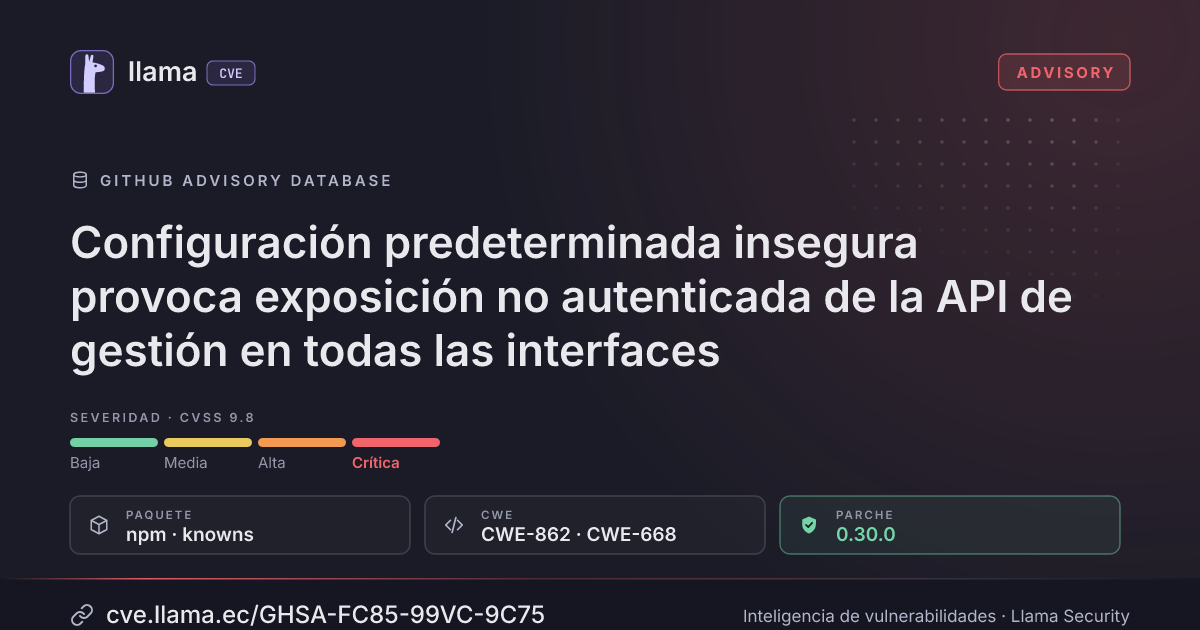
GHSA-FC85-99VC-9C75
Insecure Default Configuration leads to Unauthenticated Management API Exposure on All Interfaces
CVSS:3.1/AV:N/AC:L/PR:N/UI:N/S:U/C:H/I:H/A:H
Fuente: GitHub
Ciclo de vida de la vulnerabilidad
| Fecha | Fase | Evento | Detalle |
|---|---|---|---|
| Divulgación | Publicada | GHSA-FC85-99VC-9C75 divulgada · CVSS 9.8 (GitHub) | |
| Remediación | Parche 0.30.0 | knowns · 0 d desde divulgación | |
| Divulgación | Modificada | Última actualización del registro | |
| Monitoreo | Detectada | Ingresó al índice | |
| Monitoreo | Verificada | Última verificación contra las fuentes |
Overview
Verified. The default deployment of the Knowns browser server operates in a fully unauthenticated state, binds to all network interfaces (`0.0.0.0`), and exposes the entire management API to the local network. Furthermore, the server includes a built-in Cloudflare Quick Tunnel feature that can be triggered via an unauthenticated API endpoint (`POST /api/tunnel/start`) or a CLI flag, instantly exposing the unauthenticated instance to the public internet.
This insecure default posture acts as the linchpin for the entire application's threat model, escalating every subsequent vulnerability (Path Traversal, SSRF, XSS, and the previously identified RCE chain) from localized/network-restricted issues to zero-credential remote attacks from the public internet. When exposed via the tunnel feature, the attack surface yields a Critical severity (CVSS 3.1: 9.8).
Affected paths
| File Path / Component | Role | Vulnerability & Execution Impact |
| :--- | :--- | :--- |
| `internal/server/auth.go` | Security Bypass | Authentication Disabled by Default (CWE-306): `AuthManager.Middleware` is explicitly coded as a no-op when no password is configured, allowing unrestricted access to all protected routes. |
| Server Initialization | Insecure Network Binding | Unsafe Default Bind (CWE-668): The HTTP server defaults to binding on all interfaces (`0.0.0.0`) instead of the loopback address (`127.0.0.1`), exposing the service to the local network (LAN). |
| `internal/server/routes/tunnel.go` | Public Exposure Sink | Missing Function Level Access Control (CWE-862): The `POST /api/tunnel/start` endpoint directly invokes `tunnelMgr.Start()` without any internal authorization checks, opening a public Cloudflare Quick Tunnel. |
Root Cause
Insecure Default Authentication
In `internal/server/auth.go`, the authentication middleware explicitly bypasses all security checks if the server is started without a password:
if am == nil || !am.HasPassword() {
    next.ServeHTTP(w, r)
    return
}
Because there is no mandatory first-time setup or auto-generated token, a default installation has no password. Consequently, every API endpoint-including configuration, workspace management, LSP control, and tunneling-is fully accessible to anyone with network reach.
Insecure Default Network Binding
During server initialization, the listener is typically configured using a pattern like `net.Listen("tcp", ":"+port)`. In Go, omitting the host portion of the address implicitly binds the server to all available network interfaces (`0.0.0.0`). This exposes the unauthenticated API to any device on the local network, rather than restricting it to `127.0.0.1` (localhost).
Unauthenticated Public Exposure (Cloudflare Tunnel)
The application includes a feature to create a Cloudflare Quick Tunnel for remote access. In `internal/server/routes/tunnel.go`, the `SetupTunnelRoutes` function registers the `/start` endpoint which directly calls `tunnelMgr.Start()`. There are absolutely no internal authorization checks within the handler; it delegates security entirely to the global middleware.
Because the global `AuthManager.Middleware` is a no-op by default, any unauthenticated user on the LAN can send a single request to `POST /api/tunnel/start`. This immediately provisions a public internet URL pointing directly to the unauthenticated management API, bypassing any local firewall or NAT protections.
Attack Vector
| Phase | Request / Action | Effect |
| :--- | :--- | :--- |
| 1. Reconnaissance | `GET /api/auth/status` | Confirms `{"authenticated": false, "protected": false}`, verifying the server is unauthenticated. |
| 2. Exposure | `POST /api/tunnel/start` | Triggers `tunnelMgr.Start()` via the unauthenticated API, generating a public `.trycloudflare.com` URL accessible from the internet. |
| 3. Exploitation | Chain with secondary vulnerabilities | Attacker uses the newly exposed public URL to execute write primitives (e.g., `POST /api/docs`), trigger SSRF, or execute the LSP RCE chain from anywhere on the internet. |
Preconditions: Knowns running with default config (no `--password` flag); server started without explicitly binding to `127.0.0.1`.
Analysis
Auth Bypass - `auth.go`
The middleware design relies on an opt-in security model rather than a fail-closed model. The check `!am.HasPassword()` assumes that an empty password implies a local, trusted development environment. However, because the server binds to `0.0.0.0` by default, this assumption is fundamentally broken in any real-world deployment. There is no mechanism to enforce password creation before the server begins accepting connections.
Network Binding - Server Initialization
The use of `net.Listen("tcp", ":"+port)` is a common anti-pattern for local development tools that are inadvertently deployed to production or shared networks. Without explicitly defaulting to `"127.0.0.1:" + port`, the Go standard library binds to the wildcard address, making the service discoverable and reachable via ARP/routing on the local subnet.
Tunnel Endpoint - `tunnel.go`
The `SetupTunnelRoutes` function registers the tunnel control endpoints directly onto the router. Inside the `/start` handler, the code unconditionally executes:
// internal/server/routes/tunnel.go (vulnerable sink)
r.Post("/start", func(w http.ResponseWriter, r *http.Request) {
    url, err := tunnelMgr.Start() // No internal auth check
    // ...
})
It delegates security entirely to the global middleware. Since the global middleware is bypassed when no password is set, the tunnel creation becomes a zero-credential action. Cloudflare Quick Tunnels (`cloudflared tunnel --url`) punch through NAT/firewalls, effectively turning a LAN-restricted service into a public-facing target. This is a classic Missing Function Level Access Control (CWE-862) flaw compounded by the insecure global state.
Fix
*Patch is available right now at New Release https://github.com/knowns-dev/knowns/releases.*
Incluye detalles técnicos publicados por el investigador. Úselos solo para validar y corregir sus propios sistemas.
Desglose de métricas
Rangos afectados
Estado del parche por paquete
| Paquete / producto | Estado | Corregida en | Desde divulgación | Última versión |
|---|---|---|---|---|
npmknowns |
Corregida | 0.30.0 | 0 d | 0.35.0 no afectada |
0.30.0Arsenal público
Sin exploits, módulos ni PoC públicos conocidos a la fecha de verificación.
https://github.com/knowns-dev/knowns/security/advisories/GHSA-fc85-99vc-9c75Las referencias externas se muestran para copiar: cve.llama.ec no lo redirige a otros sitios.