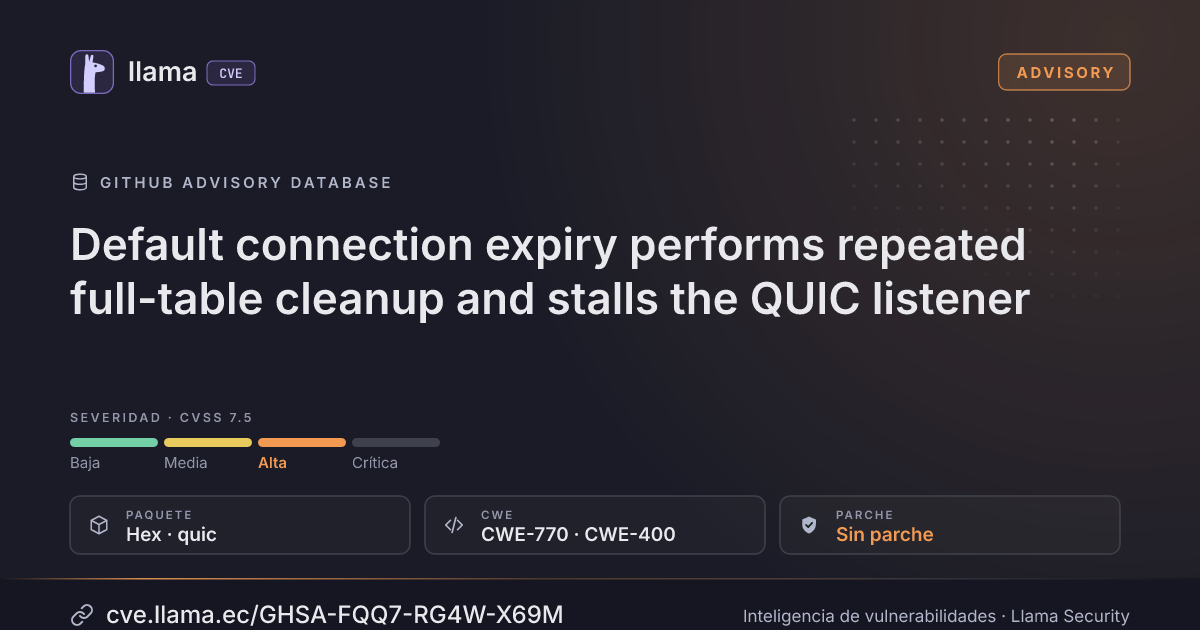
GHSA-FQQ7-RG4W-X69M
Default connection expiry performs repeated full-table cleanup and stalls the QUIC listener
CVSS:3.1/AV:N/AC:L/PR:N/UI:N/S:U/C:N/I:N/A:H
Fuente: GitHub
Ciclo de vida de la vulnerabilidad
| Fecha | Fase | Evento | Detalle |
|---|---|---|---|
| Divulgación | Publicada | GHSA-FQQ7-RG4W-X69M divulgada · CVSS 7.5 (GitHub) | |
| Divulgación | Modificada | Última actualización del registro | |
| Monitoreo | Detectada | Ingresó al índice | |
| Monitoreo | Verificada | Última verificación contra las fuentes |
Summary
The `quic 2.1.1` listener defaults to no address validation and no connection
cap. A remote unauthenticated sender can create a large cohort of short-lived
connection processes. When they expire near the default 30-second deadline,
the single listener handles every process exit by scanning the entire shared
connection-ID ETS table with `ets:select_delete/2`.
The resulting approximately quadratic cleanup work prevents the listener from
serving unrelated clients. A 75,000-packet run caused more than 47.5 seconds of
continuous independent service failure.
Details
Affected revision: `quic 2.1.1`, commit
`0b5634b6468c1b2aa3132baaabe5515d4ea485bd`.
- The listener defaults `address_validation` to `never`
https://github.com/benoitc/erlang_quic/blob/0b5634b6468c1b2aa3132baaabe5515d4ea485bd/src/quic_listener.erl#L360-L389. - A new DCID enters connection creation
https://github.com/benoitc/erlang_quic/blob/0b5634b6468c1b2aa3132baaabe5515d4ea485bd/src/quic_listener.erl#L1020-L1032, and the no-Retry branch starts an unvalidated connectionhttps://github.com/benoitc/erlang_quic/blob/0b5634b6468c1b2aa3132baaabe5515d4ea485bd/src/quic_listener.erl#L1049-L1098. - `max_connections` defaults to `infinity`
https://github.com/benoitc/erlang_quic/blob/0b5634b6468c1b2aa3132baaabe5515d4ea485bd/src/quic_listener.erl#L1100-L1108. - Each connection inserts client and server CIDs into the shared table
https://github.com/benoitc/erlang_quic/blob/0b5634b6468c1b2aa3132baaabe5515d4ea485bd/src/quic_listener.erl#L1194-L1202. - Every linked connection exit invokes `cleanup_connection/2` in the listener process
https://github.com/benoitc/erlang_quic/blob/0b5634b6468c1b2aa3132baaabe5515d4ea485bd/src/quic_listener.erl#L540-L566. - `cleanup_connection/2` runs `ets:select_delete/2` over the shared table
https://github.com/benoitc/erlang_quic/blob/0b5634b6468c1b2aa3132baaabe5515d4ea485bd/src/quic_listener.erl#L904-L908. - The default idle timeout is 30 seconds
https://github.com/benoitc/erlang_quic/blob/0b5634b6468c1b2aa3132baaabe5515d4ea485bd/include/quic.hrl#L340-L347.
For `N` expiring connections and approximately `2N` CID entries, the listener
performs `N` table-wide cleanup scans. Because routing and cleanup share the
same listener process, unrelated connection attempts wait behind this work.
Proof of concept
Required conditions
- A QUIC listener using the default no-Retry admission policy is reachable over
- `max_connections` remains at its default `infinity` value.
- No external admission or per-source rate limit stops the connection cohort.
No completed handshake, application authentication, response feedback, or
server-side access is required.
Proof of concept
- Build `quic 2.1.1` at the tested commit with OTP 27.
- Start a listener with default `address_validation=never`, default
- Run it with exact 4 GiB Docker memory and total memory+swap limits.
- Send 75,000 short QUIC-v1 Initial-shaped datagrams with distinct destination
- Throughout attack, expiry, and recovery, repeatedly open a fresh legitimate
- As a policy control, repeat the same count and pacing with
The default arm created 59,238 routing entries. After the live process count
fell to 84, 58,272 stale entries still remained and legitimate probes failed
continuously for more than 47.5 seconds. A 10,000-packet arm recovered after
five initial recovery failures, confirming cohort-size dependence. Two
75,000-packet Retry controls remained healthy and passed every probe.
Independent malformed-token and batched-version admission campaigns also
reproduced the same cleanup sink in `2/2` matched runs; they are trigger
variants of this root cause.
Impact
An unauthenticated remote peer can stall the shared QUIC listener and prevent
unrelated clients from establishing connections for tens of seconds. Existing
connection processes may remain alive, but admission and routing through the
listener become unavailable.
Incluye detalles técnicos publicados por el investigador. Úselos solo para validar y corregir sus propios sistemas.
Desglose de métricas
Rangos afectados
Estado del parche por paquete
| Paquete / producto | Estado | Corregida en | Desde divulgación | Última versión |
|---|---|---|---|---|
Hexquic |
Sin parche | — | — | — |
Arsenal público
Sin exploits, módulos ni PoC públicos conocidos a la fecha de verificación.
https://github.com/benoitc/erlang_quic/security/advisories/GHSA-fqq7-rg4w-x69mLas referencias externas se muestran para copiar: cve.llama.ec no lo redirige a otros sitios.