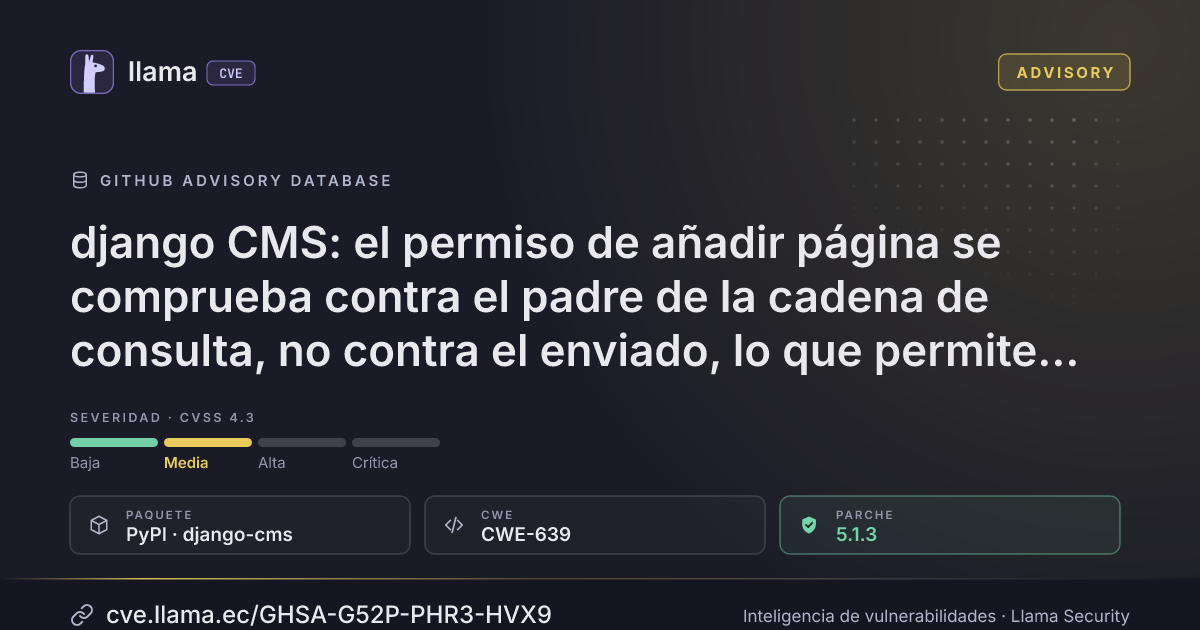
GHSA-G52P-PHR3-HVX9
django CMS: page-add permission is checked against the query-string parent, not the submitted one, allowing page creation outside a delegated subtree
Texto original en inglés · Ver en español
CVSS:3.1/AV:N/AC:L/PR:L/UI:N/S:U/C:N/I:L/A:N
Fuente: GitHub
Ciclo de vida de la vulnerabilidad
| Fecha | Fase | Evento | Detalle |
|---|---|---|---|
| Remediación | Parche 5.1.3 | django-cms · -1 d desde divulgación | |
| Divulgación | Publicada | GHSA-G52P-PHR3-HVX9 divulgada · CVSS 4.3 (GitHub) | |
| Monitoreo | Detectada | Ingresó al índice | |
| Monitoreo | Verificada | Última verificación contra las fuentes |
Impact
In installations running with `CMS_PERMISSION = True` (delegated page-permission mode), a staff user whose page permissions are confined to one part of the page tree can create pages anywhere in the tree, including at the root level.
When adding a page, `PageAdmin._has_add_permission_from_request()` decides whether the user may add a sub-page by reading the parent from the query string (`request.GET["parent_page"]`, `parent_node` on 4.1.x and earlier). The page is then actually created under the parent supplied in the POST body (`AddPageForm.parent_page`), whose only validation was a site-match check — it did not re-verify the add permission on that parent.
By pointing the permission check at a page they may edit while submitting a different parent in the form body, the user obtains exactly the action that would otherwise be denied.
Impact is to integrity only: unauthorised page insertion (content injection, navigation and URL-namespace pollution) across page-tree boundaries the installation intends to enforce. There is no confidentiality or availability impact, and no privilege escalation beyond page creation. Installations with `CMS_PERMISSION = False` are not affected, since page permissions are not delegated per subtree in that mode.
Proof of concept
With `CMS_PERMISSION = True`, two sibling pages `A` and `B`, and a staff user holding a `PagePermission` on `A` only (`can_add = can_change = True`) and none on `B`:
| # | `?parent_page=` (GET) | `parent_page=` (POST) | Result |
|---|---|---|---|
| 1 | `A` | `A` | `302` — created under `A` (legitimate baseline) |
| 2 | `B` | `B` | `403` — correctly denied, user has no rights on `B` |
| 3 | `A` | `B` | `302` — page created under `B` (bypass) |
| 4 | `A` | *(empty)* | `302` — root-level page created (bypass) |
| 5 | *(absent)* | `B` | `403` — not exploitable without the GET parameter |
Case 2 establishes that the user genuinely lacks add rights on `B`; cases 3 and 4 grant precisely that denied action. Case 4 is the more severe variant: an empty parent in the body creates a top-level page, affecting the site-root URL namespace and top-level navigation.
Case 5 shows the attack requires the query-string parameter: omitting it falls back to `user_can_add_page()`, which correctly denies.
Affected code
- `cms/admin/pageadmin.py` — `PageAdmin._has_add_permission_from_request()` reads the parent from `request.GET`
- `cms/admin/forms.py` — `AddPageForm.clean_parent_page()` (`clean_parent_node()` on 4.1.x) validated only `site_id`
- `cms/admin/forms.py` — `AddPageForm.save()` creates the page under the POST-bound parent
The sibling implementation in `cms/forms/wizards.py` (`CreateCMSPageForm.clean_parent_page()`) already re-checks `user_can_add_subpage()` with the comment *"this is to prevent people from possible form-hacking"*. The admin form lacking the same defence is an asymmetry, not an intended relaxation.
The pattern is present as far back as 3.11.x; the advisory covers the maintained release lines.
Patches
`AddPageForm.clean_parent_page()` now re-checks the permission against the parent the page is actually created under — `user_can_add_subpage()` when a parent is submitted, and `user_can_add_page()` when none is, so the root-page variant is covered as well. Adding a translation to an existing page (`cms_page`) is exempted, as it does not use the parent and is already authorised by `clean_cms_page()`.
`PageAdmin._has_add_permission_from_request()` is left in place; it remains a useful early-exit and UI gate, but the form is now the authorisation boundary because it is what `save()` uses.
Workarounds
Restrict the `cms.add_page` / `cms.add_pagecontent` Django model permissions to users who are already trusted across the whole page tree until the patched release is applied.
Severity
Maintainer assessment: `CVSS:3.1/AV:N/AC:L/PR:L/UI:N/S:U/C:N/I:L/A:N` (4.3, Medium).
The reporter suggested the same vector with `I:H`, which scores 6.5 (Medium) — their quoted base score of 5.3 does not match the vector they supplied. We assess the integrity impact as Low: the flaw permits page *insertion* only — it does not allow reading, modifying or deleting existing pages, nor does it grant any permission beyond page creation. Requires an authenticated staff account that already holds page-add rights somewhere in the tree.
Credits
Reported responsibly by Fatih Şeker (@fatihsugar https://github.com/fatihsugar), including a working proof of concept and an accurate root-cause analysis.
Incluye detalles técnicos publicados por el investigador. Úselos solo para validar y corregir sus propios sistemas.
Desglose de métricas
Rangos afectados
Estado del parche por paquete
| Paquete / producto | Estado | Corregida en | Desde divulgación | Última versión |
|---|---|---|---|---|
pypidjango-cms |
Corregida | 5.1.3 | -1 d | 5.1.3 no afectada |
5.1.3Arsenal público
Sin exploits, módulos ni PoC públicos conocidos a la fecha de verificación.
https://github.com/django-cms/django-cms/security/advisories/GHSA-g52p-phr3-hvx9Las referencias externas se muestran para copiar: cve.llama.ec no lo redirige a otros sitios.