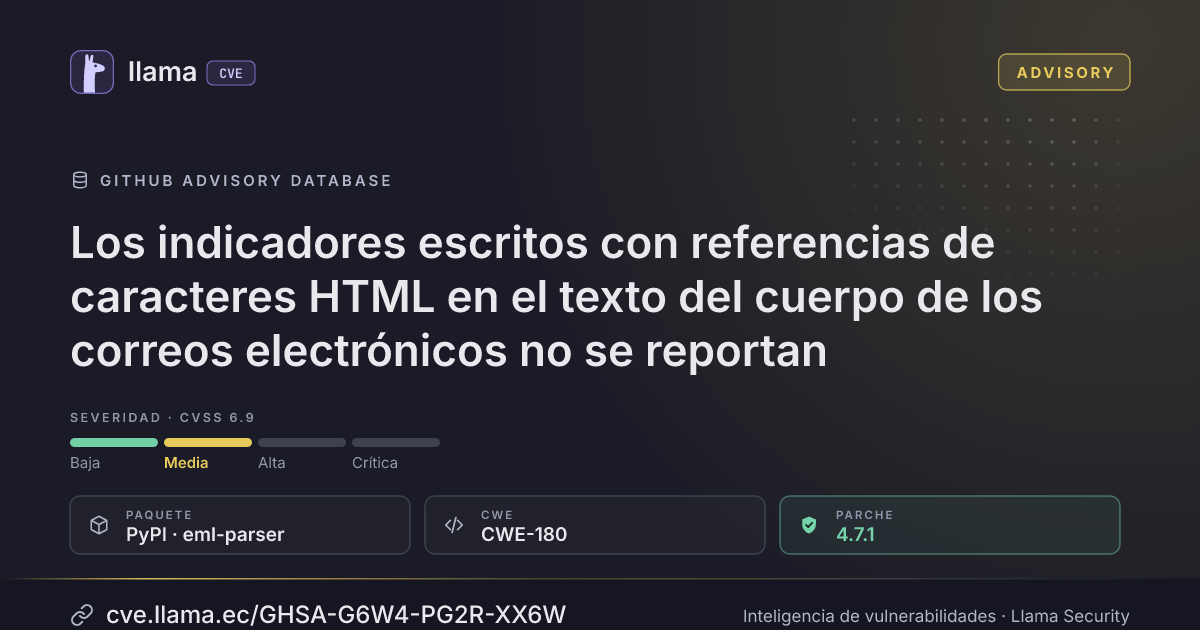
GHSA-G6W4-PG2R-XX6W
Indicators written with HTML character references in e-mail body text are not reported
Texto original en inglés · Ver en español
CVSS:4.0/AV:N/AC:L/AT:N/PR:N/UI:N/VC:N/VI:L/VA:N/SC:N/SI:N/SA:N
Fuente: GitHub
Ciclo de vida de la vulnerabilidad
| Fecha | Fase | Evento | Detalle |
|---|---|---|---|
| Divulgación | Publicada | GHSA-G6W4-PG2R-XX6W divulgada · CVSS 6.9 (GitHub) | |
| Divulgación | Modificada | Última actualización del registro | |
| Monitoreo | Detectada | Ingresó al índice | |
| Monitoreo | Verificada | Última verificación contra las fuentes |
### Summary
eml_parser extracts indicators (URLs, domains, e-mail addresses, IP addresses) from the body of an e-mail. HTML character
references in the body text were not decoded before this search. An URL, domain, address or IP address written with
character references (for example `https://phishing.example.com/login`) is shown to the reader of an
HTML part as a normal link text, but eml_parser reported no indicator for it. The fix of CVE-2026-55618
(GHSA-fxgq-9m89-cxj9, version 3.0.2) only covered dots in an URL whose scheme was written as is.
### Details
Character references were decoded only in two places: inside matches of the URL pattern (which needs a literal
`scheme:`) and in HTML attribute values (`href`, `src`, ...). The indicator patterns themselves run on the raw text, and
the domain pattern deliberately rejects tokens touching an encoded dot. As a result, in text/html and text/plain parts:
- `https://phishing.example.com/login` (and hexadecimal or named variants such as `.`,
- `www.phishing.example.com`, `phishing.example.com`, `user@phishing.example.com` and
- partly encoded values gave fragments instead: `user@phishing.example.com` was reported as the address
Version 4.7.1 decodes every text part once, the way its reader sees it, before the indicators are searched: HTML parts
by the rules of browsers (a legacy named reference without `;` in front of `=` or a letter or digit is kept, as in
attribute values), other text parts only for complete references ending in `;`, and attribute values by the rules for
attribute values. Nothing is decoded twice, so `:` stays `:`, as a browser shows it.
### Impact
Detection evasion. Systems that rely on the indicators reported by eml_parser (phishing triage, blocklist matching,
sandbox submission, incident response tooling) do not see a link or address that the recipient sees, so a malicious
message can pass checks based on these indicators. The parser does not crash and no other data is affected; the
recipient still has to follow the link for further harm, which is outside of eml_parser. Domains that are written
without references elsewhere in the message, for example in an `href` attribute or in the headers, were still reported.
### Workarounds
Decode HTML character references in the body text before passing it to an own indicator extraction, or apply an
additional extraction on the decoded text. There is no setting in eml_parser < 4.7.1 that changes this behaviour.
### Credits
Reported by @lanjianchun.
### References
- GHSA-fxgq-9m89-cxj9 / CVE-2026-55618 (earlier, incomplete fix in 3.0.2)
- Changelog of eml_parser 4.7.1
Desglose de métricas
Rangos afectados
Estado del parche por paquete
| Paquete / producto | Estado | Corregida en | Desde divulgación | Última versión |
|---|---|---|---|---|
pypieml-parser |
Sin parche | — | — | 4.7.0 afectada |
4.7.1Arsenal público
Sin exploits, módulos ni PoC públicos conocidos a la fecha de verificación.
https://github.com/GOVCERT-LU/eml_parser/security/advisories/GHSA-g6w4-pg2r-xx6wLas referencias externas se muestran para copiar: cve.llama.ec no lo redirige a otros sitios.