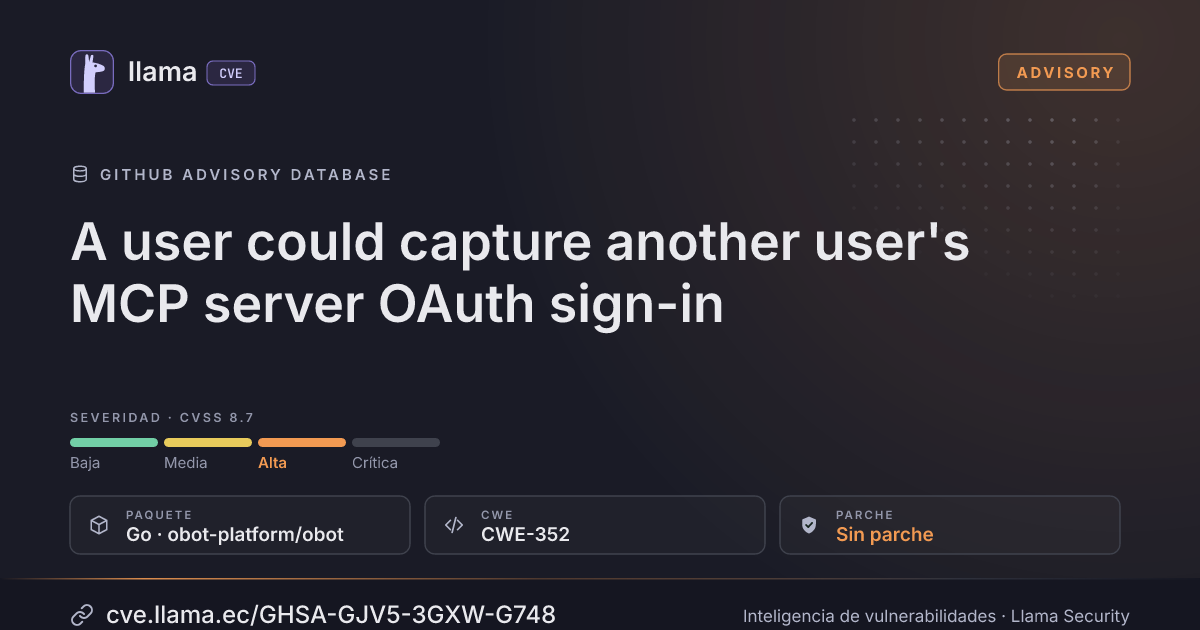
GHSA-GJV5-3GXW-G748
A user could capture another user's MCP server OAuth sign-in
CVSS:3.1/AV:N/AC:L/PR:L/UI:R/S:C/C:H/I:H/A:N
Fuente: GitHub
Ciclo de vida de la vulnerabilidad
| Fecha | Fase | Evento | Detalle |
|---|---|---|---|
| Divulgación | Publicada | GHSA-GJV5-3GXW-G748 divulgada · CVSS 8.7 (GitHub) | |
| Monitoreo | Detectada | Ingresó al índice | |
| Monitoreo | Verificada | Última verificación contra las fuentes |
Summary
When Obot signed a user in to an OAuth-protected remote MCP server, it stored the resulting upstream token for the user who started the sign-in without checking that the same user finished it. An attacker could start a sign-in, send the provider's authorization link to another Obot user, and have that user's upstream account linked to the attacker's Obot account. The attacker's tool calls on that MCP server would then run as the victim's account at the upstream service.
Am I affected?
Obot releases `>= v0.8.0, <= v0.28.1` are affected if you use at least one OAuth-protected remote MCP server. The attacker needs an Obot account that can use that server. The victim must be signed in to Obot and open a link from the attacker; the victim does not need access to that MCP server in Obot. If the victim previously approved Obot at the upstream provider, the provider may not show a consent prompt.
Details
Obot records which user started each upstream OAuth sign-in and saves the resulting token for that user when the provider redirects back to Obot. The callback only confirmed that the user completing the sign-in was the user who started it when the sign-in was triggered by the MCP server rejecting a request after connecting, a flow added in v0.28.0. For ordinary sign-ins, and for sign-ins completed through the local login page, any signed-in Obot user who completed the flow had their upstream account saved for the user who started it. The PKCE verifier did not prevent this because Obot holds it on the server and looks it up from the callback's state value.
Impact
The attacker could use the victim's account at the upstream service through Obot, with whatever the MCP server's tools can read and change, for as long as the token and its refresh token remain valid. The victim saw Obot's normal sign-in completion page and received no token of their own. The victim's Obot account, session, and Obot API keys are not exposed.
Mitigation
Upgrade to v0.28.2 or later. The fixed release refuses an OAuth callback before exchanging the authorization code unless it comes from the user who started the sign-in, for every sign-in attempt and for local logins. Tool preview sign-ins, which store their token for the system rather than a user, now record the user who started them and are bound to that user.
Severity
CVSS v3.1 Score: 8.7/10 (High) — `CVSS:3.1/AV:N/AC:L/PR:L/UI:R/S:C/C:H/I:H/A:N`
Credits
The Obot team would like to thank @jakub2929 https://github.com/jakub2929 for responsibly disclosing this issue in accordance with our security policy https://github.com/obot-platform/obot/?tab=security-ov-file.
Desglose de métricas
Rangos afectados
Estado del parche por paquete
| Paquete / producto | Estado | Corregida en | Desde divulgación | Última versión |
|---|---|---|---|---|
gogithub.com/obot-platform/obot |
Sin parche | — | — | v0.28.1 afectada |
Arsenal público
Sin exploits, módulos ni PoC públicos conocidos a la fecha de verificación.
https://github.com/obot-platform/obot/security/advisories/GHSA-gjv5-3gxw-g748Las referencias externas se muestran para copiar: cve.llama.ec no lo redirige a otros sitios.