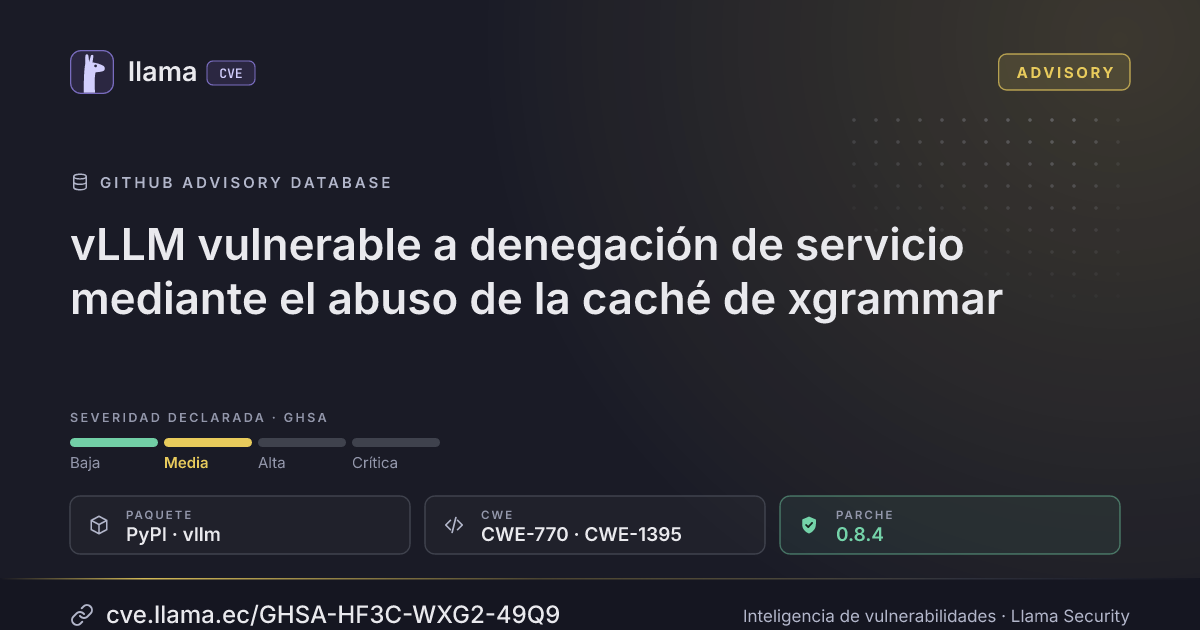
GHSA-HF3C-WXG2-49Q9
vLLM vulnerable to Denial of Service by abusing xgrammar cache
Ciclo de vida de la vulnerabilidad
| Fecha | Fase | Evento | Detalle |
|---|---|---|---|
| Divulgación | Publicada | GHSA-HF3C-WXG2-49Q9 divulgada | |
| Remediación | Parche 0.8.4 | vllm · 0 d desde divulgación | |
| Monitoreo | Detectada | Ingresó al índice |
Impact
This report is to highlight a vulnerability in XGrammar, a library used by the structured output feature in vLLM. The XGrammar advisory is here: https://github.com/mlc-ai/xgrammar/security/advisories/GHSA-389x-67px-mjg3
The xgrammar https://xgrammar.mlc.ai/docs/ library is the default backend used by vLLM to support structured output (a.k.a. guided decoding). Xgrammar provides a required, built-in cache for its compiled grammars stored in RAM. xgrammar is available by default through the OpenAI compatible API server with both the V0 and V1 engines.
A malicious user can send a stream of very short decoding requests with unique schemas, resulting in an addition to the cache for each request. This can result in a Denial of Service by consuming all of the system's RAM.
Note that even if vLLM was configured to use a different backend by default, it is still possible to choose xgrammar on a per-request basis using the `guided_decoding_backend` key of the `extra_body` field of the request with the V0 engine. This per-request choice is not available when using the V1 engine.
### Patches
- https://github.com/vllm-project/vllm/pull/16283
Workarounds
There is no way to workaround this issue in existing versions of vLLM other than preventing untrusted access to the OpenAI compatible API server.
References
- https://github.com/mlc-ai/xgrammar/security/advisories/GHSA-389x-67px-mjg3
Rangos afectados
Estado del parche por paquete
| Paquete / producto | Estado | Corregida en | Desde divulgación | Última versión |
|---|---|---|---|---|
pypivllm |
Corregida | 0.8.4 | 0 d | 0.34.0 no afectada |
0.8.4Arsenal público
Sin exploits, módulos ni PoC públicos conocidos a la fecha de verificación.
https://github.com/mlc-ai/xgrammar/security/advisories/GHSA-389x-67px-mjg3https://github.com/vllm-project/vllm/security/advisories/GHSA-hf3c-wxg2-49q9https://github.com/vllm-project/vllm/pull/16283https://github.com/vllm-project/vllm/commit/cb84e45ac75b42ba6795145923e8eb323bb825adhttps://github.com/vllm-project/vllmLas referencias externas se muestran para copiar: cve.llama.ec no lo redirige a otros sitios.